On this page
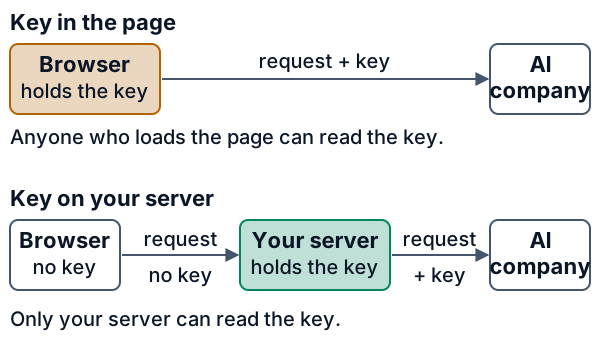
An AI API key (the secret code that tells an AI company whom to bill) is a password that spends your money, and a web page hands everything in it to every visitor. In a pretend case, a stranger copies a key from a page and sends 1,000 requests in 10 seconds at $0.005 each: $5.00. Keep the key on a server that caps how often one network address (the number your internet connection shows to websites) may call, and the stranger gets 14 requests through: $0.07. All numbers are pretend, priced as in What is a token?.
In one minute
No: whatever a page holds can be read by whoever loads it, so an API key in frontend JavaScript (code that runs in a visitor’s browser) is public, and anyone who copies it can spend your money. Putting the key in a page is like taping a card number to a shop window. The fix is a small server of your own (a program on a computer you control) that holds the key, asks the AI company for the answer and refuses callers who ask too much. If a key leaks, cancel it, make a new one, then check what was spent.
Explore the numbers
Open the widget. Press Send, open the Network tab, then let the pretend stranger run up the meter. Switch to “On my server” and try 1, 20 and 100 addresses.
How it works
A key is a password that spends money
A program asks an AI model for an answer by sending a request to the company’s API (where to send a question, and the rules for asking). Every request carries an API key, and the company bills whoever holds it: the key says whose bill it is, not who is typing.
OpenAI’s API overview (read 2026-10-18) says “Don’t share it with others or expose it in any client-side code such as browsers or apps.” Client-side code runs on the visitor’s own device.
Anything sent to a browser can be read
A web page is a set of files your server sends to each visitor’s browser, so whatever is in them is on the visitor’s computer. The developer tools (a panel built into browsers) list each request the page makes, in a tab called Network, with what it carries.
An app is no different. An Android app is an APK, and the APK Analyzer page (read 2026-10-18) says “APKs are files that follow the ZIP file format”, the format of ordinary compressed folders, so anyone with the app can open it. Leaks are common: a study of public GitHub repositories (Meli and colleagues, 2019) found thousands of new secrets leaked daily.
What does not protect a key
- Hiding it in the code. Scrambling the code only makes it harder to read. The request still carries the real key, so the Network tab shows it.
- CORS. CORS (cross-origin resource sharing) is a browser rule about which other sites a page may read from (MDN, read 2026-10-18). It does not check who is asking, and a program that is not a browser ignores it.
The fix: your own server holds the key
Put a small server between the page and the AI company. The page sends its question to a route on your server (a path it answers, here /api/chat); the server reads the key from an environment variable (a named setting kept outside the code), adds it and sends the request on.
A server alone is not enough: with no limits it forwards a stranger’s 1,000 requests too. $5.00 again.
Limits only a server can add
Your server can check each request before it spends money.
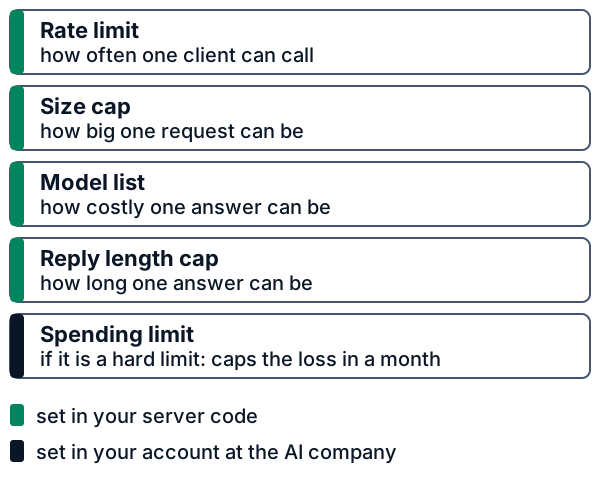
- Rate limit. A cap on how often one client, here one network address, may call. Over it, the server answers with status code 429 (“Too Many Requests”), a number that says how a request went.
- Size cap. A request whose content (its body) is above a set size is refused with status code 413 (“Content Too Large”).
- Model list and reply cap. Only the models you chose are accepted, and the server, not the page, sets the longest reply it asks for.
- Spending limit. If it is a hard limit, the AI company stops requests at a monthly amount you set, even when your code has a bug. Check that yours stops requests and is not only an email alert. Usage is tracked with a delay, so a small overshoot is possible.
The server also never writes the key to its log (the file where it records what it did).
The rate limit here is a bucket of tickets: it holds a few (3 in the picture, 5 in the widget), gains one every second, and each request takes one.
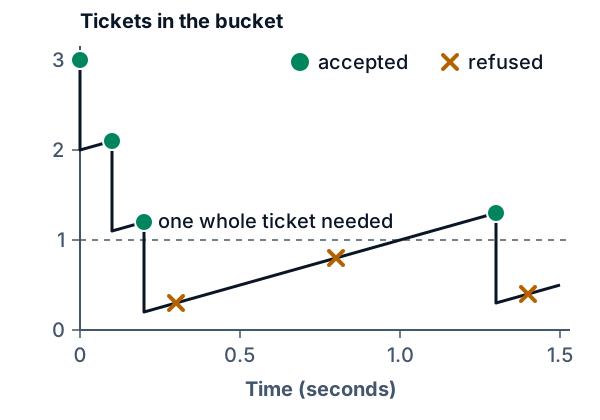
Each address has its own bucket, so more addresses get more requests: 1 address gets 14 of 1,000 through ($0.07), 20 get 280 ($1.40) and 100 get all 1,000 ($5.00). If it is a hard limit, the spending limit caps the loss when every other check fails.
If a key leaks
Treat a key as leaked once it has been in a page, a public repository (a project folder tracked by a tool called git), a chat or a log. In order:
- Revoke the key at the AI company (cancel it). GitHub’s guide to leaked secrets (read 2026-10-18) says “as a first step you need to revoke and/or rotate that secret.”
- Make a new key (rotating it) and put it only in your server’s environment variable.
- Check the usage for requests you did not make, then clean up where it leaked.
Deleting is not revoking. Git keeps every earlier version in its history, a list of saved snapshots called commits. Commit a .env file (a file of those settings) and delete it in the next commit, and the first commit still holds the key: git log -p shows it.
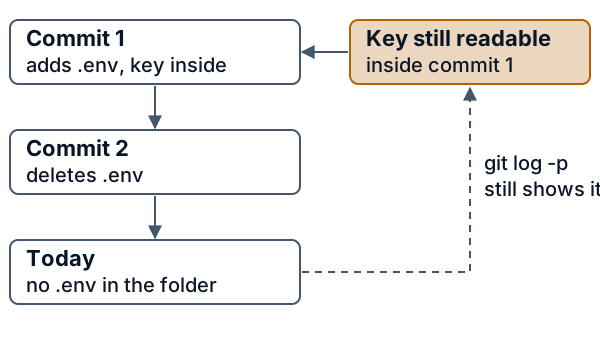
The better habit: list .env in .gitignore, a file that tells git which files to leave out, before the first commit. GitHub’s secret scanning (it looks for key-shaped text in uploads) catches some leaks; it is a net, not the plan.
What this means when you build
- Call the AI company only from your own server. If a tutorial puts the key in a page script, use a server route.
- Read the names. Build tools (programs that package your app) such as Vite and Next.js copy variables named
VITE_...orNEXT_PUBLIC_...into the code the browser receives. Name secrets without those prefixes. - Set a monthly spending limit that stops requests, not only an alert, and add the server checks before the first user. Use separate keys for development and production, so one leak is revoked alone (Claude Help Center, read 2026-10-18).
- Keep keys out of git, logs, chat and screenshots. If a key was ever committed, revoke it.
Optionalabout 12 min
Go deeper
Optional, for readers who write Python. The code is in the code/ folder: keyproxy.py is the server and test_keyproxy.py its tests. python3 show_numbers.py prints every number above.
The token bucket by hand
One word needs care. A “token” in this section is a ticket in a bucket that counts requests. It has nothing to do with the tokens an AI model reads. TokenBucket holds up to capacity tickets and gains rate tickets per second; a request takes one whole ticket or is refused.
class TokenBucket:
    """Holds up to `capacity` tickets and gains `rate` tickets per second. A request spends one.

    (The word "token" here has nothing to do with the tokens an AI model reads.)
    """

    def __init__(self, capacity, rate, now):
        self.capacity, self.rate = capacity, rate
        self.level, self.last = float(capacity), now

    def take(self, now):
        """Spend one ticket. Return 0.0 if allowed, else the seconds until a ticket is available."""
        self.level = min(self.capacity, self.level + (now - self.last) * self.rate)
        self.last = now
        if self.level >= 1:
            self.level -= 1
            return 0.0
        return (1 - self.level) / self.rate
take first adds the tickets earned since the last call, never going above capacity, then spends one if a whole ticket is there. If not, it returns how long until one arrives, (1 - level) / rate seconds, and spends nothing. Time arrives as the argument now, so a test can move the clock without waiting. The table is the bucket from the figure, with 3 tickets and 1 a second:
| Time (s) | Tickets before | Outcome |
|---|---|---|
| 0.0 | 3.0 | accepted |
| 0.1 | 2.1 | accepted |
| 0.2 | 1.2 | accepted |
| 0.3 | 0.3 | refused, try again in 0.7 s |
| 0.8 | 0.8 | refused, try again in 0.2 s |
| 1.3 | 1.3 | accepted |
| 1.4 | 0.4 | refused, try again in 0.6 s |
Check one row by hand: the request at 0.0 left 2 tickets, so at 0.1 the bucket holds 2 + 0.1 x 1 = 2.1.
scenario.py runs the stranger from the widget: 1,000 requests spaced evenly over 10 seconds, so 100 a second, against a bucket of 5 that gains 1 a second for each address. The price is the pretend $0.005 a request (500 input tokens at $2 per million plus 400 output tokens at $10 per million).
| Setup | Accepted | Pretend bill |
|---|---|---|
| Key in the page | 1,000 | $5.00 |
| Server, no limits | 1,000 | $5.00 |
| Server, rate limit, 1 address | 14 | $0.07 |
| Server, rate limit, 20 addresses | 280 | $1.40 |
| Server, rate limit, 100 addresses | 1,000 | $5.00 |
One address gets 14, not 15: 5 tickets at the start plus 9.99 seconds at 1 a second before the last request is 14.99 tickets, and only whole requests count.
The server, one check at a time
Config holds the settings. The comment on the first field is the point: a config that prints itself must not print the key.
@dataclass
class Config:
    api_key: str = field(repr=False)  # repr=False: printing the config must not print the key
    upstream_url: str
    allowed_models: frozenset
    max_body_bytes: int = 4096
    max_output_tokens: int = 300
    bucket_capacity: int = 5
    refill_per_second: float = 1.0
    timeout_seconds: float = 10.0
This server sends no CORS headers, and nothing in it relies on them. MDN (read 2026-10-18) says “browsers restrict cross-origin HTTP requests initiated from scripts”; that is a rule for browsers. The server still receives requests from any caller, so the checks below are what protect the bill.
config_from_env reads AI_API_KEY, AI_UPSTREAM_URL and AI_MODELS from the environment. When one is missing it exits with a message that names the three variables and never prints a value. It strips spaces around model names and refuses an upstream address that does not start with https:// unless the host is this computer, so a typo cannot send the key in clear text. make_app returns a WSGI app (Python’s standard interface between a web server and an application), so a test can call it as a function. The client is environ["REMOTE_ADDR"], the address of whoever opened the connection; the code never reads X-Forwarded-For, which the client writes.
The cheap checks run first, before the body is read and before any money is spent:
        if client not in buckets:
            buckets[client] = TokenBucket(cfg.bucket_capacity, cfg.refill_per_second, clock())
        wait = buckets[client].take(clock())
        if wait:
            return fail(429, "too many requests", [("Retry-After", str(math.ceil(wait)))])

        length = environ.get("CONTENT_LENGTH") or ""
        if not (length.isascii() and length.isdigit()):
            return fail(411, "length required")
        length = length.lstrip("0") or "0"  # leading zeros do not change the number
        if len(length) > 9 or int(length) > cfg.max_body_bytes:  # refuse before reading a byte of the body
            return fail(413, "request too large")
        raw = environ["wsgi.input"].read(int(length))
Every request takes a ticket, even one that fails a later check, so junk costs a stranger part of the allowance too. A missing or odd Content-Length gets 411, because the server will not read a body of unknown size. Leading zeros are stripped first, so 0000000005 means 5. A length of more than nine digits then gets 413 before conversion, because recent Python versions raise an error on numbers of more than 4,300 digits, zeros included. MDN’s pages on 429 (with its Retry-After header) and 413 (Content Too Large), read 2026-10-18, define the other two statuses. Then the request is checked and rebuilt:
        try:
            data = json.loads(raw)
            model, messages = data["model"], data["messages"]
        except (ValueError, KeyError, TypeError, RecursionError):
            return fail(400, "send JSON with model and messages")
        if not isinstance(model, str) or not isinstance(messages, list) or not messages:
            return fail(400, "send JSON with model and messages")
        if model not in cfg.allowed_models:
            return fail(400, "model not allowed")

        # The server builds the upstream request: the client cannot add options such as a longer reply.
        upstream_body = json.dumps(
            {"model": model, "messages": messages, "max_tokens": cfg.max_output_tokens}).encode()
        request = urllib.request.Request(cfg.upstream_url, upstream_body, method="POST", headers={
            "Authorization": "Bearer " + cfg.api_key, "Content-Type": "application/json"})
        try:
            with opener.open(request, timeout=cfg.timeout_seconds) as upstream:
                answer = upstream.read(MAX_REPLY_BYTES)
        except Exception as exc:  # an error body can repeat what we sent, so log only a code or a class name
            log.warning("client=%s upstream=%s", client, getattr(exc, "code", type(exc).__name__))
            return fail(502, "upstream failed")
        return reply(200, answer.replace(cfg.api_key.encode(), b"[removed]"))
RecursionError is in the except list because on Python 3.11 and earlier, a body of about a thousand [ in a row makes the JSON parser run out of stack; the test makes it raise on purpose. The server forwards an allowed model, a non-empty messages list and a max_tokens it chose. Anything else the client sent, such as a longer reply or a stream option, is dropped. The key appears once, in the Authorization header of the outgoing request. The last line removes the exact key from the provider’s answer in case a careless provider repeats it back. A key in some other form would pass, so this is a last net, not the main defence.
One detail guards the key on the way out. Python’s urllib follows a redirect and, in the lesson’s test, sends the header to the new address. The opener is built with a handler that refuses to follow redirects:
class NoRedirect(urllib.request.HTTPRedirectHandler):
    """Python's urllib would resend the Authorization header to wherever a redirect points."""

    def redirect_request(self, *args, **kwargs):
        return None
All output goes through two small functions, and the log line is built from the address and the status code only:
        def reply(status, body, extra=()):
            log.info("client=%s status=%d", client, status)  # no path, no headers, no body
            start_response(f"{status} {HTTPStatus(status).phrase}", [
                ("Content-Type", "application/json"), ("Content-Length", str(len(body))), *extra])
            return [body]

        def fail(status, message, extra=()):
            return reply(status, json.dumps({"error": message}).encode(), extra)  # fixed text, never input
Error messages are fixed text, so the app copies nothing the client sent into a response or a log line. The web server around it keeps its own access log, though, and Python’s standard one prints the whole request line, path included, so a request whose path is the key would put the key in the log. PathFreeHandler replaces both log methods with a line that holds only the client address and the status code:
class PathFreeHandler(WSGIRequestHandler):
    """The standard handler prints each request line, path included, to stderr. This one prints the address and status."""

    def log_request(self, code="-", size="-"):
        sys.stderr.write(f"client={self.client_address[0]} status={code}\n")

    def log_message(self, format, *args):  # protocol errors quote the request line, so print none of it
        sys.stderr.write(f"client={self.client_address[0]} protocol error\n")
log_request covers ordinary requests; log_message covers protocol errors such as a malformed request line, which the standard handler quotes in full. main, which __main__ calls, passes the class to make_server as handler_class. For a malformed request line the standard error page can still repeat a bad word back to the sender, but that reply is not logged. OWASP’s secrets guide (read 2026-10-18) says secrets should not be logged in plain text.
Proof it works
cd lessons/api-key-in-the-browser/code && python3 -m pytest -qThe proxy checks in test_keyproxy.py run against a fake provider on 127.0.0.1, so they touch no network and need no key. The fake can behave badly on purpose: it can repeat the Authorization header in its answer, return an error that quotes it, put it in the status line’s reason phrase, answer slowly or redirect. Each check has a test that fails without it:
| Check | A test that fails when it is removed |
|---|---|
| Rate limit | test_sixth_request_in_a_burst_is_refused_and_never_reaches_the_provider |
| One bucket per address | test_each_client_address_has_its_own_bucket |
Address from REMOTE_ADDR only |
test_a_forwarded_for_header_cannot_buy_a_fresh_bucket |
| Size cap before reading | test_body_over_the_cap_is_refused_before_it_is_read |
| Wait time rounds up | test_retry_after_rounds_a_fraction_of_a_second_up |
| Model list | test_a_model_that_is_not_on_the_list_is_refused_and_not_forwarded |
| Server sets the reply length | test_good_request_is_forwarded_with_the_key_and_the_server_sets_the_limits |
| No redirect | test_a_redirect_is_not_followed_so_the_key_is_not_sent_elsewhere |
| Key out of the config’s printout | test_printing_the_config_does_not_print_the_key |
| Request line out of the server’s log | test_the_servers_own_access_log_leaves_out_the_request_line and test_main_serves_with_the_path_free_handler |
| Upstream address must be https | test_an_upstream_address_that_is_not_https_is_refused_unless_it_is_this_computer |
The test that matters most is test_the_key_is_in_no_response_body_header_or_log_line. For each of six provider behaviours it sends eight requests, among them an oversized body, malformed JSON, a wrong method, a missing length and a path that is the key. It then checks every response body, every response header and every captured log record for the key. A scan that finds nothing proves little unless the key was really there to find, so a second test first shows that the provider received the key and repeated it, and that the lesson’s server replaced it with [removed].
Switching off one check in a copy of keyproxy.py makes a named test fail each time. That held for the rate limit, the per-address buckets, trusting X-Forwarded-For, the size cap, the model list, a client-set max_tokens, redirects, the scrub of the answer, repr=False, rounding Retry-After down, dropping the digit bound on Content-Length, logging the provider’s error body or reason phrase, and printing the request line in the server’s own log. Other tests check that the widget’s JavaScript bucket gives the same answers as TokenBucket (the test runs it under Node.js), that a deleted .env is still in git log -p, and that every Python block in this lesson is a verbatim excerpt of keyproxy.py.
Leaks, history and scanners
The plain layer says revoke first. The reasons come from how git and its hosts behave.
- Prefixes. Vite copies variables whose names start with
VITE_into the code it sends to browsers, and its documentation (read 2026-10-18) says they “should not contain sensitive information such as API keys”. - History stays.
test_git_history.pybuilds a throwaway repository and shows two things: a.envlisted in.gitignorestays out of the first commit, and onegit add --forcefollowed by a delete leaves the key readable ingit log --all -p. GitHub’s guide (read 2026-10-18) says that once the secret is rotated, rewriting history “may not be warranted”, and that you cannot remove sensitive data from other users’ clones. - Templates help. The Next.js documentation (read 2026-10-18) notes that its starter template adds
.envfiles to.gitignoreand says “You almost never want to commit these files”. It also writesNEXT_PUBLIC_values into the JavaScript sent to the browser at build time. - Secret scanning. GitHub’s secret scanning (read 2026-10-18) is free and automatic on public repositories, covers the full history of all branches, and tells the provider about partner secrets so it can revoke them. Push protection blocks a push that contains a secret.
- gitleaks. It is an open-source (MIT) scanner you run yourself. Its README (read 2026-10-18) describes a
gitmode that scans history withgit log -p, adirmode for files, and a pre-commit hook, and says the project now gets only security patches.
All of these work by pattern, so a key in a shape they do not know goes unseen.
Where this is used in practice
The pattern is common in public tools. LiteLLM’s proxy server issues its own “virtual keys” to callers; its documentation (read 2026-10-18) says each key can carry a list of allowed models, a spend budget and request and token rate limits, which overlaps with the checks above. OpenAI’s Realtime guide (read 2026-10-18) has the browser ask a developer-controlled server to mint an ephemeral key (a temporary one) and says “Just ensure that you only use standard OpenAI API keys on the server, not in the browser.” Google’s key guidance (read 2026-10-18) says “The client should pass requests to the server, which can add the credential and issue the request.”
On spending limits, the providers separate an alert from a limit. OpenAI’s production guide (read 2026-10-18) says spend alerts “send notifications when usage exceeds a certain dollar amount”, while “Hard spend limits stop affected API traffic when tracked spend reaches the limit.” Google Cloud’s budgets page (read 2026-10-18) warns “Setting an alerts-only budget doesn’t automatically cap Google Cloud or Google Maps Platform usage or spending” and mentions “delays in usage reporting”. So the backstop needs a hard limit, and the stop can come a little late. Anthropic’s rate limits page (read 2026-10-18) says spend limits “set a maximum monthly cost an organization can incur”, and that you can set your own below the tier’s cap.
What this server leaves out
- Many addresses. One bucket per address does not stop a stranger who has 100 addresses (the table above). Set the provider’s spending limit, and add limits per user once your app has accounts. Anthropic’s rate limits page (read 2026-10-18) says limits are enforced at the organization level, so a stranger’s requests and your own draw on one allowance.
- A proxy in front. Behind a reverse proxy or a hosting platform,
REMOTE_ADDRis the proxy’s address, so every visitor would share one bucket. Reading a forwarded address is safe only from a proxy you control, which is why the code does not do it. - Memory.
bucketsgets one entry per address and never shrinks. A long-running server needs a cleanup. - Exact-string scrub. The answer is cleaned of the exact key only.
- Shared and wide addresses. Everyone behind one shared address, such as an office, draws on one bucket, while a home connection often gets a whole range of IPv6 addresses, so a stranger can change address on every request.
- One request at a time. The
mainfunction uses the standard library’s small demo server to keep the lesson to one file. It serves one connection at a time with no read timeout, so a client that sends part of a request and goes quiet blocks everyone else. Use a production server for real traffic. - No streaming. The answer is read in full, up to
MAX_REPLY_BYTES. - Provider details. URLs and field names differ between providers, so check your provider’s reference before you reuse
upstream_body. - Environment variables. They are the common way to pass a key, but the OWASP secrets guide (read 2026-10-18) notes that they are “generally accessible to all processes and may be included in logs or system dumps”, and prefers a secret manager where you have one.
Skills this lesson builds
- Find a secret in a build folder and in a repository’s history, and move the call it served behind a server route.
- Load secrets from environment variables or a secret manager, keep
.envout of git, and scan history with a tool such as gitleaks. - Implement and test a token bucket, a body-size cap and a model allowlist, and return 429 and 413 with the right headers.
- Respond to a leaked key in order: revoke, replace, check usage, clean history, and say what each step can and cannot undo.
- Test that a secret never reaches a response, a header or a log line, and show the test can fail.
Portfolio project: build a small chat page and a server route that calls a model through a fake upstream you wrote. Publish tests that scan every response, header and log line for the key, a table of what a stranger with 1, 20 and 100 addresses can still do, and a short note that says which limits you set at the provider.
Check yourself
-
A friend says: “I made the key safe by splitting it into three strings and joining them in the page’s script.” Is it safe?
Answer
No. The page still has to send the whole key in the request, so the Network tab shows it however the code hid it, and anyone can read the script too. Scrambling the code makes it harder to read, not impossible. The key has to leave the page and live on a server.
-
You committed a
.envfile that holds a key, deleted it in the next commit and pushed both. What do you do first, and why is deleting not enough?Answer
Revoke the key at the AI company, make a new one, put it only in the server’s environment variable, and check the usage for requests you did not make. Deleting the file leaves the first commit in the history, where
git log -pstill shows the key, and other people may hold copies of the repository. Rewriting history is a clean-up step you may skip once the key is revoked. -
A bucket holds 2 tickets and gains 0.5 a second. Requests arrive at 0, 0.5, 1.0 and 2.0 seconds. Which are accepted, and what is the wait for any refused one?
Answer
Time 0: 2 tickets, accepted, leaves 1. Time 0.5: 1 + 0.25 = 1.25, accepted, leaves 0.25. Time 1.0: 0.25 + 0.25 = 0.5, refused; the wait is (1 - 0.5) / 0.5 = 1.0 second, and the refusal spends nothing. Time 2.0: 0.5 + 0.5 = 1.0, accepted (it needs at least 1), leaves 0. So 0, 0.5 and 2.0 are accepted.
-
Why does the server read the client’s address from
REMOTE_ADDRand not from anX-Forwarded-Forheader?Answer
The client writes
X-Forwarded-For. A stranger could send a new value with every request and get a fresh, full bucket each time, which would switch the rate limit off.REMOTE_ADDRcomes from the connection itself. The testtest_a_forwarded_for_header_cannot_buy_a_fresh_bucketchecks it. Behind a proxy you control, the forwarded header can be right to use, but only from that proxy. -
A stranger uses 100 addresses and the rate limit lets all 1,000 requests through. Which control still caps the bill, and what does it cost you when it triggers?
Answer
The monthly spending limit at the AI company, if it is a hard limit that stops requests; an alert only sends a message and stops nothing. Usage is tracked with a delay, so a small overshoot is possible, but the loss stays near the amount you set. A hard limit also stops your own app, for every real user, until the limit is raised or the month ends, so it is the backstop and not the plan. The server checks and per-user limits should keep requests from getting that far.
Further reading
Web pages were read on 2026-10-18; providers change them.
Gentle
- API Overview (OpenAI documentation)
- Production best practices (OpenAI documentation)
- Realtime API with WebRTC (OpenAI documentation)
- API Key Best Practices: Keeping Your Keys Safe and Secure (Claude Help Center)
- Rate limits (Anthropic documentation)
- Best practices for managing API keys (Google Cloud)
- Create, edit, or delete budgets and budget alerts (Google Cloud)
- Analyze your build with the APK Analyzer (Android Developers)
- Env Variables and Modes (Vite)
- How to use environment variables in Next.js (Next.js)
- Removing sensitive data from a repository (GitHub)
- About secret scanning (GitHub)
- About push protection (GitHub)
- Cross-Origin Resource Sharing (CORS) (MDN)
- 429 Too Many Requests (MDN)
- 413 Content Too Large (MDN)
Deep
- How Bad Can It Git? Characterizing Secret Leakage in Public GitHub Repositories (Meli, McNiece and Reaves, NDSS 2019)
- Secrets Management Cheat Sheet (OWASP)
- Token bucket (Wikipedia)
- Virtual Keys (LiteLLM documentation)
- gitleaks (source code and README)
Optional
Code
Each file runs on its own. Download it, or read it here.
Show code
"""Keep the numbers inside ../widget.html equal to the ones in scenario.py.

    python3 embed_widget.py          rewrite the data block in widget.html
    python3 embed_widget.py --check  exit 1 if widget.html differs (test_widget.py runs the same check)
"""
import json
import re
import sys
from pathlib import Path

from scenario import CAPACITY, DEMO_KEY, PRICE_PER_REQUEST, REFILL_PER_SECOND, STRANGER_REQUESTS, STRANGER_SECONDS

WIDGET = Path(__file__).resolve().parent.parent / "widget.html"
CONFIG_BLOCK = re.compile(r'(<script type="application/json" id="akb-config">)(.*?)(</script>)', re.S)


def config():
    return {"capacity": CAPACITY, "refillPerSecond": REFILL_PER_SECOND, "requests": STRANGER_REQUESTS,
            "seconds": STRANGER_SECONDS, "priceMilliDollars": int(PRICE_PER_REQUEST * 1000), "key": DEMO_KEY}


def embed(html):
    """html with the config block rewritten from scenario.py."""
    block = json.dumps(config(), indent=1)
    return CONFIG_BLOCK.sub(lambda m: m.group(1) + "\n" + block + "\n" + m.group(3), html, count=1)


if __name__ == "__main__":
    current = WIDGET.read_text(encoding="utf-8")
    updated = embed(current)
    if "--check" in sys.argv:
        sys.exit(0 if updated == current else 1)
    WIDGET.write_text(updated, encoding="utf-8")
print("widget.html data block now matches scenario.py")Show code
"""A small server-side proxy that keeps an AI API key out of the browser. Python standard library only.

The browser sends a chat request to this server. The server checks it, adds the secret key, and
forwards it to the AI provider. The key is read from an environment variable and appears in one place
only: the header of the outgoing request. It is not in any response, error message or log line, and the
server's own access log (see PathFreeHandler) leaves out the request line, so a path that is the key is not logged.

Run it:  AI_API_KEY=... AI_UPSTREAM_URL=... AI_MODELS=demo-small python3 keyproxy.py
"""
import json
import logging
import math
import os
import sys
import time
import urllib.parse
import urllib.request
from dataclasses import dataclass, field
from http import HTTPStatus
from wsgiref.simple_server import WSGIRequestHandler, make_server

log = logging.getLogger("keyproxy")
ROUTE = "/api/chat"
MAX_REPLY_BYTES = 1_000_000


class TokenBucket:
    """Holds up to `capacity` tickets and gains `rate` tickets per second. A request spends one.

    (The word "token" here has nothing to do with the tokens an AI model reads.)
    """

    def __init__(self, capacity, rate, now):
        self.capacity, self.rate = capacity, rate
        self.level, self.last = float(capacity), now

    def take(self, now):
        """Spend one ticket. Return 0.0 if allowed, else the seconds until a ticket is available."""
        self.level = min(self.capacity, self.level + (now - self.last) * self.rate)
        self.last = now
        if self.level >= 1:
            self.level -= 1
            return 0.0
        return (1 - self.level) / self.rate


@dataclass
class Config:
    api_key: str = field(repr=False)  # repr=False: printing the config must not print the key
    upstream_url: str
    allowed_models: frozenset
    max_body_bytes: int = 4096
    max_output_tokens: int = 300
    bucket_capacity: int = 5
    refill_per_second: float = 1.0
    timeout_seconds: float = 10.0


def config_from_env(env=os.environ):
    try:
        models = frozenset(name.strip() for name in env["AI_MODELS"].split(","))
        cfg = Config(env["AI_API_KEY"], env["AI_UPSTREAM_URL"], models)
    except KeyError:
        raise SystemExit("set AI_API_KEY, AI_UPSTREAM_URL and AI_MODELS") from None
    url = urllib.parse.urlsplit(cfg.upstream_url)
    if url.scheme != "https" and url.hostname not in ("127.0.0.1", "localhost"):  # a typo must not send the key in clear text
        raise SystemExit("AI_UPSTREAM_URL must start with https://")
    return cfg


class NoRedirect(urllib.request.HTTPRedirectHandler):
    """Python's urllib would resend the Authorization header to wherever a redirect points."""

    def redirect_request(self, *args, **kwargs):
        return None


def make_app(cfg, clock=time.monotonic):
    """Return a WSGI app. `clock` is a parameter so tests can move time without waiting."""
    buckets = {}  # one TokenBucket per client address
    opener = urllib.request.build_opener(NoRedirect)

    def app(environ, start_response):
        client = environ.get("REMOTE_ADDR", "unknown")  # never X-Forwarded-For: a client can write that

        def reply(status, body, extra=()):
            log.info("client=%s status=%d", client, status)  # no path, no headers, no body
            start_response(f"{status} {HTTPStatus(status).phrase}", [
                ("Content-Type", "application/json"), ("Content-Length", str(len(body))), *extra])
            return [body]

        def fail(status, message, extra=()):
            return reply(status, json.dumps({"error": message}).encode(), extra)  # fixed text, never input

        if environ.get("PATH_INFO") != ROUTE:
            return fail(404, "not found")
        if environ.get("REQUEST_METHOD") != "POST":
            return fail(405, "use POST", [("Allow", "POST")])

        if client not in buckets:
            buckets[client] = TokenBucket(cfg.bucket_capacity, cfg.refill_per_second, clock())
        wait = buckets[client].take(clock())
        if wait:
            return fail(429, "too many requests", [("Retry-After", str(math.ceil(wait)))])

        length = environ.get("CONTENT_LENGTH") or ""
        if not (length.isascii() and length.isdigit()):
            return fail(411, "length required")
        length = length.lstrip("0") or "0"  # leading zeros do not change the number
        if len(length) > 9 or int(length) > cfg.max_body_bytes:  # refuse before reading a byte of the body
            return fail(413, "request too large")
        raw = environ["wsgi.input"].read(int(length))

        try:
            data = json.loads(raw)
            model, messages = data["model"], data["messages"]
        except (ValueError, KeyError, TypeError, RecursionError):
            return fail(400, "send JSON with model and messages")
        if not isinstance(model, str) or not isinstance(messages, list) or not messages:
            return fail(400, "send JSON with model and messages")
        if model not in cfg.allowed_models:
            return fail(400, "model not allowed")

        # The server builds the upstream request: the client cannot add options such as a longer reply.
        upstream_body = json.dumps(
            {"model": model, "messages": messages, "max_tokens": cfg.max_output_tokens}).encode()
        request = urllib.request.Request(cfg.upstream_url, upstream_body, method="POST", headers={
            "Authorization": "Bearer " + cfg.api_key, "Content-Type": "application/json"})
        try:
            with opener.open(request, timeout=cfg.timeout_seconds) as upstream:
                answer = upstream.read(MAX_REPLY_BYTES)
        except Exception as exc:  # an error body can repeat what we sent, so log only a code or a class name
            log.warning("client=%s upstream=%s", client, getattr(exc, "code", type(exc).__name__))
            return fail(502, "upstream failed")
        return reply(200, answer.replace(cfg.api_key.encode(), b"[removed]"))

    return app


class PathFreeHandler(WSGIRequestHandler):
    """The standard handler prints each request line, path included, to stderr. This one prints the address and status."""

    def log_request(self, code="-", size="-"):
        sys.stderr.write(f"client={self.client_address[0]} status={code}\n")

    def log_message(self, format, *args):  # protocol errors quote the request line, so print none of it
        sys.stderr.write(f"client={self.client_address[0]} protocol error\n")


def main():
    logging.basicConfig(level=logging.INFO, format="%(asctime)s %(message)s")
    with make_server("127.0.0.1", 8080, make_app(config_from_env()), handler_class=PathFreeHandler) as server:
        server.serve_forever()


if __name__ == "__main__":
main()Show code
"""The pretend scenario in widget.html: a stranger sends many requests. How many does each setup let through?

Every number is an example you can edit. The price per request is the lesson's own arithmetic: 500 input
tokens at $2 per million plus 400 output tokens at $10 per million (the example in "What is a token?").
"""
from decimal import Decimal

from keyproxy import TokenBucket

CAPACITY = 5  # tickets in each bucket
REFILL_PER_SECOND = 1.0
STRANGER_REQUESTS = 1000
STRANGER_SECONDS = 10
PRICE_PER_REQUEST = (500 * Decimal(2) + 400 * Decimal(10)) / 1_000_000  # dollars, pretend


DEMO_KEY = "EXAMPLE-demo-key-do-not-use"  # the made-up key the widget shows; it opens nothing


def stranger_outcomes(limited, addresses=1):
    """One True or False per request the stranger sends: was it accepted?

    The requests are evenly spaced over STRANGER_SECONDS and take the stranger's addresses in turn.
    limited=False is a key in the page, or a server with no limits: every request is accepted.
    """
    buckets = [TokenBucket(CAPACITY, REFILL_PER_SECOND, 0.0) for _ in range(addresses)]
    return [not limited or buckets[i % addresses].take(i * STRANGER_SECONDS / STRANGER_REQUESTS) == 0.0
            for i in range(STRANGER_REQUESTS)]


def stranger_run(limited, addresses=1):
    """How many of the stranger's requests are accepted."""
    return sum(stranger_outcomes(limited, addresses))


def bill(accepted):
return accepted * PRICE_PER_REQUESTShow code
"""Print every number the lesson computes. Run it from this folder: python3 show_numbers.py"""
from decimal import Decimal

from keyproxy import TokenBucket
from scenario import (CAPACITY, PRICE_PER_REQUEST, REFILL_PER_SECOND, STRANGER_REQUESTS, STRANGER_SECONDS,
                      bill, stranger_run)

print(f"== Pretend price of one chat request: ${PRICE_PER_REQUEST} (500 input tokens at $2/M + 400 output tokens at $10/M)")

print("\n== A bucket of 3 tickets that gains 1 ticket per second, requests at the times shown")
bucket = TokenBucket(3, 1.0, 0.0)
print("  time (s) | tickets before | outcome")
for t in (0.0, 0.1, 0.2, 0.3, 0.8, 1.3, 1.4):
    wait = bucket.take(t)
    before = bucket.level + (0 if wait else 1)
    outcome = "accepted" if not wait else f"refused, try again in {wait:.1f} s"
    print(f"  {t:8.1f} | {before:14.1f} | {outcome}")

print(f"\n== The stranger: {STRANGER_REQUESTS:,} requests in {STRANGER_SECONDS} s "
      f"({STRANGER_REQUESTS // STRANGER_SECONDS}/s), bucket of {CAPACITY} gaining {REFILL_PER_SECOND:g}/s per address")
rows = [("Key in the page", False, 1), ("Server, no limits", False, 1), ("Server, rate limit, 1 address", True, 1)]
rows += [(f"Server, rate limit, {n} addresses", True, n) for n in (20, 100)]
print("  setup | accepted | pretend bill")
for name, limited, addresses in rows:
    accepted = stranger_run(limited, addresses)
    print(f"  {name} | {accepted:,} | ${bill(accepted):.3f}")

last = (STRANGER_REQUESTS - 1) * STRANGER_SECONDS / STRANGER_REQUESTS
print("\n== Why one address gets 14, not 15")
print(f"  {CAPACITY} tickets at the start + {last:g} s x {REFILL_PER_SECOND:g}/s before the last request "
f"= {CAPACITY + last * REFILL_PER_SECOND:g} tickets, and only whole requests count")Show code
"""Guards the lesson's claim that deleting a committed secret does not remove it from git history."""
import os
import subprocess

KEY = "EXAMPLE-demo-key-0000-not-a-real-key"


def git(repo, *args):
    env = {**os.environ, "GIT_CONFIG_GLOBAL": os.devnull, "GIT_CONFIG_SYSTEM": os.devnull}
    run = subprocess.run(["git", "-C", str(repo), "-c", "user.name=demo", "-c", "user.email=demo@example.invalid",
                          "-c", "commit.gpgsign=false", *args], capture_output=True, text=True, env=env)
    assert run.returncode == 0, run.stderr
    return run.stdout


def test_a_deleted_secret_is_still_in_history_and_gitignore_stops_the_first_commit(tmp_path):
    git(tmp_path, "init", "-q")
    (tmp_path / ".gitignore").write_text(".env\n")
    (tmp_path / ".env").write_text(f"AI_API_KEY={KEY}\n")
    git(tmp_path, "add", "--all")
    git(tmp_path, "commit", "-q", "-m", "first")
    assert ".env" not in git(tmp_path, "ls-files")  # the ignore rule kept it out
    git(tmp_path, "add", "--force", ".env")  # one --force, the mistake
    git(tmp_path, "commit", "-q", "-m", "oops")
    git(tmp_path, "rm", "-q", "--cached", ".env")
    (tmp_path / ".env").unlink()
    git(tmp_path, "commit", "-q", "-m", "remove the file")
    assert not (tmp_path / ".env").exists() and ".env" not in git(tmp_path, "ls-files")
assert KEY in git(tmp_path, "log", "--all", "-p") # gone from the folder, still in the historyShow code
"""Tests for keyproxy.py. Nothing here touches the internet: the "AI provider" is a fake server on 127.0.0.1."""
import io
import json
import logging
import re
import socket
import textwrap
import threading
import urllib.request
from http.server import BaseHTTPRequestHandler, ThreadingHTTPServer
from pathlib import Path
from wsgiref.simple_server import WSGIRequestHandler, make_server

import pytest

import keyproxy
from keyproxy import Config, PathFreeHandler, TokenBucket, config_from_env, make_app

KEY = "EXAMPLE-demo-key-0000-not-a-real-key"
GOOD = json.dumps({"model": "demo-small", "messages": [{"role": "user", "content": "hi"}]}).encode()


class QuietServer(ThreadingHTTPServer):
    def handle_error(self, request, client_address):  # the slow-provider test hangs up on purpose
        pass


class FakeProvider:
    """A local stand-in for the AI provider. `mode` picks how it misbehaves; `seen` records what arrived."""

    def __init__(self, mode="ok", redirect_to=None):
        self.mode, self.redirect_to, self.seen = mode, redirect_to, []
        outer = self

        class Handler(BaseHTTPRequestHandler):
            def do_POST(self):
                self.answer(self.rfile.read(int(self.headers["Content-Length"])))

            def do_GET(self):  # urllib turns a redirected POST into a GET
                self.answer(b"null")

            def answer(self, body):
                outer.seen.append({"auth": self.headers.get("Authorization"), "body": json.loads(body)})
                if outer.mode == "slow":
                    threading.Event().wait(0.5)
                echo = self.headers.get("Authorization", "")
                status, payload, headers, message = 200, {"answer": "pretend answer"}, {}, None
                if outer.mode == "echo-key":  # a careless provider that repeats the header it was given
                    payload = {"answer": "pretend answer", "debug": echo}
                if outer.mode == "error-with-key":
                    status, payload = 401, {"error": f"bad credential {echo}"}
                if outer.mode == "key-in-reason":  # the key rides in the status line, which urllib keeps as HTTPError.reason
                    status, message = 401, f"bad credential {echo}"
                if outer.mode == "redirect":
                    status, headers = 302, {"Location": outer.redirect_to}
                data = json.dumps(payload).encode()
                self.send_response(status, message)
                for name, value in headers.items():
                    self.send_header(name, value)
                self.send_header("Content-Length", str(len(data)))
                self.end_headers()
                self.wfile.write(data)

            def log_message(self, *args):
                pass

        self.server = QuietServer(("127.0.0.1", 0), Handler)
        self.url = f"http://127.0.0.1:{self.server.server_port}/v1/chat"
        threading.Thread(target=self.server.serve_forever, args=(0.01,), daemon=True).start()

    def close(self):
        self.server.shutdown()
        self.server.server_close()


@pytest.fixture
def provider():
    made = []

    def make(**kwargs):
        made.append(FakeProvider(**kwargs))
        return made[-1]

    yield make
    for p in made:
        p.close()


class Clock:
    def __init__(self):
        self.now = 1000.0

    def __call__(self):
        return self.now


def cfg_for(provider, **kwargs):
    return Config(KEY, provider.url, frozenset({"demo-small"}), **kwargs)


class NoRead(io.BytesIO):
    def read(self, *args):
        raise AssertionError("the body was read")


def call(app, body=GOOD, method="POST", path="/api/chat", client="203.0.113.7", length="auto", **extra):
    """Run a WSGI app once. Returns (status code, headers dict, body bytes)."""
    environ = {"REQUEST_METHOD": method, "PATH_INFO": path, "REMOTE_ADDR": client,
               "wsgi.input": body if isinstance(body, io.BytesIO) else io.BytesIO(body), **extra}
    if length == "auto":
        length = str(len(body.getvalue() if isinstance(body, io.BytesIO) else body))
    if length is not None:
        environ["CONTENT_LENGTH"] = length
    out = {}

    def start_response(status, headers):
        out["status"], out["headers"] = int(status.split()[0]), dict(headers)

    parts = app(environ, start_response)
    return out["status"], out["headers"], b"".join(parts)


# ---- the token bucket

def test_bucket_allows_a_burst_then_says_how_long_to_wait():
    bucket = TokenBucket(capacity=3, rate=1.0, now=0.0)
    assert [bucket.take(0.0) for _ in range(3)] == [0.0, 0.0, 0.0]
    assert bucket.take(0.0) == 1.0  # empty: one ticket arrives in 1 second
    assert bucket.take(0.5) == pytest.approx(0.5)  # a refused request spends nothing; half a ticket has arrived
    assert bucket.take(1.0) == 0.0


def test_bucket_never_holds_more_than_its_capacity():
    bucket = TokenBucket(capacity=3, rate=1.0, now=0.0)
    for _ in range(3):
        bucket.take(0.0)
    assert [bucket.take(1000.0) for _ in range(4)] == [0.0, 0.0, 0.0, 1.0]  # waiting 1,000 s buys only 3


# ---- what a good request does

def test_good_request_is_forwarded_with_the_key_and_the_server_sets_the_limits(provider):
    p = provider()
    body = json.dumps({"model": "demo-small", "messages": [{"role": "user", "content": "hi"}],
                       "max_tokens": 99999, "stream": True, "tools": [{"name": "x"}]}).encode()
    status, headers, out = call(make_app(cfg_for(p)), body)
    assert (status, json.loads(out)) == (200, {"answer": "pretend answer"})
    assert headers["Content-Type"] == "application/json"
    assert p.seen == [{"auth": f"Bearer {KEY}", "body": {
        "model": "demo-small", "messages": [{"role": "user", "content": "hi"}], "max_tokens": 300}}]


def test_printing_the_config_does_not_print_the_key(provider):
    cfg = cfg_for(provider())
    assert KEY not in repr(cfg) and KEY not in str(cfg)


def test_config_comes_from_environment_variables_and_names_only_the_variables_when_one_is_missing():
    env = {"AI_API_KEY": KEY, "AI_UPSTREAM_URL": "http://127.0.0.1:1/x", "AI_MODELS": "demo-small, demo-large"}
    assert config_from_env(env).allowed_models == {"demo-small", "demo-large"}  # a space after the comma is not part of the name
    with pytest.raises(SystemExit) as exc:
        config_from_env({"AI_UPSTREAM_URL": "x", "AI_MODELS": "m"})
    assert "AI_API_KEY" in str(exc.value) and KEY not in str(exc.value)


@pytest.mark.parametrize("url", ["http://api.example.com/v1/chat", "api.example.com/v1/chat",
                                 "http://localhost.evil.example/v1/chat", "http://127.0.0.1.evil.example/v1/chat"])
def test_an_upstream_address_that_is_not_https_is_refused_unless_it_is_this_computer(url):
    """Guards a typo (http for https) that would send the key in clear text."""
    env = {"AI_API_KEY": KEY, "AI_UPSTREAM_URL": url, "AI_MODELS": "demo-small"}
    with pytest.raises(SystemExit) as exc:
        config_from_env(env)
    assert "https" in str(exc.value) and KEY not in str(exc.value)
    env["AI_UPSTREAM_URL"] = "https://api.example.com/v1/chat"
    assert config_from_env(env).upstream_url == env["AI_UPSTREAM_URL"]


# ---- rate limit

def test_sixth_request_in_a_burst_is_refused_and_never_reaches_the_provider(provider):
    p, clock = provider(), Clock()
    app = make_app(cfg_for(p, bucket_capacity=5, refill_per_second=1.0), clock)
    codes = [call(app)[0] for _ in range(6)]
    assert codes == [200] * 5 + [429]
    status, headers, _ = call(app)
    assert (status, headers["Retry-After"]) == (429, "1")
    assert len(p.seen) == 5
    clock.now += 1.0
    assert call(app)[0] == 200


def test_retry_after_rounds_a_fraction_of_a_second_up(provider):
    """Guards ceil() turning into int(): a wait of 0.4 s must say 1, because 0 tells the client to retry at once."""
    clock = Clock()
    app = make_app(cfg_for(provider(), bucket_capacity=1, refill_per_second=1.0), clock)
    assert call(app)[0] == 200
    clock.now += 0.6
    status, headers, _ = call(app)
    assert (status, headers["Retry-After"]) == (429, "1")


def test_each_client_address_has_its_own_bucket(provider):
    app = make_app(cfg_for(provider(), bucket_capacity=1), Clock())
    assert call(app, client="203.0.113.1")[0] == 200
    assert call(app, client="203.0.113.1")[0] == 429
    assert call(app, client="203.0.113.2")[0] == 200


def test_a_forwarded_for_header_cannot_buy_a_fresh_bucket(provider):
    app = make_app(cfg_for(provider(), bucket_capacity=1), Clock())
    assert call(app, HTTP_X_FORWARDED_FOR="198.51.100.1")[0] == 200
    assert call(app, HTTP_X_FORWARDED_FOR="198.51.100.2")[0] == 429


# ---- request size

def test_body_over_the_cap_is_refused_before_it_is_read(provider):
    p = provider()
    app = make_app(cfg_for(p, max_body_bytes=100))
    status, _, _ = call(app, NoRead(b"x" * 101), length="101")
    assert status == 413 and p.seen == []
    assert call(app, NoRead(b"x"), length="9999999999")[0] == 413
    assert call(app, NoRead(b"x"), length="9" * 5000)[0] == 413  # int() refuses more than 4,300 digits, which was a 500


@pytest.mark.parametrize("length", [None, "", "abc", "-5", "²", "1.5"])
def test_missing_or_odd_content_length_is_refused(provider, length):
    assert call(make_app(cfg_for(provider())), length=length)[0] == 411


def test_body_exactly_at_the_cap_passes(provider):
    app = make_app(cfg_for(provider(), max_body_bytes=len(GOOD)))
    assert call(app)[0] == 200


@pytest.mark.parametrize("body, length, status", [(GOOD, str(len(GOOD)).zfill(12), 200), (b"", "0" * 12, 400)],
                         ids=["padded-real-length", "padded-zero"])
def test_a_content_length_with_leading_zeros_is_the_number_it_spells(provider, body, length, status):
    """Guards the nine-digit bound counting padding (a valid length got 413) and int("") on an all-zero length."""
    assert call(make_app(cfg_for(provider())), body, length=length)[0] == status


# ---- model allowlist and shape

def test_a_model_that_is_not_on_the_list_is_refused_and_not_forwarded(provider):
    p = provider()
    body = json.dumps({"model": "demo-huge-and-costly", "messages": [{"role": "user", "content": "hi"}]}).encode()
    status, _, out = call(make_app(cfg_for(p)), body)
    assert (status, json.loads(out)) == (400, {"error": "model not allowed"}) and p.seen == []


@pytest.mark.parametrize("body", [
    b"", b"not json", b"[]", b"7", b'{"model": "demo-small"}', b'{"messages": [{"role": "user"}]}',
    b'{"model": ["demo-small"], "messages": [{"role": "user"}]}',
    b'{"model": "demo-small", "messages": []}', b'{"model": "demo-small", "messages": "hi"}', b"\xff\xfe"])
def test_malformed_json_is_refused_without_a_crash(provider, body):
    p = provider()
    assert call(make_app(cfg_for(p)), body)[0] == 400 and p.seen == []


def test_a_parser_that_runs_out_of_stack_gives_400_not_a_crash(monkeypatch):
    """Guards Python 3.11 and earlier, where json.loads raises RecursionError on about a thousand open brackets."""
    def too_deep(*args):
        raise RecursionError

    monkeypatch.setattr(json, "loads", too_deep)
    cfg = Config(KEY, "http://127.0.0.1:9/v1/chat", frozenset({"demo-small"}))
    assert call(make_app(cfg), b"[" * 4000)[0] == 400


def test_only_post_on_the_one_route_is_served(provider):
    app = make_app(cfg_for(provider()))
    assert call(app, path="/")[0] == 404 and call(app, path="/api/chat/")[0] == 404
    status, headers, _ = call(app, method="GET")
    assert (status, headers["Allow"]) == (405, "POST")


# ---- upstream trouble

def test_provider_error_becomes_a_plain_502(provider):
    p = provider(mode="error-with-key")
    status, _, out = call(make_app(cfg_for(p)))
    assert (status, json.loads(out)) == (502, {"error": "upstream failed"})


def test_provider_that_never_answers_gives_502_after_the_timeout(provider):
    p = provider(mode="slow")
    assert call(make_app(cfg_for(p, timeout_seconds=0.05)))[0] == 502


def test_nothing_listening_gives_502():
    cfg = Config(KEY, "http://127.0.0.1:9/v1/chat", frozenset({"demo-small"}))
    assert call(make_app(cfg))[0] == 502


def test_a_redirect_is_not_followed_so_the_key_is_not_sent_elsewhere(provider):
    elsewhere = provider()
    redirecting = provider(mode="redirect", redirect_to=elsewhere.url)
    status, _, _ = call(make_app(cfg_for(redirecting)))
    assert status == 502
    assert redirecting.seen and elsewhere.seen == []


# ---- the key never comes back out

def test_a_provider_that_echoes_the_key_is_scrubbed_and_the_test_is_not_vacuous(provider):
    p = provider(mode="echo-key")
    status, _, out = call(make_app(cfg_for(p)))
    assert p.seen[0]["auth"] == f"Bearer {KEY}"  # the provider really did receive it, and repeated it
    assert status == 200 and KEY.encode() not in out and b"[removed]" in out


@pytest.mark.parametrize("mode", ["ok", "echo-key", "error-with-key", "key-in-reason", "slow", "redirect"])
def test_the_key_is_in_no_response_body_header_or_log_line(provider, caplog, mode):
    caplog.set_level(logging.DEBUG)
    elsewhere = provider()
    p = provider(mode=mode, redirect_to=elsewhere.url)
    clock = Clock()
    app = make_app(cfg_for(p, bucket_capacity=1, max_body_bytes=200, timeout_seconds=0.05), clock)
    seen = []
    seen.append(call(app))  # a good request, whatever the provider then does
    seen.append(call(app, client="203.0.113.9"))
    seen.append(call(app))  # runs out of tickets: 429
    seen.append(call(app, b"x" * 300, client="203.0.113.10"))  # 413
    seen.append(call(app, b"not json", client="203.0.113.11"))  # 400
    seen.append(call(app, method="GET", client="203.0.113.12"))  # 405
    seen.append(call(app, path=f"/{KEY}", client="203.0.113.13"))  # a path that contains the key: 404
    seen.append(call(app, length=None, client="203.0.113.14"))  # 411
    assert {s[0] for s in seen} >= {400, 404, 405, 411, 413, 429}
    for status, headers, body in seen:
        assert KEY.encode() not in body, status
        assert all(KEY not in f"{name}: {value}" for name, value in headers.items()), status
    assert caplog.records
    for record in caplog.records:
        text = " ".join([record.getMessage(), str(record.args), str(record.exc_text), record.pathname])
        assert KEY not in text


# ---- through a real server socket

def stderr_after_raw_request(handler_class, request_line, capsys, cfg):
    """Serve one raw request through a real wsgiref server and return what the server printed to stderr."""
    server = make_server("127.0.0.1", 0, make_app(cfg), handler_class=handler_class)
    threading.Thread(target=server.serve_forever, args=(0.01,), daemon=True).start()
    try:
        with socket.create_connection(("127.0.0.1", server.server_port), timeout=5) as conn:
            conn.sendall(f"{request_line}\r\nContent-Length: 0\r\n\r\n".encode())
            while conn.recv(65536):  # the server closes after it has answered and logged
                pass
    finally:
        server.shutdown()
        server.server_close()
    return capsys.readouterr().err


@pytest.mark.parametrize("request_line", [f"POST /{KEY} HTTP/1.1", f"GET /x {KEY}"], ids=["key-as-path", "key-in-a-bad-request-line"])
def test_the_servers_own_access_log_leaves_out_the_request_line(capsys, request_line):
    """Guards PathFreeHandler: the standard handler prints the whole request line, so a key used as the path was logged."""
    cfg = Config(KEY, "http://127.0.0.1:9/v1/chat", frozenset({"demo-small"}))
    assert KEY in stderr_after_raw_request(WSGIRequestHandler, request_line, capsys, cfg)  # the stock handler really prints it
    printed = stderr_after_raw_request(PathFreeHandler, request_line, capsys, cfg)
    assert KEY not in printed and re.search(r"client=127\.0\.0\.1 (status=\d+|protocol error)", printed)


def test_main_serves_with_the_path_free_handler(monkeypatch):
    """Guards the wiring: a main() that leaves handler_class out serves with the standard handler and logs the key."""
    class Stop(Exception):
        pass

    seen = {}

    def fake_make_server(host, port, app, handler_class=None):
        seen["handler_class"] = handler_class
        raise Stop  # no socket is opened

    monkeypatch.setattr(logging, "basicConfig", lambda **kwargs: None)
    monkeypatch.setattr("keyproxy.make_server", fake_make_server)
    monkeypatch.setenv("AI_API_KEY", KEY)
    monkeypatch.setenv("AI_UPSTREAM_URL", "https://api.example.com/v1/chat")
    monkeypatch.setenv("AI_MODELS", "demo-small")
    with pytest.raises(Stop):
        keyproxy.main()
    assert seen["handler_class"] is PathFreeHandler


def test_end_to_end_through_a_real_wsgi_server(provider):
    class Quiet(WSGIRequestHandler):
        def log_message(self, *args):
            pass

    p = provider()
    server = make_server("127.0.0.1", 0, make_app(cfg_for(p)), handler_class=Quiet)
    threading.Thread(target=server.serve_forever, args=(0.01,), daemon=True).start()
    try:
        request = urllib.request.Request(f"http://127.0.0.1:{server.server_port}/api/chat", GOOD,
                                         headers={"Content-Type": "application/json"})
        with urllib.request.urlopen(request, timeout=5) as response:
            body = response.read()
            headers = str(response.headers)
    finally:
        server.shutdown()
        server.server_close()
    assert json.loads(body) == {"answer": "pretend answer"} and KEY not in headers
    assert p.seen[0]["auth"] == f"Bearer {KEY}"


def test_every_python_block_in_the_lesson_is_a_verbatim_excerpt_of_the_source():
    """The lesson quotes this file. If the code changes and the lesson does not, the reader sees code that was never tested."""
    lesson = (Path(__file__).parent.parent / "lesson.md").read_text()
    source = Path(__file__).with_name("keyproxy.py").read_text().splitlines()
    blocks = re.findall(r"^```python\n(.*?)^```", lesson, flags=re.S | re.M)
    assert blocks, "the lesson has no python blocks to check"
    for block in blocks:
        lines = block.rstrip("\n").splitlines()
        windows = (textwrap.dedent("\n".join(source[i:i + len(lines)])) for i in range(len(source) - len(lines) + 1))
assert textwrap.dedent("\n".join(lines)) in windows, f"not in keyproxy.py:\n{block}"Show code
"""Guards for ../widget.html: its data block, what it may show, and that its bucket counts like keyproxy.py."""
import json
import re
import subprocess

import embed_widget
from embed_widget import WIDGET, embed
from scenario import DEMO_KEY, bill, stranger_outcomes

HTML = WIDGET.read_text(encoding="utf-8")
SNIPPETS = json.loads(re.search(r'<script type="application/json" id="akb-text">(.*?)</script>', HTML, re.S).group(1))

# Reads the bucket and bill code out of the widget between its marker comments, runs it, and compares with Python.
PARITY = r"""
import fs from 'node:fs';
const [fixture, widget] = process.argv.slice(2);
const fx = JSON.parse(fs.readFileSync(fixture, 'utf8'));
const html = fs.readFileSync(widget, 'utf8');
const cfg = JSON.parse(html.match(/<script type="application\/json" id="akb-config">([\s\S]*?)<\/script>/)[1]);
const js = html.slice(html.indexOf('/* ---------- the bucket and the stranger'), html.indexOf('/* ---------- state'));
const api = new Function('cfg', "'use strict';" + js + '; return {outcomes, dollars};')(cfg);
const bad = [];
fx.runs.forEach((r) => {
  if (JSON.stringify(api.outcomes(r.limited, r.addresses)) !== JSON.stringify(r.outcomes)) bad.push(['outcomes', r.limited, r.addresses]);
});
fx.money.forEach(([n, s]) => { if (api.dollars(n) !== s) bad.push(['dollars', n, api.dollars(n), s]); });
console.log(JSON.stringify({ runs: fx.runs.length, money: fx.money.length, bad: bad.slice(0, 5) }));
process.exit(bad.length ? 1 : 0);
"""


def money(accepted):
    text = f"{bill(accepted):.3f}"
    return "$" + (text[:-1] if text.endswith("0") else text)


def test_widget_data_block_matches_scenario():
    """Guards a scenario.py edit that was not copied into the widget (run embed_widget.py)."""
    assert embed(HTML) == HTML


def test_every_element_the_script_looks_up_exists_inside_the_root():
    """Guards a widget that never starts: a lookup of an id that is not in the page throws in the browser."""
    root = HTML[HTML.index('<div class="akb-root">'):HTML.index("<script")]
    lookups = set(re.findall(r"\$\('([\w-]+)'\)", HTML[HTML.index("<script>"):]))
    assert lookups and all(f'id="{i}"' in root for i in lookups), sorted(i for i in lookups if f'id="{i}"' not in root)


def test_widget_is_small_and_asks_for_nothing_online():
    """The shown code samples mention fetch() and a URL, so look at the page without its two data blocks."""
    assert len(HTML.encode("utf-8")) < 40 * 1024
    page = re.sub(r'<script type="application/json" id="akb-(config|text)">.*?</script>', "", HTML, flags=re.S)
    for banned in ("http://", "https://", "fetch(", "XMLHttpRequest", "WebSocket", "sendBeacon", "import("):
        assert banned not in page, banned
    assert " src=" not in page and "@import" not in page
    assert set(re.findall(r"https?://[a-z0-9./-]+", HTML)) == {"https://api.example.com/v1/chat"}


def test_widget_has_no_form_element():
    """Guards a dead Send button: the lesson page loads widget.html in a sandboxed frame, where a form cannot submit."""
    assert "<form" not in HTML and 'type="submit"' not in HTML


def test_the_key_is_shown_only_where_it_is_really_in_the_page():
    """Guards the lesson's central picture: with the key on the server, no panel text may contain it."""
    assert "EXAMPLE" in DEMO_KEY and "demo" in DEMO_KEY
    assert {name for name, text in SNIPPETS.items() if "{KEY}" in text} == {"sourcePage", "networkPage"}
    assert not [text for text in SNIPPETS.values() if DEMO_KEY in text]  # the key itself comes only from the config block


def test_widget_bucket_and_bill_match_the_python_code(tmp_path):
    """Guards the widget's JavaScript drifting from keyproxy.py: its counts must be the lesson's."""
    runs = [{"limited": limited, "addresses": n, "outcomes": stranger_outcomes(limited, n)}
            for limited, n in [(False, 1), (True, 1), (True, 2), (True, 3), (True, 7), (True, 20), (True, 100)]]
    fixture = {"runs": runs, "money": [[n, money(n)] for n in range(1001)]}
    (tmp_path / "fixture.json").write_text(json.dumps(fixture), encoding="utf-8")
    (tmp_path / "parity.mjs").write_text(PARITY, encoding="utf-8")
    run = subprocess.run(["node", str(tmp_path / "parity.mjs"), str(tmp_path / "fixture.json"), str(WIDGET)],
                         capture_output=True, text=True, timeout=60)
    assert run.returncode == 0, run.stdout + run.stderr
    assert json.loads(run.stdout) == {"runs": 7, "money": 1001, "bad": []}
    assert sum(runs[1]["outcomes"]) == 14 and sum(runs[0]["outcomes"]) == 1000  # the numbers the lesson quotes