On this page
A toy assistant (it follows fixed rules and is not a real model) answers 20 questions about a made-up bike shop’s help page, and 12 of them pass. Turn on one instruction, “Say I don’t know”, and it fixes 3 questions, such as “Do you deliver bikes?”, which it first answered with a sentence about warranties. The score rises to 13 of 20. The same change also breaks 2 questions that passed before. Looking at the 3 fixes alone, you would never know.
In one minute
Keep a fixed list of about 20 questions with known answers, run all of them after every change, and compare the results question by question. A fix for the case you were looking at can break others you were not looking at. It is like a cook who, after changing a recipe, tastes the same short list of dishes, not only the one a customer complained about. The assistant in the demo is a toy, not a language model (the kind of program behind a chatbot), so its numbers are exact and you can follow every one.
Explore the numbers
Open the widget. It opens with one instruction on. Tap a square to see that question, its right answer and the check. Then turn the instructions on and off in turn and watch which squares turn green (fixed) or orange (broke), not only the score. Open More settings to make the toy vary from run to run.
How it works
A fixed list of questions
A test set is a fixed list of questions, each with the right answer written down before you change anything; it is the list you rerun after each change. Here there are 20, numbered Q1 to Q20. Most ask for a fact the page gives, such as “What does a full overhaul cost?”. Four ask something the page never says, where the right answer is “I don’t know” (see Why does AI make things up?).
A grader is a small check that reads one answer and says pass or fail. The pass rate is the share of questions that pass: 12 of 20 is 60%. The instructions are the text that tells the assistant how to behave. The toy has three instruction switches: Page only, Say “I don’t know” and One sentence. The starting instructions have all three off.
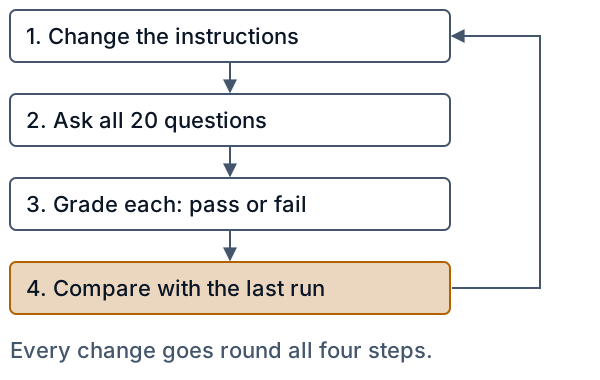
Figure 1. The loop to run after every change.
Compare question by question
After each change, line the new results up against the old ones and give each question one of four labels: fixed (failed before, passes now), broke (passed before, fails now), still passes and still fails. This is the compare step.
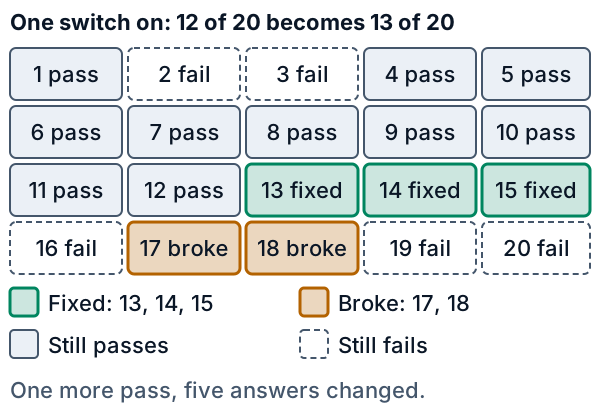
Figure 2. One switch on: three questions fixed, two broke, and the score moves from 12 to 13.
Say “I don’t know” makes the toy refuse when its best match with the page is weak. That fixes Q13, Q14 and Q15, where refusing is right. It breaks Q17, “Can I leave my bicycle by the door?”, and Q18, “What do I pay for a whole week?”. The page does answer both, but in other words, so the match looks weak and the toy refuses. The score rose by one while five answers changed.
The One sentence switch does something else: it fixes 2 questions and breaks 2, so the score stays at 12 of 20. A flat score can hide a swap.
How much one run tells you
With 20 questions, one question is 5 points. Is 13 of 20 really better than 12 of 20? A range helps. The Wilson score interval is a standard formula for the range a pass rate could plausibly sit in. Its 95% range for 12 of 20 is 39% to 78%, and for 13 of 20 it is 43% to 82%. A 95% range means that if you built ranges this way again and again, about 95 in 100 would hold the true rate (the rate on a huge set of similar questions).
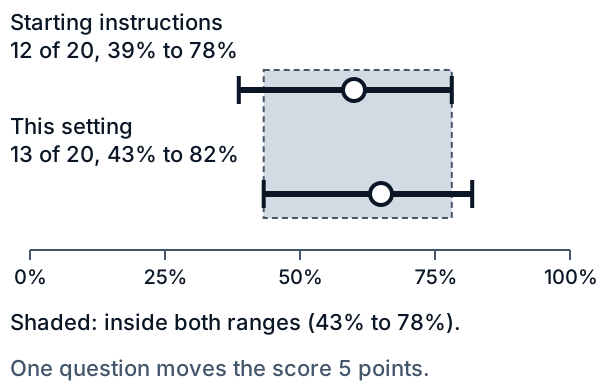
Figure 3. The 95% ranges for 12 of 20 and 13 of 20 overlap from 43% to 78%.
The ranges overlap almost completely, so a gap of one question could be chance. More questions narrow the range. At a rate near 65%, 20 questions give 43% to 82%, 100 give 55% to 74% and 400 give 60% to 70%.
Run-to-run variation adds more noise, meaning differences that come from chance and not from your change. A real model can answer the same question differently on two runs; the lesson Why does the same question give different answers? covers why. In More settings the toy does the same: each result flips with a 1 in 10 chance, from a fixed table. Over 5 runs the starting instructions score 10 to 14 of 20, and in run 5 the change that won the first four runs scores 13 against 14. One run of each is not enough to call a winner.
The toy is a toy
The toy follows fixed rules, so the same switches always give the same answers and every number here can be checked. A real model answers by probability, and real answers are free text, which is harder to grade. Go deeper lists what the toy leaves out.
What this means when you build
- Start with about 20 questions from real use. Write the right answer for each before you change anything, or you will grade to whatever the assistant said.
- Run the whole list on every change to the prompt or the model, including a new version of the same model.
- Read the fixed and broken lists, not only the rate. A flat or rising score can hide a swap.
- Add every bug a user finds as a new question. The list then follows the failures you really see.
- Keep the checks simple and test them. A check that passes a wrong answer is a bug. Try each one on a few right and wrong answers.
- Treat a one-question gap as weak evidence until more questions or more runs agree.
- Keep a few questions back. If you tune the instructions until the list passes, the list stops telling you anything new. Questions you never tuned on show whether a gain is real.
Optionalabout 15 min
Go deeper
Optional, for readers who write Python. The code is in the code/ folder: toy.py is the assistant, evalset.py holds the questions, graders, compare step and interval, and test_evalset.py and test_widget.py are the tests. python3 show_numbers.py prints every number above, and python3 -m pytest -q runs the tests.
The help page and the 20 questions
The page is 15 one-fact sentences (PAGE in toy.py), for example “A basic tune-up costs $60.” and “Used parts cannot be returned.” Each row below is one entry of QUESTIONS: the question, its right answer in bold, and the kind of check.
| # | Question | Check |
|---|---|---|
| 1 | What time do you open on weekdays? 9am to 6pm | words |
| 2 | What are the opening hours on Saturday? 10am to 4pm | words |
| 3 | How many days does a basic tune-up take? 2 days | number |
| 4 | What does a full overhaul cost? $140 | words |
| 5 | How much is the deposit on a rental? $100 | number |
| 6 | What does a city bike cost to rent for a week? $60 a week | words |
| 7 | How long is the warranty on repairs? 90 days | number |
| 8 | When are the riding lessons? Saturdays at 11am | words |
| 9 | Is the shop open on Sunday? No, closed | exact |
| 10 | What are your hours on Saturday and Sunday? 10am to 4pm; closed Sunday | words |
| 11 | What is the warranty on repairs and on a bike bought here? 90 days; 2 years | words |
| 12 | How many months is the warranty on a bike bought here? 24 months | words |
| 13 | Do you deliver bikes? page does not say | unknown |
| 14 | Do you sell helmets? page does not say | unknown |
| 15 | Are you open on public holidays? page does not say | unknown |
| 16 | Is there a student discount on a basic tune-up? page does not say | unknown |
| 17 | Can I leave my bicycle by the door? Yes, free parking at the front door | words |
| 18 | What do I pay for a whole week? $60 a week | words |
| 19 | Can I return a part after 40 days? No, only within 30 days | words |
| 20 | What does a bicycle rental cost for one day? $15 a day | words |
Q10, Q11 and Q12 need two sentences, or a change of units, put together. Q17 to Q20 ask in other words than the page uses. Q16 looks like a question the page answers, because it shares words with the tune-up lines, but the page has no discount.
The toy’s rules
The toy drops small words (STOP) and word endings (stem), so “bikes” matches “bike”. It then counts the words each page sentence shares with the question and ranks the sentences, keeping page order on a tie. answer turns that ranking into a reply:
def answer(question, d):
    """What the toy says to one question under the instructions d."""
    (best, i), (next_best, j) = ranked(question)[:2]
    if best == 0:
        return DONT_KNOW if d.page_only or d.dont_know else GUESS
    if d.dont_know and best < MIN_SHARED:
        return DONT_KNOW
    said = [PAGE[i]]
    if next_best >= ALSO_SHARED and not d.one_sentence:
        said.append(PAGE[j])
    text = " ".join(said)
    if not d.page_only and "month" in words(question):
        text = re.sub(r"(\d+) year", lambda m: f"{int(m.group(1)) * 12} month", text)
    return text
With no switch on, a question that shares no word gets the guess “Yes, we do.” “Do you deliver bikes?” shares one word, “bike”, with four sentences, and the first on the page is the warranty one, so that is the reply. Each switch is one line of this function:
- Page only (
page_only): no guess when nothing matches, and no unit change. It fixes Q14 and breaks Q12, which needs the change from 2 years to 24 months. - Say “I don’t know” (
dont_know): refuse when the best sentence shares fewer thanMIN_SHARED= 2 words. It fixes Q13, Q14 and Q15 and breaks Q17 and Q18, which share one word each. - One sentence (
one_sentence): never add the second sentence. It fixes Q2 and Q3, where the extra sentence added the weekday hours or a price, and breaks Q10 and Q11, which need two.
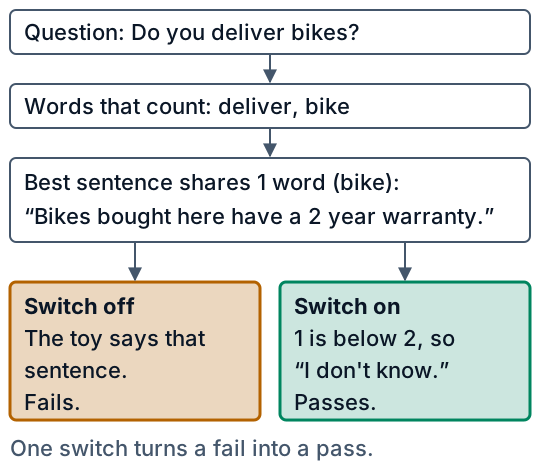
Figure 4. Q13 under the Say “I don’t know” switch, off and on.
All 8 settings, compared with the starting instructions (12 of 20). A setting’s score is 12 plus Fixed minus Broke, so only know and know + one rise, both to 13. In the first column, one is One sentence, know is Say “I don’t know” and page is Page only.
| Switches on | Fixed | Broke |
|---|---|---|
| none | 0 | 0 |
| one | 2 | 2 |
| know | 3 | 2 |
| know + one | 5 | 4 |
| page | 1 | 1 |
| page + one | 3 | 3 |
| page + know | 3 | 3 |
| all three | 5 | 5 |
Q1, Q4, Q5, Q6, Q7, Q8 and Q9 pass under all 8 settings. Q16, Q19 and Q20 fail under all 8, so no switch fixes them: Q16 shares 3 words with the tune-up lines, so the refusal never fires; Q19 would need to compare 40 with 30, and the toy never says “no”; and Q20 shares only “day” with the sentence that holds the answer, no better than the tune-up and overhaul lines, so the toy says the first tied line (the tune-up price) or, with Say “I don’t know” on, refuses. Questions like these are what the list is for. They show what a change cannot do.
The graders and their tests
passes runs one of four graders. words needs every phrase to appear as whole words and none from the avoid list (Q2 must not contain “9am”). number compares the whole numbers in the answer with the expected set. unknown looks for a phrase such as “does not say” or “I don’t know”. exact compares the text with one sentence (for Q9, “Opening hours on Sunday: closed.”), ignoring capitals and punctuation.
def has(text, phrase):
    """True when phrase appears in text as whole words: "no" is not found in "I do not know"."""
    return f" {norm(phrase)} " in f" {norm(text)} "
A looser check fails quietly, so the tests try answers it would let through. Each of these must fail in test_evalset.py:
- Q7, “Repairs have a 190 day warranty.”: the text “90” is inside “190”, which a plain substring check accepts.
- Q19, “I do not know.”: “no” is inside “not” and “know”, which
hasrules out by matching whole words. - Q3, “A basic tune-up takes 2 days. A full overhaul takes 5 days.”: the right number is there with a wrong one beside it, so the number grader wants the set to be exactly {2}.
- Q2, a reply that holds the weekday hours and the Saturday hours: it has “10am to 4pm” and also “9am”.
- Q13, “Yes, we do.”: neither a fact nor a refusal.
The test file also holds a good answer for each of the 20 questions, so a grader that rejects a right answer is caught as well. Both mistakes distort the pass rate, and the pass rate is the thing you trust.
The compare step
def compare(before, after):
    """Per question: "fixed", "broke", "pass" (still passing) or "fail" (still failing)."""
    return [("fixed" if not b else "pass") if a else ("broke" if b else "fail") for b, a in zip(before, after)]
before and after are lists of True and False, one per question. The widget colours its squares from this list and prints the counts.
The interval, with one worked example
def wilson(passed, n, z=Z):
    """Wilson score interval for a proportion: (low, high) as fractions."""
    p = passed / n
    centre = p + z * z / (2 * n)
    spread = z * math.sqrt(p * (1 - p) / n + z * z / (4 * n * n))
    shrink = 1 + z * z / n
    return (centre - spread) / shrink, (centre + spread) / shrink
For 13 of 20, p = 0.65, and z = 1.96 is the multiplier for a 95% range. Then centre = 0.65 + 1.96² / 40 = 0.7460, spread = 1.96 × √(0.65 × 0.35 / 20 + 1.96² / 1600) = 0.2300, and shrink = 1 + 1.96² / 20 = 1.1921. The range is (0.7460 − 0.2300) / 1.1921 = 0.4329 to (0.7460 + 0.2300) / 1.1921 = 0.8188, which is 43% to 82%.
The NIST/SEMATECH e-Handbook of Statistical Methods, section 7.2.4.1 (read 2026-10-19), gives this formula and works one example: 26 out of 200 (13%), with a one-sided 95% limit (z = 1.645), for which it gives a lower limit of 0.09577. A test calls wilson(26, 200, z=1.645) and checks that the lower limit rounds to the same value. The method goes back to E. B. Wilson (1927), as the Wikipedia page on binomial proportion confidence intervals (read 2026-10-19) records.
Overlap is a rough guide, not a test: both runs use the same 20 questions, so a paired comparison can see a difference that two separate ranges do not. Here 3 fixed against 2 broke is itself a small difference.
Run-to-run variation
wobble builds a table of 5 runs by 20 questions with random.Random(5). Where an entry is True, that question’s result comes out the other way, with a 1 in 10 chance. The table is the same for every setting and is embedded in the widget, which therefore needs no random numbers of its own. Because every setting uses the same row, the noise cancels in part when you compare two settings; real re-runs would flip each setting separately, so the real spread is wider. One row per run, runs 1 to 5 from the top. Start is the score of the starting instructions out of 20, and Know is the score with the Say “I don’t know” switch on, with Fixed and Broke counted against Start:
| Start | Know | Fixed | Broke |
|---|---|---|---|
| 10 | 13 | 4 | 1 |
| 11 | 12 | 3 | 2 |
| 10 | 13 | 4 | 1 |
| 11 | 12 | 3 | 2 |
| 14 | 13 | 2 | 3 |
Run 5, the last row, reads “fixed 2, broke 3: 70% to 65%”: the better change looks worse. Seed 5 shows a spread of 4 questions, a little above typical: across 2,000 seeds the median spread of the starting instructions over 5 runs is 3, and it is 4 or more in 32% of seeds. In the toy, in 10,000 single runs, the switch scored below the starting instructions 22% of the time even though, without variation, it scores one higher.
Proof it works
cd lessons/check-ai-answers-with-a-test-set/code
python3 -m pytest -q
The tests guard what a reader would see go wrong. Every grader accepts a right answer and rejects the tempting wrong ones above. The starting instructions pass 12 of 20, and each switch’s exact fixed and broken lists are checked, so a rule edit that moves them fails. The interval equals the NIST value. The lesson’s code blocks are verbatim excerpts of the source. test_widget.py runs the widget’s JavaScript in Node.js (a way to run JavaScript outside a browser) for all 8 settings and 5 runs and checks that every answer, result and range equals the Python one. It also runs the page script against a stand-in page and reads back the headline and the squares, and checks that the widget asks for nothing online and holds no form.
What the toy leaves out
- Free text is harder to grade. Real answers are sentences. A simple check misses right answers in other words and passes wrong ones. A person can grade them, or a second model can act as the judge. Zheng and colleagues (arXiv 2306.05685, read 2026-10-19) report that, when asked which of two answers is better and ties are left out, strong model judges agreed with human preferences over 80% of the time, about as often as humans agree with each other, and they also describe biases such as favouring the first answer shown or a longer one.
- The judge can be wrong too. Check a judge on answers you have graded by hand.
- The 20 questions are not a sample of real use. The range shows how far the score could move if you had picked different but similar questions. It does not say you chose the right questions.
- It has no held-back questions. Keeping some aside is practice, not a result measured here: tuning on the list is the way it stops telling you anything new.
- One page, one assistant. A real list covers many tasks, and a real model answers differently on each run.
Where this is used in practice
OpenAI’s guide “Working with evals” (read 2026-10-19) describes an eval as a test of whether model outputs meet criteria you specify. It lists three steps: describe the task, run it with test inputs, then analyse the results and iterate on the prompt. Its test data holds a correct label from a human for each input, its graders are called testing criteria, and its worked example uses an exact-match check on a small sample. It adds that you will often have to run more criteria, different prompts and different data sets. The page also says OpenAI is deprecating the Evals platform: Evals becomes read-only for existing users on October 31, 2026, and the platform is scheduled to shut down on November 30, 2026. The method does not depend on that product.
Anthropic’s documentation on defining success criteria and building evaluations (read 2026-10-19) says to design evals that mirror your real task and to include edge cases. It names string-match, code-graded and model-graded options, says to automate when possible, and says more automatically graded questions with slightly weaker signal beat fewer hand-graded ones. A comment in its code notes that it is generally best to use a different model to grade than the one that wrote the output. Both pages cover test questions and grading methods in far more detail than this lesson.
Skills this lesson builds
- Writing a test set: questions from real use, with the right answer written before the change.
- Writing graders and testing them on right answers and tempting wrong ones.
- Comparing two runs question by question instead of by pass rate alone.
- Reading a small pass rate with a range, and knowing a one-question gap can be noise.
- Keeping questions back so the list does not turn into something the instructions were tuned to.
Portfolio project: pick a small public help page or README. Write 20 questions about it with the answers written first, 4 of which the page does not answer. Write 4 graders in Python and test each on right and wrong answers. Build two versions of an assistant, which can be simple rules like the toy’s, run both, and publish a table of fixed and broken questions with the Wilson range for each, plus 3 questions you kept back.
Check yourself
- In the toy, one switch fixes 3 questions and breaks 2, and the score goes from 12 to 13 of 20. What do you learn from the fixed and broken lists that the score does not show?
Answer
Five answers changed, not one. Two questions that used to pass, Q17 and Q18, now fail, so you can look at why a weak match makes the toy refuse a question the page does answer.
- Another switch fixes 2 questions and breaks 2, and the score stays 12 of 20. Did it change nothing?
Answer
No. It swapped four answers: different questions pass now. The score hides a swap, which is why you compare question by question.
- The ranges for 12 of 20 and 13 of 20 are 39% to 78% and 43% to 82%. What does the overlap suggest, and what would you do next?
Answer
A gap of one question could be chance. Add more questions, or run more times, before calling one version better, and read the broken questions meanwhile.
- Why does the grader for Q19 fail the reply “I do not know.”, and which line of the code does that?
Answer
Q19 needs the word “no” and “30 days”. has matches whole words after punctuation is removed, so “no” is not found in “not” or “know”. A plain substring check would pass it.
- A colleague tunes the instructions until all 20 questions pass and says the assistant is now 100% accurate. What is wrong with that claim?
Answer
The instructions were shaped to this list, so passing it says little about new questions. Keep some questions back that you never tuned on, and add each new bug as a question.
Further reading
Web pages were read on 2026-10-19.
Gentle
- Define success criteria and build evaluations (Anthropic)
Deep
- 7.2.4.1. Confidence intervals, NIST/SEMATECH e-Handbook of Statistical Methods (NIST)
- Binomial proportion confidence interval (Wikipedia)
- Judging LLM-as-a-Judge with MT-Bench and Chatbot Arena (Zheng and colleagues, arXiv)
Optional
Code
Each file runs on its own. Download it, or read it here.
Show code
"""Keep the data inside ../widget.html equal to the data in toy.py and evalset.py.

    python3 embed_widget.py          rewrite the data block in widget.html
    python3 embed_widget.py --check  exit 1 if widget.html differs (test_widget.py runs the same check)
"""
import json
import re
import sys
from pathlib import Path

from evalset import QUESTIONS, UNKNOWN_PHRASES, Z, describe, wobble
from toy import ALSO_SHARED, DONT_KNOW, GUESS, MIN_SHARED, PAGE, STOP

WIDGET = Path(__file__).resolve().parent.parent / "widget.html"
CONFIG_BLOCK = re.compile(r'(<script type="application/json" id="ev-config">)(.*?)(</script>)', re.S)


def config():
    return {"page": list(PAGE), "stop": sorted(STOP), "guess": GUESS, "dontKnow": DONT_KNOW, "minShared": MIN_SHARED,
            "alsoShared": ALSO_SHARED, "unknown": list(UNKNOWN_PHRASES), "z": Z,
            "wobble": ["".join("1" if flip else "0" for flip in row) for row in wobble()],
            "questions": [{"q": q[0], "right": q[1], "kind": q[2], "args": q[3], "check": describe(q)} for q in QUESTIONS]}


def dump(value):
    return json.dumps(value, ensure_ascii=False)


def embed(html):
    """html with the config block rewritten from toy.py and evalset.py (one key per line, one question per line)."""
    cfg = config()
    lines = [f" {dump(key)}: {dump(value)}" for key, value in cfg.items() if key != "questions"]
    lines.append(' "questions": [\n  ' + ",\n  ".join(dump(q) for q in cfg["questions"]) + "\n ]")
    block = "{\n" + ",\n".join(lines) + "\n}"
    return CONFIG_BLOCK.sub(lambda m: m.group(1) + "\n" + block + "\n" + m.group(3), html, count=1)


if __name__ == "__main__":
    current = WIDGET.read_text(encoding="utf-8")
    updated = embed(current)
    if "--check" in sys.argv:
        sys.exit(0 if updated == current else 1)
    WIDGET.write_text(updated, encoding="utf-8")
print("widget.html data block now matches toy.py and evalset.py")Show code
"""The test set (20 questions with known answers), four graders, the compare step and the Wilson interval.

Python standard library only. The questions are written for toy.py's help page; each has the right answer written
down first and a check that a program can run on the toy's answer.
"""
import math
import random
import re

from toy import answer

# kind: "contains" (every phrase in need appears as whole words, none in avoid), "numbers" (the numbers in the answer
# are exactly these), "unknown" (the answer says it does not know), "exact" (the answer is this sentence, ignoring
# capitals and punctuation).
QUESTIONS = (
    ("What time do you open on weekdays?", "9am to 6pm", "contains", {"need": ["9am", "6pm"]}),
    ("What are the opening hours on Saturday?", "10am to 4pm", "contains", {"need": ["10am", "4pm"], "avoid": ["9am"]}),
    ("How many days does a basic tune-up take?", "2 days", "numbers", {"numbers": [2]}),
    ("What does a full overhaul cost?", "$140", "contains", {"need": ["$140"]}),
    ("How much is the deposit on a rental?", "$100", "numbers", {"numbers": [100]}),
    ("What does a city bike cost to rent for a week?", "$60 a week", "contains", {"need": ["$60 a week"]}),
    ("How long is the warranty on repairs?", "90 days", "numbers", {"numbers": [90]}),
    ("When are the riding lessons?", "Saturdays at 11am", "contains", {"need": ["Saturdays", "11am"]}),
    ("Is the shop open on Sunday?", "No, closed", "exact", {"text": "Opening hours on Sunday: closed."}),
    ("What are your hours on Saturday and Sunday?", "10am to 4pm; closed Sunday", "contains", {"need": ["10am", "4pm", "closed"]}),
    ("What is the warranty on repairs and on a bike bought here?", "90 days; 2 years", "contains", {"need": ["90 day", "2 year"]}),
    ("How many months is the warranty on a bike bought here?", "24 months", "contains", {"need": ["24 month"]}),
    ("Do you deliver bikes?", "The page does not say", "unknown", {}),
    ("Do you sell helmets?", "The page does not say", "unknown", {}),
    ("Are you open on public holidays?", "The page does not say", "unknown", {}),
    ("Is there a student discount on a basic tune-up?", "The page does not say", "unknown", {}),
    ("Can I leave my bicycle by the door?", "Yes, free parking at the front door", "contains", {"need": ["parking"]}),
    ("What do I pay for a whole week?", "$60 a week", "contains", {"need": ["$60 a week"]}),
    ("Can I return a part after 40 days?", "No, only within 30 days", "contains", {"need": ["no", "30 days"]}),
    ("What does a bicycle rental cost for one day?", "$15 a day", "contains", {"need": ["$15 a day"]}),
)

UNKNOWN_PHRASES = ("i don't know", "i do not know", "does not say", "not sure")
NUMBER = re.compile(r"(?<![\w.])\d+(?:\.\d+)?(?!\w)")  # a whole number: "$60." gives 60, "9am" gives nothing
Z = 1.96  # the normal quantile for a 95% interval
WOBBLE_SEED, WOBBLE_RUNS, WOBBLE_CHANCE = 5, 5, 0.1


def norm(text):
    """Lower case, punctuation turned into spaces, one space between words ($ is kept)."""
    return " ".join(re.sub(r"[^a-z0-9$]+", " ", text.lower()).split())


def has(text, phrase):
    """True when phrase appears in text as whole words: "no" is not found in "I do not know"."""
    return f" {norm(phrase)} " in f" {norm(text)} "


def passes(question, text):
    """Grade one answer. question is one row of QUESTIONS."""
    _, _, kind, args = question
    if kind == "contains":
        return all(has(text, p) for p in args["need"]) and not any(has(text, p) for p in args.get("avoid", []))
    if kind == "numbers":
        return sorted({float(x) for x in NUMBER.findall(text)}) == sorted({float(n) for n in args["numbers"]})
    if kind == "unknown":
        return any(has(text, p) for p in UNKNOWN_PHRASES)
    if kind == "exact":
        return norm(text) == norm(args["text"])
    raise ValueError(kind)


def describe(question):
    """One line saying what the check looks for (the widget and the lesson's table show it)."""
    _, _, kind, args = question
    if kind == "contains":
        need = [f"“{p}”" for p in args["need"]]
        return "Answer has " + ", ".join(need[:-1]) + (" and " if len(need) > 1 else "") + need[-1] + "".join(f", not “{p}”" for p in args.get("avoid", []))
    if kind == "numbers":
        return "The numbers in the answer are exactly " + " and ".join(str(n) for n in args["numbers"])
    if kind == "unknown":
        return "Answer says it does not know"
    return f"Answer is exactly “{args['text']}”"


def wobble(seed=WOBBLE_SEED, runs=WOBBLE_RUNS, n=len(QUESTIONS), chance=WOBBLE_CHANCE):
    """runs x n table of True/False: in this run, this question's result comes out the other way."""
    rng = random.Random(seed)
    return [[rng.random() < chance for _ in range(n)] for _ in range(runs)]


def results(d, run=None):
    """[True/False per question] under instructions d. With run set, apply that row of the wobble table."""
    marks = [passes(q, answer(q[0], d)) for q in QUESTIONS]
    if run is None:
        return marks
    return [m != flip for m, flip in zip(marks, wobble()[run])]


def compare(before, after):
    """Per question: "fixed", "broke", "pass" (still passing) or "fail" (still failing)."""
    return [("fixed" if not b else "pass") if a else ("broke" if b else "fail") for b, a in zip(before, after)]


def wilson(passed, n, z=Z):
    """Wilson score interval for a proportion: (low, high) as fractions."""
    p = passed / n
    centre = p + z * z / (2 * n)
    spread = z * math.sqrt(p * (1 - p) / n + z * z / (4 * n * n))
    shrink = 1 + z * z / n
return (centre - spread) / shrink, (centre + spread) / shrinkShow code
"""Print every number the lesson quotes. Run it from this folder: python3 show_numbers.py"""
import math
import random
from statistics import median

from evalset import QUESTIONS, WOBBLE_CHANCE, WOBBLE_RUNS, WOBBLE_SEED, Z, compare, results, wilson, wobble
from toy import FIELDS, SWITCH_NAMES, Instructions, all_settings, answer

OFF = Instructions()
base = results(OFF)


def count(marks):
    return sum(marks)


def pct(x):
    return f"{round(100 * x)}%"


def interval(passed, n=len(QUESTIONS)):
    low, high = wilson(passed, n)
    return f"{pct(low)} to {pct(high)}"


def name(d):
    on = [f for f in FIELDS if getattr(d, f)]
    return " + ".join(on) if on else "nothing on"


print("== The starting instructions: all three switches off")
print(f"  questions: {len(QUESTIONS)}; passing: {count(base)} ({pct(count(base) / len(QUESTIONS))}); failing: {len(QUESTIONS) - count(base)}")
print("  failing: " + "; ".join(f"Q{i + 1} {q[0]}" for i, q in enumerate(QUESTIONS) if not base[i]))
print(f"  \"Do you deliver bikes?\" answer: {answer('Do you deliver bikes?', OFF)}")

print("\n== Each setting against the starting instructions: fixed, broke, pass rate")
print("  switches | fixed | broke | passing | rate | 95% range")
for d in all_settings():
    after = results(d)
    c = compare(base, after)
    print(f"  {name(d)} | {c.count('fixed')} | {c.count('broke')} | {count(after)} of {len(QUESTIONS)} | {pct(count(after) / len(QUESTIONS))} | {interval(count(after))}")

print("\n== What each single switch fixes and breaks")
for field in FIELDS:
    d = Instructions(**{field: True})
    c = compare(base, results(d))
    fixed = [f"Q{i + 1}" for i, k in enumerate(c) if k == "fixed"]
    broke = [f"Q{i + 1}" for i, k in enumerate(c) if k == "broke"]
    print(f"  {SWITCH_NAMES[field]}: fixed {', '.join(fixed) or 'none'}; broke {', '.join(broke) or 'none'}")

print("\n== Questions that fail under all 8 settings")
always_fail = [i + 1 for i in range(len(QUESTIONS)) if not any(results(d)[i] for d in all_settings())]
always_pass = [i + 1 for i in range(len(QUESTIONS)) if all(results(d)[i] for d in all_settings())]
print(f"  always failing: {always_fail}; always passing: {always_pass}")

print("\n== The Wilson range (95%), worked for 13 of 20")
n, k = 20, 13
p = k / n
centre = p + Z * Z / (2 * n)
spread = Z * math.sqrt(p * (1 - p) / n + Z * Z / (4 * n * n))
shrink = 1 + Z * Z / n
print(f"  p = {p}; z = {Z}; centre = {centre:.4f}; spread = {spread:.4f}; shrink = {shrink:.4f}")
print(f"  low = {(centre - spread) / shrink:.4f}; high = {(centre + spread) / shrink:.4f}")
print("  12 of 20: " + interval(12) + "; 13 of 20: " + interval(13))
print("  range width by size at a 65% rate: " + "; ".join(
    f"{size} questions {pct(wilson(round(0.65 * size), size)[0])} to {pct(wilson(round(0.65 * size), size)[1])}" for size in (20, 100, 400)))

print(f"\n== Run-to-run wobble: the demo table (seed {WOBBLE_SEED}, {WOBBLE_RUNS} runs, each result flips with chance {WOBBLE_CHANCE})")
print("  run | starting instructions | don't-know switch | fixed | broke")
dk = Instructions(dont_know=True)
for r in range(WOBBLE_RUNS):
    b, a = results(OFF, r), results(dk, r)
    c = compare(b, a)
    print(f"  {r + 1} | {count(b)} | {count(a)} | {c.count('fixed')} | {c.count('broke')}")
spreads = []
worse = total = 0
new = results(dk)
for seed in range(1, 2001):
    counts = [(count(m != f for m, f in zip(base, row)), count(m != f for m, f in zip(new, row))) for row in wobble(seed)]
    spreads.append(max(b for b, _ in counts) - min(b for b, _ in counts))
    total += len(counts)
    worse += sum(a < b for b, a in counts)
print(f"  over 2000 seeds: median spread of the starting instructions across 5 runs = {median(spreads)} questions; "
      f"spread of 4 or more in {pct(sum(s >= 4 for s in spreads) / len(spreads))} of seeds")
print(f" a single run shows the don't-know switch scoring lower than the starting instructions in {pct(worse / total)} of {total} runs")Show code
"""A toy help-page assistant with three instruction switches. Python standard library only.

This is NOT a language model. It follows the fixed rules below, so the same question and the same switches
always give the same answer. A real model answers by probability, and the lesson says what the toy leaves out.

The scene: a small bike shop's help page, 15 one-fact sentences (made up). The assistant answers a customer's
question from the page. You can change its instructions with three switches; the lesson asks whether a change
helps or hurts across a whole set of questions.
"""
import re
from dataclasses import dataclass
from itertools import product

PAGE = (
    "Opening hours on weekdays are 9am to 6pm.",
    "Opening hours on Saturday are 10am to 4pm.",
    "Opening hours on Sunday: closed.",
    "A basic tune-up costs $60.",
    "A basic tune-up takes 2 days.",
    "A full overhaul costs $140.",
    "A full overhaul takes 5 days.",
    "Unused parts can be returned within 30 days with the receipt.",
    "Used parts cannot be returned.",
    "Repairs have a 90 day warranty.",
    "Bikes bought here have a 2 year warranty.",
    "A city bike rents for $15 a day or $60 a week.",
    "We hold a $100 deposit on your card during a rental and release it when the bike is back.",
    "Free bike parking is at the front door.",
    "Adult riding lessons are on Saturdays at 11am and cost $25.",
)

# Small words the toy ignores when it compares a question with a sentence.
STOP = frozenset(
    "a an the is are was be do does did can could will would i you your my me we our us it its of on in at to for by "
    "and or if with from as that this there here what which who how when where why much many long have has had get any".split())

GUESS = "Yes, we do."  # what the toy says when no sentence shares a word with the question and nothing stops it
DONT_KNOW = "I don't know. The help page does not say."
MIN_SHARED = 2  # the "Say you don't know" switch refuses when the best sentence shares fewer words than this
ALSO_SHARED = 2  # a second sentence is added when it shares at least this many words with the question

FIELDS = ("page_only", "dont_know", "one_sentence")
SWITCH_NAMES = {
    "page_only": "Answer only from the help page",
    "dont_know": "Say \"I don't know\" when the page doesn't say",
    "one_sentence": "Keep answers to one sentence",
}


@dataclass(frozen=True)
class Instructions:
    page_only: bool = False  # no own knowledge: no guess when nothing matches, no unit conversion
    dont_know: bool = False  # refuse when the best sentence shares fewer than MIN_SHARED words with the question
    one_sentence: bool = False  # say only the best sentence


def all_settings():
    """All 8 on/off settings, in a fixed order (the first switch changes slowest)."""
    return [Instructions(*flags) for flags in product((False, True), repeat=len(FIELDS))]


def stem(word):
    """Crude word ending removal, so that "opening" matches "open" and "returned" matches "return"."""
    if len(word) > 3 and word.endswith("s") and not word.endswith("ss"):
        word = word[:-1]
    for ending in ("ing", "ed"):
        if len(word) > 5 and word.endswith(ending):
            return word[: -len(ending)]
    return word


def words(text):
    """The set of words the toy compares: lower case, small words dropped, endings removed."""
    return {stem(w) for w in re.findall(r"[a-z0-9]+", text.lower()) if w not in STOP}


def ranked(question):
    """[(shared word count, sentence number)] best first; equal counts keep page order."""
    q = words(question)
    return sorted(((len(q & words(sentence)), i) for i, sentence in enumerate(PAGE)), key=lambda t: (-t[0], t[1]))


def answer(question, d):
    """What the toy says to one question under the instructions d."""
    (best, i), (next_best, j) = ranked(question)[:2]
    if best == 0:
        return DONT_KNOW if d.page_only or d.dont_know else GUESS
    if d.dont_know and best < MIN_SHARED:
        return DONT_KNOW
    said = [PAGE[i]]
    if next_best >= ALSO_SHARED and not d.one_sentence:
        said.append(PAGE[j])
    text = " ".join(said)
    if not d.page_only and "month" in words(question):
        text = re.sub(r"(\d+) year", lambda m: f"{int(m.group(1)) * 12} month", text)
return textShow code
"""Tests for toy.py and evalset.py. The toy is a fixed set of rules, so every number the lesson quotes can be checked exactly."""
import re
import textwrap
from pathlib import Path

import pytest

from evalset import QUESTIONS, compare, has, passes, results, wilson, wobble
from toy import DONT_KNOW, GUESS, PAGE, Instructions, all_settings, answer, ranked, stem, words

OFF = Instructions()


def Q(n):
    """Question number n as the lesson numbers it (1 to 20)."""
    return QUESTIONS[n - 1]


def numbers(marks, kind):
    return [i + 1 for i, m in enumerate(compare(results(OFF), marks)) if m == kind]


# An answer a person would accept for each of the 20 questions. Guards a check that no right answer can pass.
GOOD = {
    1: "We open at 9am and close at 6pm.", 2: "Saturday is 10am to 4pm.", 3: "2 days.", 4: "It costs $140.",
    5: "The deposit is $100.", 6: "A week costs $60 a week.", 7: "90 days.", 8: "On Saturdays at 11am.",
    9: "Opening hours on Sunday: closed", 10: "Saturday 10am to 4pm, Sunday closed.", 11: "Repairs 90 day, bikes 2 year.",
    12: "That is 24 month.", 13: "I don't know.", 14: "The page does not say.", 15: "I'm not sure.", 16: "I do not know.",
    17: "Yes, free parking is at the front door.", 18: "$60 a week.", 19: "No, parts only come back within 30 days.", 20: "$15 a day.",
}

# (question number, a wrong answer, why a looser check would pass it)
TEMPTING = [
    (7, "Repairs have a 190 day warranty.", "the text '90' is inside '190'"),
    (5, "A $1000 deposit is held.", "the text '100' is inside '1000'"),
    (3, "A basic tune-up takes 2 days. A full overhaul takes 5 days.", "the right number is there, with a wrong one beside it"),
    (19, "I do not know.", "the letters 'no' are inside 'not' and 'know'"),
    (2, "Opening hours on weekdays are 9am to 6pm. Opening hours on Saturday are 10am to 4pm.", "both sentences hold 'Saturday' hours"),
    (9, "Opening hours on Sunday: closed. Opening hours on Saturday are 10am to 4pm.", "the right sentence is there, with a second one"),
    (13, "Yes, we do.", "an answer that is neither a refusal nor a fact"),
    (6, "A city bike rents for $15 a day or $60 a day.", "the text '$60' is there, with the wrong period"),
    (1, "We open at 9am.", "the opening time is there, the closing time is not"),
    (8, "Lessons are on Saturdays.", "the day is there, the time is not"),
    (11, "Repairs have a 90 day warranty.", "one of the two warranties is there, the other is not"),
    (12, "The warranty is 24 years.", "the text '24' is there, with the wrong unit"),
    (17, "Please do not leave it by the door.", "the word 'door' is there, but no word about parking"),
    (18, "A city bike rents for $160 a week.", "the words 'a week' are there, with the wrong price"),
    (20, "A bicycle rental costs $15 a week.", "the text '$15' is there, with the wrong period"),
]


def test_each_check_accepts_a_right_answer():
    assert set(GOOD) == set(range(1, 21))
    wrong = [n for n, text in GOOD.items() if not passes(Q(n), text)]
    assert wrong == []


@pytest.mark.parametrize("n, text, note", TEMPTING)
def test_checks_reject_answers_a_looser_check_would_pass(n, text, note):
    assert not passes(Q(n), text), note


def test_phrases_match_whole_words_only():
    assert has("Used parts cannot be returned.", "used parts") and not has("Unused parts", "used parts")
    assert has("$60 a week.", "$60 a week") and not has("$160 a week", "$60 a week")


def test_the_starting_instructions_pass_12_of_20():
    marks = results(OFF)
    assert len(QUESTIONS) == 20 and sum(marks) == 12
    assert [i + 1 for i, m in enumerate(marks) if not m] == [2, 3, 13, 14, 15, 16, 19, 20]
    assert answer(Q(13)[0], OFF) == "Bikes bought here have a 2 year warranty."  # the lesson's hook: a made-up answer


def test_each_switch_fixes_some_questions_and_breaks_others():
    """The lesson's point: no switch only helps. Exact lists, so a rule edit that moves them fails here."""
    by_switch = {name: results(Instructions(**{name: True})) for name in ("page_only", "dont_know", "one_sentence")}
    assert {k: (numbers(v, "fixed"), numbers(v, "broke")) for k, v in by_switch.items()} == {
        "page_only": ([14], [12]),
        "dont_know": ([13, 14, 15], [17, 18]),
        "one_sentence": ([2, 3], [10, 11]),
    }
    assert [sum(v) for v in by_switch.values()] == [12, 13, 12]  # the same pass rate can hide different questions


def test_all_eight_settings_and_the_ones_that_never_change():
    scores = [sum(results(d)) for d in all_settings()]
    assert len(scores) == 8 and scores == [12, 12, 13, 13, 12, 12, 12, 12]
    never_pass = [n for n in range(1, 21) if not any(results(d)[n - 1] for d in all_settings())]
    always_pass = [n for n in range(1, 21) if all(results(d)[n - 1] for d in all_settings())]
    assert never_pass == [16, 19, 20] and always_pass == [1, 4, 5, 6, 7, 8, 9]


def test_toy_rules_behind_the_three_switches():
    assert (GUESS, DONT_KNOW) == ("Yes, we do.", "I don't know. The help page does not say.")  # the lesson quotes both
    # no shared word: a guess, or a refusal when either switch is on
    assert answer(Q(14)[0], OFF) == GUESS
    assert answer(Q(14)[0], Instructions(page_only=True)) == DONT_KNOW == answer(Q(14)[0], Instructions(dont_know=True))
    # one shared word is not enough for the don't-know switch; three (Q16) is too many for it to notice
    assert ranked(Q(17)[0])[0][0] == 1 and ranked(Q(16)[0])[0][0] == 3
    # the second sentence needs two shared words; one_sentence drops it
    assert answer(Q(11)[0], OFF) == "Bikes bought here have a 2 year warranty. Repairs have a 90 day warranty."
    assert answer(Q(11)[0], Instructions(one_sentence=True)) == "Bikes bought here have a 2 year warranty."
    # unit conversion happens unless page_only is on
    assert "24 month" in answer(Q(12)[0], OFF) and "24 month" not in answer(Q(12)[0], Instructions(page_only=True))


def test_word_matching_rules():
    assert stem("opening") == "open" and stem("returned") == "return" and stem("parts") == "part" and stem("class") == "class"
    assert words("Is the shop open on Sunday?") == {"shop", "open", "sunday"} and len(PAGE) == 15


def test_compare_names_each_question():
    assert compare([True, True, False, False], [True, False, True, False]) == ["pass", "broke", "fixed", "fail"]


def test_wilson_range_matches_the_nist_worked_value_and_the_edges():
    """NIST e-Handbook 7.2.4.1: 26 of 200 (13%), one-sided 95% (z = 1.645): lower limit 0.09577."""
    assert round(wilson(26, 200, z=1.645)[0], 5) == 0.09577
    low, high = wilson(13, 20)
    assert (round(low, 3), round(high, 3)) == (0.433, 0.819)
    assert [round(x, 3) for x in wilson(12, 20)] == [0.387, 0.781]
    assert wilson(0, 20)[0] == pytest.approx(0, abs=1e-12) and wilson(20, 20)[1] == pytest.approx(1)
    assert all(wilson(k, 20)[0] - 1e-12 <= k / 20 <= wilson(k, 20)[1] + 1e-12 for k in range(21))
    assert wilson(12, 20)[1] > wilson(13, 20)[0]  # 12 of 20 and 13 of 20 overlap: one question is inside the noise


def test_wobble_table_is_fixed_and_flips_results_the_same_way_for_every_instruction():
    table = wobble()
    assert len(table) == 5 and all(len(row) == 20 for row in table) and table == wobble()
    assert [sum(results(OFF, r)) for r in range(5)] == [10, 11, 10, 11, 14]  # the spread the lesson quotes: 4 questions
    d = Instructions(dont_know=True)
    assert [sum(results(d, r)) for r in range(5)] == [13, 12, 13, 12, 13]  # in run 5 the better change looks worse


def test_every_python_block_in_the_lesson_is_a_verbatim_excerpt_of_the_source():
    """The lesson quotes these files. If the code changes and the lesson does not, the reader sees code that was never tested."""
    here = Path(__file__).parent
    lesson = (here.parent / "lesson.md").read_text()
    blocks = re.findall(r"^```python\n(.*?)^```", lesson, flags=re.S | re.M)
    assert len(blocks) == 4, "answer, has, compare and wilson"
    for block in blocks:
        lines = block.rstrip("\n").splitlines()
        found = False
        for name in ("toy.py", "evalset.py"):
            source = (here / name).read_text().splitlines()
            windows = (textwrap.dedent("\n".join(source[i:i + len(lines)])) for i in range(len(source) - len(lines) + 1))
            found = found or textwrap.dedent("\n".join(lines)) in windows
assert found, f"not in toy.py or evalset.py:\n{block}"Show code
"""Guards for ../widget.html: its data block, what it may show, and that its rules give the same answers as toy.py and evalset.py."""
import json
import re
import subprocess

from embed_widget import WIDGET, embed
from evalset import NUMBER, QUESTIONS, WOBBLE_CHANCE, compare, describe, has, passes, results, wilson, wobble
from toy import FIELDS, Instructions, all_settings, answer

HTML = WIDGET.read_text(encoding="utf-8")
LESSON = WIDGET.parent
OFF = Instructions()
RUNS = [None, 0, 1, 2, 3, 4]

# Reads the rules out of the widget between its marker comments, runs them, and compares with the Python results.
PARITY = r"""
import fs from 'node:fs';
const [fixture, widget] = process.argv.slice(2);
const fx = JSON.parse(fs.readFileSync(fixture, 'utf8'));
const html = fs.readFileSync(widget, 'utf8');
const cfg = JSON.parse(html.match(/<script type="application\/json" id="ev-config">([\s\S]*?)<\/script>/)[1]);
const js = html.slice(html.indexOf("/* ---------- the toy's rules"), html.indexOf('/* ---------- the page'));
const api = new Function('cfg', "'use strict';" + js + '; return {answer, passes, results, compare, wilson, numbers, has, OFF};')(cfg);
const bad = [];
let checked = 0;
const same = (what, got, want) => { checked++; if (JSON.stringify(got) !== JSON.stringify(want)) bad.push([what, got, want]); };
fx.settings.forEach((s) => {
  same('answers ' + s.name, cfg.questions.map((q) => api.answer(q.q, s.d)), s.answers);
  fx.runs.forEach((run, k) => {
    same('results ' + s.name + ' run ' + run, api.results(s.d, run), s.results[k]);
    same('compare ' + s.name + ' run ' + run, api.compare(api.results(api.OFF, run), api.results(s.d, run)), s.compare[k]);
  });
});
fx.numbers.forEach(([text, want]) => same('numbers ' + text, api.numbers(text), want));
fx.has.forEach(([text, phrase, want]) => same('has ' + text + ' / ' + phrase, api.has(text, phrase), want));
fx.grades.forEach(([i, text, want]) => same('passes Q' + (i + 1) + ' ' + text, api.passes(cfg.questions[i], text), want));
fx.wilson.forEach(([k, lo, hi]) => {
  const w = api.wilson(k, 20);
  checked++;
  if (Math.abs(w[0] - lo) > 1e-12 || Math.abs(w[1] - hi) > 1e-12) bad.push(['wilson', k, w, lo, hi]);
});
console.log(JSON.stringify({ checked, bad: bad.slice(0, 5) }));
process.exit(bad.length ? 1 : 0);
"""


# Runs the page script (everything after the rules) against a small stand-in for the DOM, and reads back what a reader would see.
PAGE_TEST = r"""
import fs from 'node:fs';
const [widget, fixture] = process.argv.slice(2);
const html = fs.readFileSync(widget, 'utf8');
const { states, opening } = JSON.parse(fs.readFileSync(fixture, 'utf8'));
const cfgText = html.match(/<script type="application\/json" id="ev-config">([\s\S]*?)<\/script>/)[1];
const code = html.match(/<script>([\s\S]*?)<\/script>/)[1];

function el(tag) {
  const e = { tag, children: [], listeners: {}, className: '', checked: false, disabled: false, value: '0', attrs: {}, _text: '' };
  e.addEventListener = (type, f) => (e.listeners[type] = e.listeners[type] || []).push(f);
  e.appendChild = (c) => (e.children.push(c), c);
  e.setAttribute = (k, v) => (e.attrs[k] = v);
  Object.defineProperty(e, 'textContent', { get: () => e._text, set: (v) => { e._text = String(v); e.children = []; } });
  return e;
}
const controls = ['ev-page', 'ev-dk', 'ev-one', 'ev-wob', 'ev-run'];
const tagOf = (id) => html.match(new RegExp('<[a-z]+ [^>]*id="' + id + '"[^>]*>'))[0];
const value = (page, id) => (id === 'ev-run' ? page[id].value : page[id].checked);
function open() {
  const page = {};
  ['ev-live', 'ev-big', 'ev-cells', 'ev-detail', 'ev-rates', 'ev-runs', ...controls].forEach((id) => { page[id] = el('x'); });
  page['ev-config'] = el('script');
  page['ev-config']._text = cfgText;
  controls.forEach((id) => { page[id].checked = / checked[ >]/.test(tagOf(id)); page[id].disabled = / disabled[ >]/.test(tagOf(id)); });
  const doc = { getElementById: (id) => page[id], createElement: el, documentElement: { setAttribute() {} } };
  new Function('document', 'window', 'parent', code)(doc, { addEventListener() {} }, {});
  return page;
}
const fire = (e, type = 'change') => (e.listeners[type] || []).forEach((f) => f());
const cells = (page) => page['ev-cells'].children;
const detail = (page) => page['ev-detail'].children.map((p) => p._text);

const bad = [];
const want = (what, got, expected) => { if (JSON.stringify(got) !== JSON.stringify(expected)) bad.push([what, got, expected]); };

const start = open();
want('opening: headline', start['ev-big']._text, opening);
want('opening: 20 squares', cells(start).length, 20);
want('opening: don\'t-know switch is on, the other two off', [start['ev-page'].checked, start['ev-dk'].checked, start['ev-one'].checked], [false, true, false]);
want('opening: variation controls are off', [start['ev-wob'].checked, start['ev-run'].disabled, start['ev-runs']._text], [false, true, '']);
want('opening: first picked square is 13', cells(start).map((c) => c.attrs['aria-pressed']).indexOf('true'), 12);

states.forEach((st) => {
  const page = open(), was = controls.map((id) => value(page, id));
  page['ev-page'].checked = st.d[0]; page['ev-dk'].checked = st.d[1]; page['ev-one'].checked = st.d[2];
  page['ev-wob'].checked = st.run !== null;
  if (st.run !== null) page['ev-run'].value = String(st.run);
  (st.only ? [st.only] : controls.filter((id, k) => value(page, id) !== was[k])).forEach((id) => fire(page[id]));
  if (st.pick !== null) fire(cells(page)[st.pick], 'click');
  want(st.name + ': headline', page['ev-big']._text, st.headline);
  want(st.name + ': square words', cells(page).map((c) => c.children[1]._text), st.words);
  want(st.name + ': square classes', cells(page).map((c) => c.className), st.classes);
  want(st.name + ': detail', detail(page), st.detail);
  want(st.name + ': rates', page['ev-rates']._text, st.rates);
  want(st.name + ': runs line', page['ev-runs']._text, st.runs);
  want(st.name + ': run menu enabled only with variation on', page['ev-run'].disabled, st.run === null);
  want(st.name + ': screen reader line', page['ev-live']._text, st.live);
});
console.log(JSON.stringify({ states: states.length, bad: bad.slice(0, 5) }));
process.exit(bad.length ? 1 : 0);
"""


def flags(d):
    return [getattr(d, f) for f in FIELDS]


def js_settings(d):
    return {"pageOnly": d.page_only, "dontKnow": d.dont_know, "oneSentence": d.one_sentence}


def pct(x):
    return f"{round(100 * x)}%"


def span(k):
    lo, hi = wilson(k, 20)
    return f"{pct(lo)} to {pct(hi)}"


def expected_page(name, d, run, pick):
    """What the page should show, worked out from toy.py and evalset.py with none of the widget's code."""
    before, after = results(OFF, run), results(d, run)
    c = compare(before, after)
    kb, ka, fixed, broke = sum(before), sum(after), c.count("fixed"), c.count("broke")
    i = 12 if pick is None else pick
    q = QUESTIONS[i]
    flip = run is not None and wobble()[run][i]
    check = describe(q)
    gap = "" if kb == ka else " The ranges overlap, so a gap this size could come from which questions you picked." if wilson(kb, 20)[1] >= wilson(ka, 20)[0] and wilson(ka, 20)[1] >= wilson(kb, 20)[0] else " The ranges do not overlap."
    runs = [(sum(results(OFF, r)), sum(results(d, r))) for r in range(5)]
    low = lambda j: min(x[j] for x in runs)
    high = lambda j: max(x[j] for x in runs)
    headline = f"Nothing changed: still {pct(ka / 20)}." if fixed + broke == 0 else \
        f"This change fixed {fixed} question{'' if fixed == 1 else 's'} and broke {broke}: {pct(kb / 20)} to {pct(ka / 20)}."
    live = lambda v: ", ".join(f"Q{n + 1}" for n, x in enumerate(c) if x == v) or "none"
    return {"name": name, "d": flags(d), "run": run, "pick": pick, "headline": headline, "words": c,
            "classes": [f"ev-cell {x}" + (" sel" if n == i else "") for n, x in enumerate(c)],
            "detail": [f"Q{i + 1}. {q[0]}", f"Right answer: {q[1]}",
                       f"Starting instructions said: “{answer(q[0], OFF)}” ({'pass' if before[i] else 'fail'})",
                       f"This setting says: “{answer(q[0], d)}” ({'pass' if after[i] else 'fail'})",
                       "Check: " + check[0].lower() + check[1:] + "." + (" This run, both results came out the other way." if flip else "")],
            "rates": f"Starting instructions: {kb} of 20 ({span(kb)}, 95% range). This setting: {ka} of 20 ({span(ka)})." + gap,
            "runs": f"Across all 5 runs the starting instructions score {low(0)} to {high(0)} of 20; this setting scores {low(1)} to {high(1)}." if run is not None else "",
            "live": f"{headline} Fixed: {live('fixed')}. Broke: {live('broke')}."}


def run_node(tmp_path, script, fixture, args):
    (tmp_path / "script.mjs").write_text(script, encoding="utf-8")
    (tmp_path / "fixture.json").write_text(json.dumps(fixture), encoding="utf-8")
    result = subprocess.run(["node", str(tmp_path / "script.mjs"), *args(tmp_path / "fixture.json")], capture_output=True, text=True, timeout=60)
    assert result.returncode == 0, result.stdout + result.stderr
    return json.loads(result.stdout)


def test_widget_data_block_matches_toy():
    """Guards a toy.py or evalset.py edit that was not copied into the widget (run embed_widget.py)."""
    assert embed(HTML) == HTML


def test_every_element_the_script_looks_up_exists_inside_the_root():
    """Guards a widget that never starts: a lookup of an id that is not in the page throws in the browser."""
    root = HTML[HTML.index('<div class="ev-root">'):HTML.index("<script")]
    script = HTML[HTML.index("<script>"):]
    lookups = set(re.findall(r"\$\('([\w-]+)'\)", script))
    handlers = re.search(r"^\s*\['ev-page'.*$", script, re.M)
    assert handlers, "the handler list that starts with 'ev-page' has moved: update this test"
    lookups |= set(re.findall(r"'(ev-[\w-]+)'", handlers.group(0)))
    assert lookups and all(f'id="{i}"' in root for i in lookups), sorted(i for i in lookups if f'id="{i}"' not in root)


def test_widget_is_small_and_asks_for_nothing_online():
    assert len(HTML.splitlines()) <= 300 and len(HTML.encode("utf-8")) < 40 * 1024
    page = re.sub(r'<script type="application/json" id="ev-config">.*?</script>', "", HTML, flags=re.S)
    for banned in ("http://", "https://", "fetch(", "XMLHttpRequest", "WebSocket", "sendBeacon", "import("):
        assert banned not in page, banned
    assert " src=" not in page and "@import" not in page


def test_widget_has_no_form_element():
    """Guards a dead button: the lesson page loads widget.html in a sandboxed frame, where a form cannot submit."""
    assert "<form" not in HTML and 'type="submit"' not in HTML


def test_widget_keeps_the_site_theme_listener_and_palette():
    assert "d.type !== 'spicyshark:theme'" in HTML and "e.source !== parent" in HTML
    for pair in ("light-dark(#ffffff, #0a0f17)", "light-dark(#ebf0f6, #131b28)", "light-dark(#0a1626, #f4f7fb)",
                 "light-dark(#44566b, #a3b1c4)", "light-dark(#d2dae4, #1c2635)", "light-dark(#66768a, #7a8a9f)",
                 "--green: light-dark(#00855F, #009E73)", "--orange: light-dark(#b36200, #E69F00)"):
        assert pair in HTML, pair
    assert "1 in 10" in HTML and WOBBLE_CHANCE == 0.1  # the words in the widget say what evalset.py does


def test_no_blue_or_vermillion_anywhere_in_the_lesson():
    """Guards the site palette: ink, grey, orange and green only (no blue, no vermillion), in the page, the figures and the text."""
    files = [LESSON / "lesson.md", LESSON / "widget.html", *sorted((LESSON / "figs").glob("*.svg"))]
    found = {f.name: m for f in files if f.exists() for m in ("0072B2", "56B4E9", "D55E00") if m.lower() in f.read_text(encoding="utf-8").lower()}
    assert found == {}


def test_widget_rules_match_the_python_toy(tmp_path):
    """Guards the widget's JavaScript drifting from toy.py and evalset.py: same answers, marks, fixed/broke lists and ranges."""
    settings = []
    for d in all_settings():
        settings.append({"name": "+".join(f for f, on in zip(FIELDS, flags(d)) if on) or "off", "d": js_settings(d),
                         "answers": [answer(q[0], d) for q in QUESTIONS],
                         "results": [results(d, r) for r in RUNS], "compare": [compare(results(OFF, r), results(d, r)) for r in RUNS]})

    def nums(text):
        values = sorted({float(x) for x in NUMBER.findall(text)})
        return ",".join(str(int(v)) if v == int(v) else repr(v) for v in values)

    fixture = {"runs": RUNS, "settings": settings, "wilson": [[k, *wilson(k, 20)] for k in range(21)],
               "numbers": [[t, nums(t)] for t in ("$60.", "9am to 6pm", "a 190 day warranty, 2 days", "3.5 and 3.50 and 7", "$100 and $1000", "none", "1 2 2 1", "v2 5x 7")],
               "has": [[t, p, has(t, p)] for t, p in (("I do not know", "no"), ("No, only within 30 days", "no"), ("$160 a week", "$60 a week"),
                                                     ("Unused parts", "used parts"), ("Used parts.", "used parts"), ("Opening: 9AM", "9am"))],
               "grades": [[i, text, passes(QUESTIONS[i], text)] for i, text in
                          ((2, "2 days. 5 days."), (6, "a 190 day warranty"), (8, "Opening hours on Sunday: closed."), (18, "I do not know."), (18, "No, 30 days."),
                           (12, "Yes, we do."), (12, "The help page does not say."), (1, "10am to 4pm and 9am"))]}
    out = run_node(tmp_path, PARITY, fixture, lambda f: [str(f), str(WIDGET)])
    assert out["bad"] == [] and out["checked"] == 8 * (1 + 2 * len(RUNS)) + 8 + 6 + 8 + 21


def test_widget_page_shows_what_the_lesson_names(tmp_path):
    """Guards the part a reader sees: the headline sentence, the word in every square, the detail lines, the ranges, the switches the page opens with and the wiring of each control.

    The lesson names these states: the opening one (13 of 20: fixed 3, broke 2), one sentence (fixed 2, broke 2, same 60%), and run 5 of the variation (the new
    instructions score below the starting ones). The opening switches are read from widget.html's own attributes. Each control is also changed and fired on its
    own, so a control whose change handler is missing leaves the page unchanged and fails."""
    on = lambda *names: Instructions(**{n: True for n in names})
    states = [{**expected_page("opening", on("dont_know"), None, None), "live": ""},  # nothing is announced until a control changes
              expected_page("all off", OFF, None, 3),
              expected_page("one sentence", on("one_sentence"), None, 9),
              expected_page("page only", on("page_only"), None, 11),
              expected_page("all three", on("page_only", "dont_know", "one_sentence"), None, 15)]
    states += [expected_page(f"variation run {r + 1}", on("dont_know"), r, 17 if r == 2 else None) for r in range(5)]
    alone = [("ev-page", on("page_only", "dont_know"), None), ("ev-dk", OFF, None), ("ev-one", on("dont_know", "one_sentence"), None),
             ("ev-wob", on("dont_know"), 0), ("ev-run", on("dont_know"), 4)]
    states += [{**expected_page(f"{id} alone", d, run, None), "only": id} for id, d, run in alone]
    out = run_node(tmp_path, PAGE_TEST, {"states": states, "opening": states[0]["headline"]}, lambda f: [str(WIDGET), str(f)])
    assert out == {"states": len(states), "bad": []}
    assert states[0]["headline"] == "This change fixed 3 questions and broke 2: 60% to 65%."
    assert states[9]["headline"] == "This change fixed 2 questions and broke 3: 70% to 65%."  # run 5: the better change looks worse
    assert "<b>Vary the results</b>" in WIDGET.read_text()  # it flips results, not answers