On this page
A chatbot writes one token (a small piece of text, often a whole word) at a time, and each token costs one pass, a single run of the model. Take an AI model with 8 billion numbers inside, called weights, on one A100 chip built for AI work, helped by a smaller model that guesses ahead. In the best case it needs 7.88 milliseconds (ms, thousandths of a second) per token alone, and about 3.8 ms with four guesses at a time and 80% of them kept: 2.1 times as fast, with the same words. Real services are slower than these best cases, and this lesson says why.
In one minute
A small model speeds up a big one by guessing the next few tokens, which the big model then checks all at once; the method is called speculative decoding. Picture a junior who writes the next few words of a letter and a senior who reads all of them at a glance. The senior keeps the words up to the first one they would have written differently and writes that word themselves. Reading a few words takes the senior about as long as writing one, so good guesses save time, poor ones save none, and the letter is always the one the senior would have written alone.
Explore the numbers
Open the widget and drag the chance that a guess is kept. It shows best-case times from a model at the chip’s peak speed, the most it can do, not measurements. At the opening setting the plain lane needs 17 big passes for a reply and the draft lane 5, with the same words. In this toy a token is a whole word.
How it works
Guess ahead, then check
Plain decoding makes one token per pass, as Why do answers appear word by word? shows. Speculative decoding adds a much smaller model, the draft model, which writes a few tokens first; each is only a guess. The big model then reads the text so far and all the guesses in one pass, and says what it would write at each place, including the place after the last guess. It keeps the guesses up to the first one that differs from its own choice, writes its own token there, and throws the rest away. If every guess matches, its token after them comes free. So one round, four guesses and one big pass, gives 1 to 5 tokens.
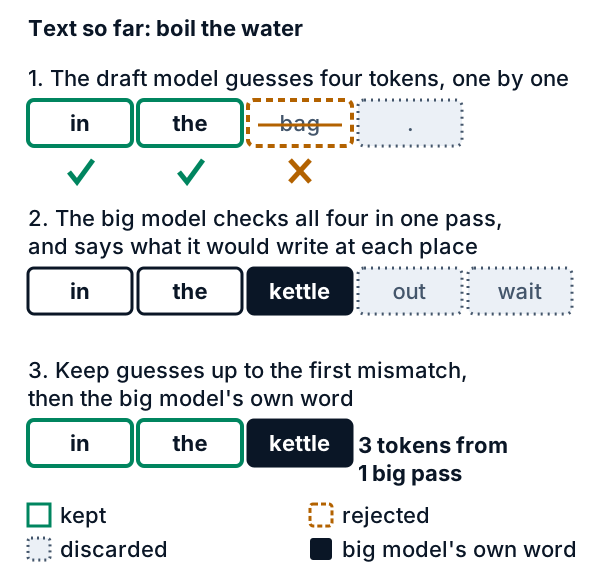
Figure 1. One round after “boil the water”. Green borders mark kept guesses, orange strikethrough the rejected one, dotted grey what is thrown away, black the big model’s own token.
Why a check costs about one token
A pass has two jobs: fetch every weight from memory, and do the arithmetic, the sums, on them. It takes the longer of the two. The lesson on the first-word wait shows that for a short input, fetching is longer: the big model’s 16 gigabytes (GB) of weights take 7.88 ms to fetch, whether the pass reads 1 token or 153. Checking four guesses reads 5 tokens, so the check still takes 7.88 ms; the chip had arithmetic to spare. From 154 tokens up, arithmetic takes longer and each added token costs time.
The draft model has the same two jobs with only 2.5 GB of weights, so one pass takes 1.21 ms, about 15% of a big pass. A round of four guesses costs four draft passes and one big pass: about 12.7 ms. At 80% kept a round brings 3.36 tokens on average, so each token costs 3.79 ms instead of 7.88.
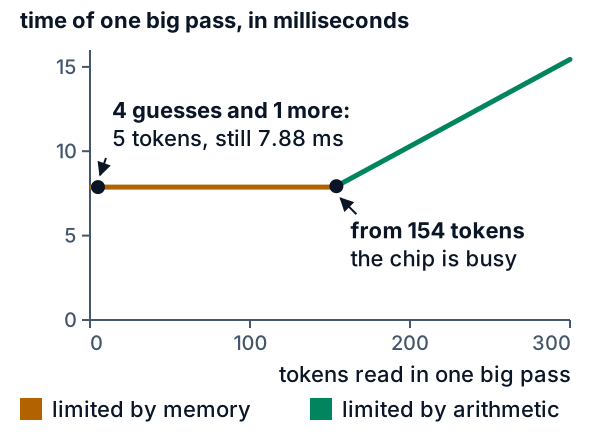
Figure 2. Best-case time of one big pass against the tokens it reads. Orange is limited by memory, green by arithmetic. The dot is four guesses and one more token.
Why the words do not change
A guess is kept only where the big model would have written the same token; elsewhere the big model’s own token is used. So when the model always picks its most likely token, the reply is word for word the one plain decoding writes, and Go deeper runs that check on a toy pair. When the model picks tokens at random, a different keep rule leaves the big model’s odds for every token exactly as they were. A poor draft model only costs time.
When guessing pays
Every round pays for its draft passes whether or not the guesses are kept. With four guesses, the pair is faster than plain decoding only when more than about 39% of guesses are kept; at 60% it is 1.43 times as fast, at 80% 2.08 times and at 90% 2.53 times. More guesses help only while they are kept: the best number is 2 at 60% kept and 8 at 90%.
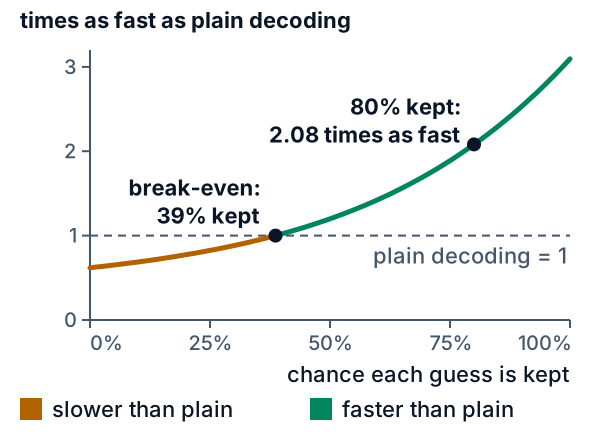
Figure 3. Best-case speed-up with four guesses per round and a draft pass of 15% of a big pass. Orange is slower than plain decoding, green faster; the dot is the widget’s opening setting.
What this toy leaves out
These are best cases at the chip’s peak speed. How often guesses are kept depends on the text and the pair of models, and the formula behind these numbers treats guesses as independent chances, which they are not. A real small model runs further below peak than a big one, so its cost is a larger share than 15%. The draft model needs its own memory and notes about earlier tokens, and software adds time. With many users sharing the chip, the spare arithmetic runs out, as Go deeper shows.
What this means when you build
- Expect the same text, sooner. Picking the most likely token gives the same words, and picking at random keeps the same odds. If a draft changes your answers beyond rounding, suspect the implementation.
- Choose a draft model that is cheap and often right. It must share the big model’s tokens. Here a draft pass twice as slow needs 58% kept to match plain decoding, not 39%.
- Measure how often guesses are kept on your own text. The rate depends on the text; set the number of guesses from it.
- Expect less gain on a busy server. A crowd sharing the chip uses up the spare arithmetic.
Optionalabout 20 min
Go deeper
Optional. This part is for readers who write Python. The code is in the code/ folder next to this lesson. From inside that folder, python3 show_numbers.py prints every number below, and python3 -B -m pytest -q -p no:cacheprovider runs the tests.
The round in code
In a real system the big model’s k + 1 choices come from one pass; in this toy each choice is a function call, and a round counts as one big pass. This is the real function with its comments cut:
def speculative_greedy(prompt, count, k, draft=small_choice, target=big_choice):
    text, rounds = list(prompt), []
    while len(text) - len(prompt) < count:
        guesses = []
        for _ in range(k):
            guesses.append(draft(text + guesses))
        own = [target(text + guesses[:i]) for i in range(k + 1)]
        kept = 0
        while kept < k and guesses[kept] == own[kept]:
            kept += 1
        new = guesses[:kept] + [own[kept]]
        rounds.append(Round(guesses, own, kept, new))
        text += new
    return text[len(prompt):len(prompt) + count], rounds
own is the big model’s choice at all k + 1 places: after the text, after one guess, and so on to after all k. kept counts matches from the start. The line new = guesses[:kept] + [own[kept]] is the whole rule: the kept guesses, then the big model’s token, which is the free extra one when kept equals k.
The toy pair
Both toy models are word tables built from one 41-token sentence of tea-making steps, treated as a ring so the last words lead back to the first. The big toy looks back two words and picks the word that most often followed them. The small toy looks back one. They pick the same word at 28 of the 41 places, 68.3%.
Proof that the text is unchanged
test_speculative_text_equals_the_big_models_own_text runs plain greedy decoding with the big toy for 50 words from each of the 41 starts, then speculative decoding with the pair for k of 1, 2, 3, 4, 6 and 8, and asserts the same 50 words. It checks each round’s shape, and that a run stopped early ended at a real disagreement. A draft that is always wrong must still give the same text, with one word per round. Dropping the big model’s own word, or keeping a guess past a mismatch, changes the text and fails it.
The rule for sampled text
Let p be the big model’s chance for a token and q the draft model’s. Leviathan, Kalman and Matias use these letters; Chen and colleagues swap them. The rule: draw a guess x from q and keep it with probability min(1, p(x) / q(x)). After a rejection, draw instead from max(0, p(x) − q(x)), scaled to add up to 1.
def keep_chance(p_x, q_x):
    return min(Fraction(1), p_x / q_x) if q_x else Fraction(1)

def residual(p, q):
    left = {x: max(Fraction(0), p[x] - q[x]) for x in p}
    total = sum(left.values())
    return {x: left[x] / total for x in left}
Take three tokens with p of 1/2, 3/10 and 1/5 for A, B and C, and q of 1/5, 3/10 and 1/2. A is drawn with chance 1/5 and kept for sure, since p is above q. B is drawn with 3/10 and kept for sure. C is drawn with 1/2 and kept with chance (1/5) / (1/2) = 2/5, so 1/5 gets through. In all 7/10 of guesses are kept. The other 3/10 are rejected, and the leftover is 3/10 for A and nothing for B and C, so every rejection becomes A. In the table, Kept is the chance a token is guessed and kept, and Redrawn the chance it is written after a rejection.
| Token | Kept | Redrawn | Total |
|---|---|---|---|
| A | 1/5 | 3/10 | 1/2 |
| B | 3/10 | 0 | 3/10 |
| C | 1/5 | 0 | 1/5 |
The totals are p exactly. test_sampling_rule_gives_the_big_models_odds_exactly asserts that in exact fractions for this example and for 30 invented pairs of 2 to 6 tokens.
Tokens per big pass
If each guess is kept with chance a, independently, the token at place j is reached when the first j guesses were all kept, a chance of a^j. So the expected tokens per big pass is 1 + a + a² + … + a^k, which is (1 − a^(k+1)) / (1 − a), or k + 1 when a is 1. Leviathan and colleagues call the independence a simplifying assumption. simulate_tokens_per_pass draws 100,000 seeded rounds, and a test holds its average to the formula within 1.5% for six pairs of a and k. At k of 4, a of 0.3, 0.6, 0.8 and 0.9 give 1.43, 2.31, 3.36 and 4.10 tokens per pass.
The toy pair tests the assumption. It keeps a guess 68.3% of the time; the formula at that chance is compared with the toy’s measured words per big pass over a start at every place:
| Guesses | Measured | Formula |
|---|---|---|
| 1 | 1.71 | 1.68 |
| 2 | 2.41 | 2.15 |
| 4 | 2.92 | 2.69 |
| 8 | 3.14 | 3.05 |
The measured value is higher at every k, so the toy’s guesses are not independent chances. For another pair the gap will differ.
Time, with a worked example
The draft model is Llama 3.2 1B, which has the big model’s vocabulary of 128,256 tokens, so the big model can check its tokens one for one. The code counts its weights from a third-party copy of its configuration: 16 layers, width 2,048, feed-forward width 8,192, 32 attention heads of which 8 keep keys and values, and one table shared by input and output. The count is 1,235,814,400 weights, the total listed for its files, or 2.47 GB at 2 bytes each; Meta’s model card agrees on 1.23 billion parameters and shared embeddings. A separate output table would give 1.50 billion weights and a draft pass 21% too slow; a test guards that. By lesson 23’s model a draft pass takes 2.47 GB over 2,039 GB a second: 1.212 ms, 15.4% of the big model’s 7.877 ms.
A round costs k draft passes plus one big pass over k + 1 tokens. The speed-up is the tokens per round times the plain time, over the round time.
def round_seconds(k, draft_seconds=None, users=1):
    each = draft_pass(users).seconds if draft_seconds is None else draft_seconds
    return k * each + big.prefill(users * (k + 1)).seconds

def speedup(a, k, draft_seconds=None, users=1):
    return expected_tokens(a, k) * plain_seconds(users) / round_seconds(k, draft_seconds, users)
Here big.prefill is lesson 23’s pass over n tokens; a test asserts that it takes exactly the time of one token for every n from 1 to 153. With c the draft pass as a share of a big pass, 0.154, the speed-up is (1 − a^(k+1)) / ((1 − a)(1 + kc)), which is Leviathan and colleagues’ Theorem 3.8. At the opening setting:
| Step | Value |
|---|---|
| Four draft passes | 4.848 ms |
| Big pass, 5 tokens | 7.877 ms |
| One round | 12.725 ms |
| Tokens per round | 3.36 |
| Time per token | 3.79 ms |
| Speed-up | 2.08 |
Break-even and the best number of guesses
break_even finds by bisection the lowest keep chance with a speed-up of at least 1: 15.4% for one guess, 24.7% for two, 38.6% for four and 55.4% for eight. More guesses cost more draft passes, so they need more luck to pay. best_k tries every k from 1 to 32. At a of 0.6 the best is 2 guesses, 1.50 times as fast; at 0.8 it is 5, 2.08 times; at 0.9 it is 8, 2.75 times; at 0.95 it is 12, 3.42 times. At 0.6 the curve falls below 1 at 10 guesses.
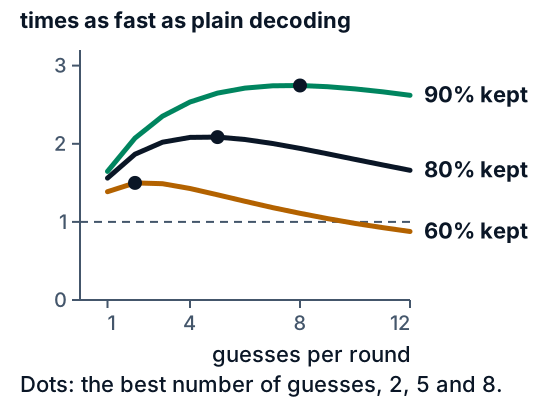
Figure 4. Best-case speed-up against guesses per round. Dots mark the best number for each chance.
Many users at once
With B users in one step, the plain step reads B tokens and the check reads B(k + 1), so the check stops being free sooner (lesson 24’s per-user cache reads are left out here too). users_when_checking_stops_being_free finds the first B with B(k + 1) at or above 154: 52 users at k of 2, 31 at 4, 22 at 6 (22 × 7 is exactly 154, and a tie counts as arithmetic) and 18 at 8. At 80% kept and four guesses the speed-up is 2.08 up to 30 users, 2.02 at 32 and 1.24 at 64, and falls below 1 at 85. From 154 users every pass is limited by arithmetic and it stays at 0.60: a round does 5.6 times a plain step’s arithmetic for 3.36 tokens. This is the toy’s time model, not a measurement of any server; lesson 24 covers how a server shares a step.
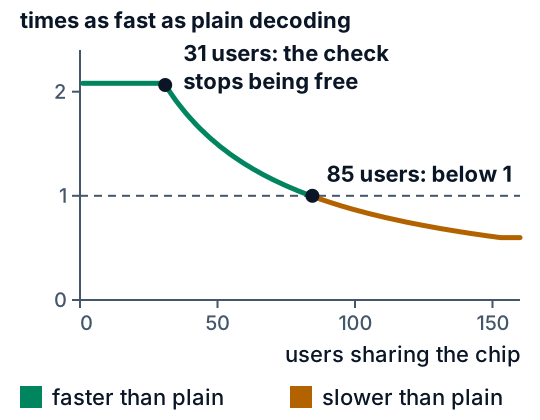
Figure 5. Best-case speed-up against users sharing the chip. The dashed line is plain decoding.
What the model leaves out
The time model counts weights only, like lesson 23’s short formulas. It leaves out the attention cache of both models, the memory the draft model takes on the same chip, and the time software spends moving between the two models. Real chips fall short of their peak, and a small model falls shorter. The widget’s More settings slow the draft pass: at 2.4 ms, twice the 1.2 ms, the speed-up at 80% kept and four guesses is 1.52, not 2.08, and break-even rises to 58%; at 7.9 ms, as slow as the big model, it is 0.67. Other ways to guess exist: Medusa (Cai and colleagues, 2024) adds extra output heads to the big model so that no second model is needed, and its abstract says it builds and checks several candidate continuations at once. This lesson does not model it.
Proof it works
test_speculative_sim.py pins the numbers above: lesson 23’s constants and the 153/154 flip, the draft model’s weight count, the text identity, the sampling rule in exact fractions, the formula against the simulation, and the time figures. test_widget.py runs the widget’s JavaScript in Node against the Python on a grid of settings with the same seeded random numbers, and drives the page through a small stand-in for the browser. The 32 tests run in under a second.
Where this is used in practice
Two papers describe the method, and both were read for this lesson on 2026-10-19. Leviathan, Kalman and Matias (2023) describe a smaller model proposing tokens that the large model checks in parallel, with identical outputs, and report a 2X-3X acceleration on T5-XXL against the standard T5X implementation. Chen and colleagues (2023) describe speculative sampling, with a modified rejection scheme that keeps the large model’s distribution, and report a 2-2.5x speedup on the 70-billion-parameter Chinchilla in a distributed setup. Those are the authors’ numbers for their own models and setups, not this toy’s.
Skills this lesson builds
- Explain how a draft model’s guesses are checked in one big pass, and why the check costs about one token.
- Say why speculative decoding keeps the big model’s text for greedy choice and its odds for sampling.
- Work out tokens per big pass and the speed-up from how often guesses are kept and what the draft model costs.
- Find the break-even keep rate and the best number of guesses for a setting.
- Say what a best-case model leaves out, and keep it apart from a measurement.
Portfolio project: pick a big and a small open model that share a tokenizer, and a library that supports guessing ahead with a draft model. On prompts from three kinds of text, such as code, a news paragraph and free chat, record how often guesses are kept, the tokens per big pass and the time per token, with greedy choice on and the output checked against plain decoding. Plot each against this lesson’s formula using the measured keep rate. Publish the script, the plots and a note on where they disagree.
Check yourself
-
A friend says the small model’s guesses make the answer worse, because the small model is writing part of it. What do you tell them?
Answer
A guess is kept only where the big model would have written the same token, and where it would not, the big model’s own token is used. So the text is what the big model alone would write. A poor draft model costs time, not quality.
-
A big pass over 1 token takes 7.88 ms. Why does a pass over 5 tokens, the last token of the text and four guesses, take about the same?
Answer
A short pass is limited by fetching the weights, which takes 7.88 ms however few tokens it reads, up to 153 of them. The chip has arithmetic to spare, so the extra four tokens ride along free.
-
A draft pass takes 1.212 ms and the big pass over 5 tokens 7.877 ms. How long is a round of four guesses, and what does a token cost if a round brings 3.36 tokens?
Answer
The round is 4 x 1.212 + 7.877 = 12.725 ms. A token costs 12.725 / 3.36 = 3.79 ms, against 7.877 ms for plain decoding: 2.08 times as fast.
-
With four guesses and 60% of them kept, how many tokens does a big pass give on average, and how much faster is the pair than plain decoding?
Answer
Tokens per pass are (1 − 0.6^5) / (1 − 0.6) = 2.31. The speed-up is 2.31 x 7.877 / 12.725 = 1.43 times.
-
With 31 users in one step, why does a four-guess check stop being free?
Answer
Each user’s check reads 5 tokens, so the pass reads 31 x 5 = 155 tokens, above the 153 where the chip stops having arithmetic to spare. From there each added token costs time, and the gain shrinks. At 80% kept it is 2.08 up to 30 users and falls below 1 at 85.
Further reading
Gentle
- Why do answers appear word by word? (lesson 4, one token per pass)
- Why does an AI wait a moment before the first word? (lesson 23, why a short pass costs the same as one token)
- How does an AI server answer many people at once? (lesson 24, many users in one step)
Deep
- Fast Inference from Transformers via Speculative Decoding (Leviathan, Kalman and Matias, ICML 2023; read 2026-10-19)
- Accelerating Large Language Model Decoding with Speculative Sampling (Chen, Borgeaud, Irving, Lespiau, Sifre and Jumper, 2023; read 2026-10-19)
- Medusa: Simple LLM Inference Acceleration Framework with Multiple Decoding Heads (Cai, Li, Geng, Peng, Lee, Chen and Dao, 2024; abstract read 2026-10-19)
- Llama 3.2 1B (a third-party copy of Meta’s model; the layer count, widths, vocabulary and weight total; read 2026-10-19)
- Llama 3.2 model card (Meta, the maker’s card; 1.23 billion parameters and shared embeddings for the 1B model; read 2026-10-19)
- Llama 3.1 model card (Meta; the 8B model used as the big model; read 2026-10-19)
- NVIDIA A100 Tensor Core GPU data sheet (peak speed and bandwidth, as read in lesson 23)
Optional
Code
Each file runs on its own. Download it, or read it here.
Show code
"""Keep the copy of the model, the chip and the reply inside ../widget.html equal to the ones in speculative_sim.py.

    python3 embed_widget.py          rewrite the data block in widget.html
    python3 embed_widget.py --check  exit 1 if widget.html differs (test_widget.py runs the same check)
"""
import json
import re
import sys
from pathlib import Path

import speculative_sim as sim

WIDGET = Path(__file__).resolve().parent.parent / "widget.html"
CONFIG_BLOCK = re.compile(r'(<script type="application/json" id="sdw-config">)(.*?)(</script>)', re.S)


def config():
    """What the page needs to run the same rounds: the big model and the chip, the reply and its wrong guesses, and the settings it offers."""
    return {
        "params": sim.big.PARAMS, "bytesPerWeight": sim.big.FP16_BYTES, "peak": sim.big.A100_PEAK_FLOPS, "bandwidth": sim.big.A100_BANDWIDTH,
        "reply": sim.REPLY, "decoys": sim.DECOYS, "draftStops": sim.DRAFT_STOPS_MS, "defaultDraft": sim.DEFAULT_DRAFT_STOP, "opening": sim.OPENING,
    }


def embed(html):
    """html with the data block rewritten from speculative_sim.py."""
    settings = json.dumps(config(), ensure_ascii=False, separators=(", ", ": "))
    return CONFIG_BLOCK.sub(lambda m: m.group(1) + "\n" + settings + "\n" + m.group(3), html, count=1)


if __name__ == "__main__":
    current = WIDGET.read_text(encoding="utf-8")
    updated = embed(current)
    if "--check" in sys.argv:
        sys.exit(0 if updated == current else 1)
    WIDGET.write_text(updated, encoding="utf-8")
print("widget.html data block now matches speculative_sim.py")Show code
"""Print every number the lesson quotes. Run: python3 show_numbers.py"""
import speculative_sim as sim

big = sim.big


def main() -> None:
    plain, draft = sim.plain_seconds(), sim.draft_pass().seconds
    print(f"big model {big.PARAMS:,} weights, {big.FP16_BYTES * big.PARAMS / 1e9:.2f} GB; draft model {sim.DRAFT_PARAMS:,} weights, {big.FP16_BYTES * sim.DRAFT_PARAMS / 1e9:.2f} GB")
    print(f"plain big pass {plain * 1000:.3f} ms; draft pass {draft * 1000:.3f} ms = {100 * draft / plain:.1f}% of a big pass (c = {draft / plain:.4f}); ridge {big.ridge():.2f}")
    print()
    print("a big pass over n inputs (the guesses plus one):")
    for n in (1, 3, 5, 9, 100, 153, 154, 200, 1000):
        p = big.prefill(n)
        print(f"  n={n:5,}: {p.seconds * 1000:8.3f} ms, {p.bound}")
    print()
    print("one round at k = 2, 4, 8:", {k: f"{sim.round_seconds(k) * 1000:.3f} ms" for k in (2, 4, 8)})
    print()
    print("tokens per big pass and speed-up at k = 4 (guesses kept with chance a, independently):")
    for a in (0.3, 0.5, 0.6, 0.8, 0.9, 0.95):
        print(f"  a={a}: {sim.expected_tokens(a, 4):.2f} tokens per pass, {sim.speedup(a, 4):.2f} times as fast, simulated {sim.simulate_tokens_per_pass(a, 4, 100_000, seed=4):.2f}")
    print("break-even acceptance:", {k: round(sim.break_even(k), 3) for k in (1, 2, 4, 8)})
    print("best k and its speed-up:", {a: (sim.best_k(a), round(sim.speedup(a, sim.best_k(a)), 2)) for a in (0.5, 0.6, 0.8, 0.9, 0.95)})
    print("speed-up at a = 0.6, 0.8, 0.9 for k = 1..12:")
    for a in (0.6, 0.8, 0.9):
        print(f"  a={a}:", [round(sim.speedup(a, k), 2) for k in range(1, 13)])
    print()
    print("many users sharing the chip (the check covers users * (k + 1) inputs):")
    print("  users when the check stops being free:", {k: sim.users_when_checking_stops_being_free(k) for k in (2, 4, 6, 8)})
    print("  speed-up at a = 0.8, k = 4:", {u: round(sim.speedup(0.8, 4, users=u), 2) for u in (1, 16, 30, 31, 32, 64, 128, 154, 1000)})
    print("  users when it stops paying (a = 0.8):", {k: sim.users_when_it_stops_paying(0.8, k) for k in (2, 4, 8)})
    print()
    print(f"toy pair: draft agrees with the big model at {float(sim.agreement()) * 100:.1f}% of places ({sim.agreement()}); measured against the formula at that chance")
    for k in (1, 2, 4, 8):
        print(f"  k={k}: measured {sim.toy_tokens_per_pass(k):.2f} tokens per pass, formula {sim.expected_tokens(float(sim.agreement()), k):.2f}")
    print(f"  reply: {' '.join(sim.REPLY)}")
    print()
    p, q = sim.HAND_P, sim.HAND_Q
    print("hand example (big model p, small model q):", {x: f"{p[x]} / {q[x]}" for x in p})
    print("  chance a guess x is drawn and kept:", {x: str(q[x] * sim.keep_chance(p[x], q[x])) for x in p}, "total kept", sim.keep_total(p, q))
    print("  redraw after a rejection:", {x: str(v) for x, v in sim.residual(p, q).items()}, "-> output", {x: str(v) for x, v in sim.output_distribution(p, q).items()})
    print()
    print("widget sentences:")
    for pct, k in ((sim.OPENING["percent"], sim.OPENING["k"]), (20, 4), (50, 4), (100, 8)):
        v = sim.view(pct, k, sim.DRAFT_STOPS_MS[sim.DEFAULT_DRAFT_STOP], sim.OPENING["seed"])
        print(f"  {pct}% k={k}: {v['spec']} {v['verdict']} | {v['average']}")
    print(f"  plain: {sim.view(80, 4, sim.DRAFT_STOPS_MS[2], sim.OPENING['seed'])['plain']}")
    print(f"  draft stops (ms): {[round(x, 3) for x in sim.DRAFT_STOPS_MS]}; opening run rounds {sim.plan_run(sim.OPENING['percent'], sim.OPENING['k'], sim.OPENING['seed'])}")


if __name__ == "__main__":
main()Show code
"""Speculative decoding: a small model guesses a few words, the big model checks them all in one pass.

Four parts, each short:

  1. A toy pair of word models (a big one that looks back two words, a small one that looks back one), built from one
     sentence. `speculative_greedy` runs the round exactly as the papers describe it, and test_speculative_sim.py checks
     that the text it keeps is the big model's own text, word for word.
  2. The rule for sampled text (`keep_chance`, `residual`, `output_distribution`), checked with exact fractions.
  3. Tokens per big pass: a seeded simulation (`simulate_tokens_per_pass`) and the formula it should match (`expected_tokens`).
  4. Time: lesson 23's roofline model for the big model (Llama 3.1 8B on an A100) plus a draft model of 1.24 billion
     weights (Llama 3.2 1B). Every number is a best case at the chip's data-sheet peak, not a measurement.

Python 3 standard library only. The widget (../widget.html) repeats `plan_run` and `view` in JavaScript;
test_widget.py runs both and compares them.
"""
from __future__ import annotations

import importlib.util
import random
import sys
from collections import Counter
from dataclasses import dataclass
from decimal import ROUND_HALF_UP, Decimal
from fractions import Fraction
from pathlib import Path

sys.dont_write_bytecode = True                           # loading lesson 23's file below must not leave a __pycache__ in its folder
LESSON_23 = Path(__file__).resolve().parents[2] / "why-ai-waits-before-the-first-word" / "code" / "prefill_sim.py"


def _lesson_23():
    spec = importlib.util.spec_from_file_location("prefill_sim_lesson_23", LESSON_23)
    module = importlib.util.module_from_spec(spec)
    sys.modules[spec.name] = module                      # dataclasses looks the module up by name
    spec.loader.exec_module(module)
    return module


big = _lesson_23()                                       # the big model and the chip: Llama 3.1 8B on an A100 80GB SXM, 8,030,261,248 weights

# --- the draft model: Llama 3.2 1B. Shape typed from config.json of huggingface.co/unsloth/Llama-3.2-1B, a third-party copy of Meta's
# model (base_model meta-llama/Llama-3.2-1B); the total below is what that page lists for the weight files (safetensors metadata, BF16).
# Read 2026-10-19. Its output table is the input table reused ("tied"), and its vocabulary is the big model's, as a draft model needs.
# Meta's own model card (llama-models, models/llama3_2/MODEL_CARD.md) lists the 1B model as 1.23B parameters with shared embeddings.
D_HIDDEN, D_FFN, D_LAYERS, D_HEADS, D_KV_HEADS, D_HEAD_DIM, D_VOCAB = 2048, 8192, 16, 32, 8, 64, 128256
D_WEIGHT_FILES_PARAMS = 1_235_814_400


def draft_parameter_count() -> int:
    """Count the draft model's weights from its config, as lesson 23 does for the big one, but with one table for input and output."""
    attention = 2 * D_HIDDEN * D_HIDDEN + 2 * D_HIDDEN * D_KV_HEADS * D_HEAD_DIM      # query and output matrices, then key and value matrices
    layer = attention + 3 * D_HIDDEN * D_FFN + 2 * D_HIDDEN                          # feed-forward gate, up and down, then two norm vectors
    return D_LAYERS * layer + D_VOCAB * D_HIDDEN + D_HIDDEN                          # one shared table, final norm


DRAFT_PARAMS = draft_parameter_count()


# --- 1. the toy pair ---------------------------------------------------------------------------

TEXT = "boil the water in the kettle . pour it over the tea bag . wait for three minutes . take the bag out . add a little milk . stir with a spoon . drink it while it is hot ."
WORDS = TEXT.split()
PROMPT = WORDS[:2]                                       # the widget starts a reply after "boil the"


def _followers(order: int) -> dict:
    """For each run of `order` words in the text, how often each word came next. The text is a ring, so the last words are followed by the first."""
    ring = WORDS + WORDS[:order]
    table: dict = {}
    for i in range(order, len(ring)):
        table.setdefault(tuple(ring[i - order:i]), Counter())[ring[i]] += 1
    return table


BIG_TABLE, SMALL_TABLE = _followers(2), _followers(1)


def _ranked(counts: Counter) -> list[str]:
    """Most common follower first; a tie goes to the word that sorts first, so the same input always gives the same answer."""
    return [word for word, _ in sorted(counts.items(), key=lambda item: (-item[1], item[0]))]


def big_ranked(context: list[str]) -> list[str]:
    """The big toy model: looks back two words, and falls back to one word if that pair never occurred."""
    pair = tuple(context[-2:])
    return _ranked(BIG_TABLE[pair]) if pair in BIG_TABLE else _ranked(SMALL_TABLE[pair[-1:]])


def small_ranked(context: list[str]) -> list[str]:
    """The small toy model: looks back one word."""
    return _ranked(SMALL_TABLE[tuple(context[-1:])])


def big_choice(context: list[str]) -> str:
    return big_ranked(context)[0]


def small_choice(context: list[str]) -> str:
    return small_ranked(context)[0]


def greedy(choose, prompt: list[str], count: int) -> list[str]:
    """Plain decoding: one model, always its top choice, one word per pass."""
    text = list(prompt)
    for _ in range(count):
        text.append(choose(text))
    return text[len(prompt):]


@dataclass(frozen=True)
class Round:
    guesses: list[str]     # what the small model wrote, one cheap pass each
    own: list[str]         # what the big model would write after the text and after each guess prefix, all from one pass over k + 1 inputs
    kept: int              # guesses kept: the run of matches from the start
    new: list[str]         # words added to the text this round: the kept guesses, then the big model's own word


def speculative_greedy(prompt: list[str], count: int, k: int, draft=small_choice, target=big_choice) -> tuple[list[str], list[Round]]:
    """Speculative decoding for greedy text. Each round: the draft writes k guesses; the target looks at the last word and all k guesses
    in one pass and says what it would write at each of the k + 1 places; keep guesses up to the first place where they differ;
    there, use the target's word; if every guess was kept, the target's word after the last guess comes free."""
    text, rounds = list(prompt), []
    while len(text) - len(prompt) < count:
        guesses: list[str] = []
        for _ in range(k):
            guesses.append(draft(text + guesses))
        own = [target(text + guesses[:i]) for i in range(k + 1)]
        kept = 0
        while kept < k and guesses[kept] == own[kept]:
            kept += 1
        new = guesses[:kept] + [own[kept]]
        rounds.append(Round(guesses, own, kept, new))
        text += new
    return text[len(prompt):len(prompt) + count], rounds


def agreement() -> Fraction:
    """How often the two toy models pick the same next word, over every place in the ring of text."""
    ring = WORDS + WORDS
    n = len(WORDS)
    same = sum(1 for i in range(n) if big_choice(ring[i:i + 2]) == small_choice(ring[i:i + 2]))
    return Fraction(same, n)


def toy_tokens_per_pass(k: int, count: int = 600) -> float:
    """Words per big pass for the toy pair, over a start at every place in the text. The guesses here are not independent chances,
    so this is the number to hold against `expected_tokens` at the same agreement."""
    ring = WORDS * 2
    words = passes = 0
    for i in range(len(WORDS)):
        _, rounds = speculative_greedy(ring[i:i + 2], count, k)
        words += count
        passes += len(rounds)
    return words / passes


# --- 2. the rule for sampled text ---------------------------------------------------------------
# Leviathan, Kalman and Matias (2023) write p for the big model and q for the draft; Chen et al. (2023) swap the letters. This file uses Leviathan's.

def keep_chance(p_x: Fraction, q_x: Fraction) -> Fraction:
    """The big model keeps a guess x with probability min(1, p(x) / q(x))."""
    return min(Fraction(1), p_x / q_x) if q_x else Fraction(1)


def keep_total(p: dict, q: dict) -> Fraction:
    """The chance that a guess is kept at all: the sum of q(x) * min(1, p(x) / q(x)) over every word, which is the sum of min(p, q)."""
    assert p.keys() == q.keys(), "p and q must give odds for the same tokens"
    return sum((q[x] * keep_chance(p[x], q[x]) for x in q), Fraction(0))


def residual(p: dict, q: dict) -> dict:
    """After a rejection the big model draws from the leftover odds: max(0, p - q), scaled to add up to 1."""
    assert p.keys() == q.keys(), "p and q must give odds for the same tokens"
    left = {x: max(Fraction(0), p[x] - q[x]) for x in p}
    total = sum(left.values())
    return {x: left[x] / total for x in left}


def output_distribution(p: dict, q: dict) -> dict:
    """The exact chance of each word coming out of one check: guessed and kept, or rejected and redrawn."""
    reject = 1 - keep_total(p, q)
    redraw = residual(p, q) if reject else {x: Fraction(0) for x in p}
    return {x: q[x] * keep_chance(p[x], q[x]) + reject * redraw[x] for x in p}


HAND_P = {"A": Fraction(1, 2), "B": Fraction(3, 10), "C": Fraction(1, 5)}       # the big model's odds
HAND_Q = {"A": Fraction(1, 5), "B": Fraction(3, 10), "C": Fraction(1, 2)}       # the small model's odds


# --- 3. tokens per big pass ---------------------------------------------------------------------

def expected_tokens(a: float, k: int) -> float:
    """Words per big pass if each guess is kept with chance a, independently of the others: (1 - a^(k+1)) / (1 - a), and k + 1 when a is 1.
    Leviathan et al. call the independence a simplifying assumption."""
    return k + 1.0 if a == 1 else (1 - a ** (k + 1)) / (1 - a)


def simulate_tokens_per_pass(a: float, k: int, rounds: int, seed: int) -> float:
    """Average words per big pass over seeded rounds: draw k guesses, each kept with chance a, count the run kept from the start, add one."""
    rng = random.Random(seed)
    total = 0
    for _ in range(rounds):
        kept = 0
        while kept < k and rng.random() < a:
            kept += 1
        total += kept + 1
    return total / rounds


# --- 4. time ------------------------------------------------------------------------------------

def draft_pass(users: int = 1):
    """One pass of the draft model over one new word for each of `users` users: 2 FLOPs per weight per word, every weight read once."""
    return big.Pass(flops=2 * DRAFT_PARAMS * users, nbytes=big.FP16_BYTES * DRAFT_PARAMS)


def plain_seconds(users: int = 1) -> float:
    """Plain decoding: one big pass per word (for `users` users at once, one word each)."""
    return big.prefill(users).seconds


def round_seconds(k: int, draft_seconds: float | None = None, users: int = 1) -> float:
    """One round: k draft passes, then one big pass over k + 1 inputs for each user."""
    each = draft_pass(users).seconds if draft_seconds is None else draft_seconds
    return k * each + big.prefill(users * (k + 1)).seconds


def speedup(a: float, k: int, draft_seconds: float | None = None, users: int = 1) -> float:
    """Words per second with the draft model divided by words per second without it: E * plain / round (Leviathan et al., Theorem 3.8)."""
    return expected_tokens(a, k) * plain_seconds(users) / round_seconds(k, draft_seconds, users)


def break_even(k: int, draft_seconds: float | None = None, users: int = 1) -> float:
    """The lowest keep chance at which speculative decoding is no slower than plain decoding, found by bisection."""
    low, high = 0.0, 1.0
    for _ in range(60):
        mid = (low + high) / 2
        low, high = (mid, high) if speedup(mid, k, draft_seconds, users) < 1 else (low, mid)
    return high


MAX_K = 32


def best_k(a: float, draft_seconds: float | None = None, users: int = 1) -> int:
    """The draft length that gives the largest speed-up at keep chance a."""
    return max(range(1, MAX_K + 1), key=lambda k: speedup(a, k, draft_seconds, users))


def users_when_checking_stops_being_free(k: int) -> int:
    """The smallest number of users whose big pass over users * (k + 1) inputs is limited by arithmetic instead of memory."""
    return next(users for users in range(1, 10_000) if big.prefill(users * (k + 1)).bound == "arithmetic")


def users_when_it_stops_paying(a: float, k: int) -> int:
    """The smallest number of users at which speculative decoding is slower than plain decoding."""
    return next(users for users in range(1, 10_000) if speedup(a, k, users=users) < 1)


# --- the widget's run ---------------------------------------------------------------------------

REPLY = greedy(big_choice, PROMPT, 17)                   # the reply both lanes write: the big model's own text, 17 tokens (here a token is a whole word)
DRAFT_STOPS_MS = [0.3, 0.6, draft_pass().seconds * 1000, 2.4, 3.9, 7.9]       # draft pass times the widget offers; the third is the 1B model at the chip's peak
DEFAULT_DRAFT_STOP = 2
OPENING = {"percent": 80, "k": 4, "seed": 60}            # the opening setting; the seed is pinned by test_opening_run_is_typical...: a typical run at 80% whose lanes change as the chance moves
M32 = 0xFFFFFFFF


def decoy(i: int) -> str:
    """A wrong guess for place i of the reply: what the small model would write there if it differs from the big model's word, else the
    big model's second choice, else the next word in alphabetical order. It only gives the widget a believable word to strike out."""
    context = PROMPT + REPLY[:i]
    others = [w for w in small_ranked(context) + big_ranked(context) if w != REPLY[i]]
    if others:
        return others[0]
    vocabulary = sorted(set(WORDS))
    return vocabulary[(vocabulary.index(REPLY[i]) + 1) % len(vocabulary)]


DECOYS = [decoy(i) for i in range(len(REPLY))]


def random_stream(seed: int):
    """mulberry32, a small seeded generator that JavaScript can repeat exactly: whole numbers from 0 to 2^32 - 1."""
    state = seed & M32

    def draw() -> int:
        nonlocal state
        state = (state + 0x6D2B79F5) & M32
        t = ((state ^ (state >> 15)) * (state | 1)) & M32
        t ^= (t + (((t ^ (t >> 7)) * (t | 61)) & M32)) & M32
        return (t ^ (t >> 14)) & M32

    return draw


def plan_run(percent: int, k: int, seed: int) -> list[list[int]]:
    """The rounds of one reply at keep chance percent/100. Each round draws k numbers, keeps the run that falls under the chance, and adds the big
    model's word. Returns [start, kept, rejected, own, words] per round: where it starts, guesses shown as kept, whether a wrong guess was struck out,
    whether the big model's own word was needed, and how many words it added. The last round stops at the end of the reply."""
    draw, start, rounds = random_stream(seed), 0, []
    while start < len(REPLY):
        left = len(REPLY) - start
        run = 0
        draws = [draw() for _ in range(k)]
        while run < k and draws[run] * 100 < percent * 2**32:
            run += 1
        words = min(run + 1, left)
        own = int(run + 1 <= left)
        rounds.append([start, min(run, words), int(own and run < k), own, words])
        start += words
    return rounds


def fmt(x: float, places: int) -> str:
    """Round half up on the exact value, as JavaScript's toFixed does (Python's format rounds ties to even)."""
    return format(Decimal(x).quantize(Decimal(1).scaleb(-places), rounding=ROUND_HALF_UP), "f")


def view(percent: int, k: int, draft_ms: float, seed: int) -> dict:
    """Everything the widget says for a setting: both lanes in words, the draft pass time, the two times it animates with, and the rounds."""
    n, rounds = len(REPLY), plan_run(percent, k, seed)
    plain_ms = plain_seconds() * 1000
    round_ms = k * draft_ms + big.prefill(k + 1).seconds * 1000
    per_token = len(rounds) * round_ms / n
    ratio = plain_ms / per_token
    average = expected_tokens(percent / 100, k) * plain_ms / round_ms
    shown = float(fmt(average, 1))                           # the verdict is read off the number printed below it, so the two cannot disagree
    verdict = ("On average, slower than plain decoding: the draft passes cost more than the kept guesses save." if shown < 1
               else "On average, about the same speed as plain decoding." if shown < 1.1 else "")
    return {
        "plain": f"{n} big passes, 1 token each, {fmt(plain_ms, 2)} ms per token.",
        "spec": f"This reply: {len(rounds)} big passes, {fmt(n / len(rounds), 1)} tokens each, {fmt(per_token, 2)} ms per token, {fmt(ratio, 1)} times as fast.",
        "verdict": verdict,
        "average": f"Averaged over many replies at this setting: {fmt(expected_tokens(percent / 100, k), 2)} tokens per big pass, {fmt(average, 1)} times as fast.",
        "draft": f"{fmt(draft_ms, 1)} ms ({fmt(draft_ms / plain_ms * 100, 0)}%)",
        "plainMs": plain_ms,
        "roundMs": round_ms,
        "rounds": rounds,
}Show code
"""Guards for speculative_sim.py: the draft model's size, the chip it takes from lesson 23, the toy pair and the proof that its text is unchanged,
the sampling rule, the tokens-per-pass formula, the time model, and the numbers the lesson prints."""
from fractions import Fraction
import random

import pytest

import speculative_sim as sim

big = sim.big
DRAFT_MS = sim.draft_pass().seconds * 1000
RING = sim.WORDS * 3


def test_numbers_taken_from_lesson_23_are_the_ones_this_lesson_prints():
    """Guards a change to lesson 23's model or chip that would leave this lesson's prose stale: the weights, the 7.877 ms step, the ridge and the 153 / 154 flip."""
    assert big.PARAMS == 8_030_261_248 and big.A100_PEAK_FLOPS == 312e12 and big.A100_BANDWIDTH == 2039e9 and big.FP16_BYTES == 2
    assert big.decode_step(1).seconds * 1000 == pytest.approx(7.877, abs=5e-4)
    assert big.ridge() == pytest.approx(153.016, abs=1e-3) and big.first_arithmetic_limited_prompt() == 154


def test_draft_model_count_matches_the_listed_total_and_shares_the_big_models_vocabulary():
    """Guards a wrong config value: counting a separate output table (a second 263 million weights) would give 1.50 billion and a draft pass 21% too slow.
    The shared vocabulary is what lets the big model check the draft's words one for one."""
    assert sim.draft_parameter_count() == sim.DRAFT_PARAMS == sim.D_WEIGHT_FILES_PARAMS == 1_235_814_400
    separate = sim.DRAFT_PARAMS + sim.D_VOCAB * sim.D_HIDDEN                                  # a second table of the same size
    assert round(separate / 1e9, 2) == 1.50 and round((separate / sim.DRAFT_PARAMS - 1) * 100) == 21
    assert sim.D_VOCAB == big.VOCAB == 128_256
    assert sim.DRAFT_PARAMS * big.FP16_BYTES / 1e9 == pytest.approx(2.47, abs=5e-3)


def test_both_toy_models_have_an_answer_after_every_run_of_words_in_the_text():
    """Guards a gap in the tables: the text is a ring, so no context may be missing, and ties must break the same way every time."""
    for i in range(len(sim.WORDS)):
        context = RING[i:i + 2]
        assert sim.big_choice(context) == sim.big_ranked(context)[0] and sim.small_choice(context) == sim.small_ranked(context)[0]
    assert sim.big_choice(["xx", "kettle"]) == sim.small_choice(["kettle"]) == "."          # a pair never seen falls back to the last word alone
    assert sim.REPLY == sim.WORDS[2:2 + len(sim.REPLY)] and len(sim.REPLY) == 17


@pytest.mark.parametrize("k", [1, 2, 3, 4, 6, 8])
def test_speculative_text_equals_the_big_models_own_text(k):
    """The claim the lesson rests on, run: for every start in the text, keeping guesses up to the first disagreement and using the big model's word there
    gives exactly the word-by-word text of the big model. A draft that is always wrong changes only the speed, never the text."""
    for i in range(len(sim.WORDS)):
        prompt = RING[i:i + 2]
        plain = sim.greedy(sim.big_choice, prompt, 50)
        text, rounds = sim.speculative_greedy(prompt, 50, k)
        assert text == plain, (k, prompt)
        for r in rounds:
            assert len(r.guesses) == k and len(r.own) == k + 1 and 1 <= len(r.new) <= k + 1
            assert r.new[:r.kept] == r.guesses[:r.kept] and r.new[-1] == r.own[r.kept]       # kept guesses, then the big model's word
            assert (r.kept == k) == (len(r.new) == k + 1)                                    # all kept: the extra word came free
            if r.kept < k:
                assert r.guesses[r.kept] != r.own[r.kept]                                    # stopped at a real disagreement
        always_wrong = lambda context: next(w for w in sim.WORDS if w != sim.big_choice(context))
        junk, junk_rounds = sim.speculative_greedy(prompt, 50, k, draft=always_wrong)
        assert junk == plain and all(len(r.new) == 1 for r in junk_rounds)


def test_toy_pair_agreement_and_its_words_per_pass_against_the_formula():
    """Guards the lesson's note that real guesses are not independent: the toy pair agrees 68% of the time, the formula for that
    chance gives 2.69 words per pass at k = 4 and the toy measures 2.92. The gap is why the formula is called an assumption."""
    assert sim.agreement() == Fraction(28, 41)
    measured, formula = sim.toy_tokens_per_pass(4), sim.expected_tokens(float(sim.agreement()), 4)
    assert (round(measured, 2), round(formula, 2)) == (2.92, 2.69) and measured > 1.05 * formula


def test_sampling_rule_gives_the_big_models_odds_exactly():
    """Guards the rule's two halves: keep with chance min(1, p/q), redraw from max(0, p - q) scaled. Drop the redraw or use q and the odds change.
    The hand example is the one in the lesson; the loop is the same check on many invented pairs, in exact fractions."""
    p, q = sim.HAND_P, sim.HAND_Q
    assert {x: q[x] * sim.keep_chance(p[x], q[x]) for x in p} == {"A": Fraction(1, 5), "B": Fraction(3, 10), "C": Fraction(1, 5)}
    assert sim.keep_total(p, q) == Fraction(7, 10) and sim.residual(p, q) == {"A": 1, "B": 0, "C": 0}
    assert sim.output_distribution(p, q) == p
    rng = random.Random(7)
    for _ in range(30):
        size = rng.randint(2, 6)
        weights = lambda: [rng.randint(0, 9) + (i == 0) for i in range(size)]               # at least one nonzero
        wp, wq = weights(), weights()
        P = {i: Fraction(w, sum(wp)) for i, w in enumerate(wp)}
        Q = {i: Fraction(w, sum(wq)) for i, w in enumerate(wq)}
        assert sim.output_distribution(P, Q) == P
        assert sim.output_distribution(P, P) == P and sim.keep_total(P, P) == 1
    for rule in (sim.keep_total, sim.residual):                                              # odds for different tokens are a caller's mistake, not a KeyError
        with pytest.raises(AssertionError, match="same tokens"):
            rule({"A": Fraction(1)}, {"B": Fraction(1)})


@pytest.mark.parametrize("a, k", [(0.3, 1), (0.6, 2), (0.6, 4), (0.8, 4), (0.9, 8), (0.5, 12)])
def test_simulated_words_per_pass_match_the_formula(a, k):
    """Guards the formula against the process it describes: seeded rounds, each guess kept with chance a, within 1.5%. Also that the closed form is the sum
    1 + a + ... + a^k (the chance that the word at each place is reached) and ends at 1 and k + 1."""
    assert sim.simulate_tokens_per_pass(a, k, 100_000, seed=k) == pytest.approx(sim.expected_tokens(a, k), rel=0.015)
    assert sim.expected_tokens(a, k) == pytest.approx(sum(a**j for j in range(k + 1)), rel=1e-12)
    assert sim.expected_tokens(0, k) == 1 and sim.expected_tokens(1, k) == k + 1


def test_time_model_numbers_the_lesson_prints():
    """Pins the time and speed-up figures in lesson.md and the figures, so a change to the model cannot leave stale prose."""
    plain = big.decode_step(1).seconds
    assert plain * 1000 == pytest.approx(7.877, abs=5e-4) and DRAFT_MS == pytest.approx(1.212, abs=5e-4)
    assert sim.draft_pass().seconds / plain == pytest.approx(0.1539, abs=5e-5) == pytest.approx(sim.DRAFT_PARAMS / big.PARAMS, abs=5e-5)
    assert all(big.prefill(n).seconds == plain for n in range(1, 154)) and big.prefill(154).seconds > plain      # checking up to 153 inputs costs one plain pass
    assert sim.round_seconds(4) * 1000 == pytest.approx(12.725, abs=5e-4)
    assert [round(sim.expected_tokens(a, 4), 2) for a in (0.6, 0.8, 0.9)] == [2.31, 3.36, 4.10]
    assert [round(sim.speedup(a, 4), 2) for a in (0.3, 0.6, 0.8, 0.9)] == [0.88, 1.43, 2.08, 2.53]
    assert round(sim.round_seconds(4) * 1000 / sim.expected_tokens(0.8, 4), 2) == 3.79                          # ms per word at the opening setting
    assert [round(sim.break_even(k), 3) for k in (2, 4, 8)] == [0.247, 0.386, 0.554]
    assert [sim.best_k(a) for a in (0.5, 0.6, 0.8, 0.9, 0.95)] == [2, 2, 5, 8, 12]
    assert [round(sim.speedup(a, sim.best_k(a)), 2) for a in (0.6, 0.8, 0.9)] == [1.50, 2.08, 2.75]
    assert sim.speedup(0.386, 4) < 1 < sim.speedup(0.387, 4)


def test_speed_up_falls_as_users_are_added_and_ends_below_one():
    """Guards the claim that spare room is what pays for guessing: with several users the check covers users * (k + 1) inputs, so it stays
    free only up to the ridge. At k = 4 that is 31 users; past 154 inputs per word the speed-up is flat at E / (k * 0.154 + k + 1)."""
    assert [sim.users_when_checking_stops_being_free(k) for k in (2, 4, 6, 8)] == [52, 31, 22, 18]      # 6: 22 * 7 = 154 exactly, a tie counts as arithmetic
    assert [round(sim.speedup(0.8, 4, users=u), 2) for u in (1, 30, 32, 64, 128)] == [2.08, 2.08, 2.02, 1.24, 0.70]
    assert sim.users_when_it_stops_paying(0.8, 4) == 85
    limit = sim.expected_tokens(0.8, 4) / (4 * sim.DRAFT_PARAMS / big.PARAMS + 5)
    assert sim.speedup(0.8, 4, users=1000) == pytest.approx(limit, rel=1e-9) and round(limit, 2) == 0.60
    speeds = [sim.speedup(0.8, 4, users=u) for u in range(1, 400)]
    assert all(later <= earlier + 1e-12 for earlier, later in zip(speeds, speeds[1:]))


def test_plan_run_covers_the_reply_once_and_follows_the_chance():
    """Guards the widget's run: every word written once, rounds that stop at the end, none kept at 0%, all kept at 100%."""
    n = len(sim.REPLY)
    for percent in (0, 20, 50, 80, 100):
        for k in (1, 4, 8):
            for seed in range(1, 6):
                rounds = sim.plan_run(percent, k, seed)
                assert sum(r[4] for r in rounds) == n and [r[0] for r in rounds] == [sum(x[4] for x in rounds[:i]) for i in range(len(rounds))]
                for start, kept, rejected, own, words in rounds:
                    assert 0 <= kept <= min(k, words) and 1 <= words <= k + 1 and (own == 1 or words == kept)
    assert all(r[1] == 0 for r in sim.plan_run(0, 4, 1)) and len(sim.plan_run(0, 4, 1)) == n
    assert len(sim.plan_run(100, 4, 1)) == -(-n // 5) and all(r[2] == 0 for r in sim.plan_run(100, 4, 1))


def test_opening_run_is_typical_and_shows_each_kind_of_round():
    """Guards the first screen: the opening setting (80%, k = 4, seed 60) must show a rejection, a round with every guess kept and its free word, and a
    speed-up near the average (2.1 here), so the reader does not meet a lucky or unlucky run first. It must also move: a seed whose rejection draws all
    sat above 0.95 left the lanes frozen from 80% to 95%, so the chance slider looked dead. Here the speed-up changes at least once on that stretch."""
    view = sim.view(sim.OPENING["percent"], sim.OPENING["k"], DRAFT_MS, sim.OPENING["seed"])
    rounds = view["rounds"]
    speed = lambda v: v["plainMs"] * len(sim.REPLY) / (len(v["rounds"]) * v["roundMs"])
    assert speed(view) == pytest.approx(sim.speedup(0.8, 4), rel=0.05)
    assert len({round(speed(sim.view(pct, 4, DRAFT_MS, sim.OPENING["seed"])), 6) for pct in (80, 85, 90, 95)}) > 1
    assert any(r[2] for r in rounds) and any(r[1] == sim.OPENING["k"] and r[3] for r in rounds) and any(r[1] == 0 for r in rounds)
    assert view["plain"] == "17 big passes, 1 token each, 7.88 ms per token."
    assert view["spec"] == "This reply: 5 big passes, 3.4 tokens each, 3.74 ms per token, 2.1 times as fast."
    assert view["average"] == "Averaged over many replies at this setting: 3.36 tokens per big pass, 2.1 times as fast." and view["verdict"] == ""


def test_view_says_so_when_guessing_loses_and_rounds_ties_up():
    """Guards the low-speed message and the rounding: half up as JavaScript's toFixed does (2.25 is 2.3, not Python's 2.2). The verdict follows the averaged
    speed-up printed below it, whatever the cause: with 95% of guesses kept and the draft pass as slow as the big one it is still slower, and it must not
    blame the guesses. With every guess kept the same slow draft is only 0.2% behind, which prints as 1.0 times, so the verdict says about the same."""
    assert sim.fmt(2.25, 1) == "2.3" and sim.fmt(0.125, 2) == "0.13" and sim.fmt(7.8766, 2) == "7.88" and sim.fmt(12.0, 1) == "12.0"
    low = sim.view(20, 4, DRAFT_MS, 1)
    assert low["verdict"].startswith("On average, slower than plain decoding") and low["spec"].endswith("times as fast.")
    slow_draft = sim.view(95, 4, sim.DRAFT_STOPS_MS[-1], 1)
    assert slow_draft["verdict"] == "On average, slower than plain decoding: the draft passes cost more than the kept guesses save." and "0.9 times as fast" in slow_draft["average"]
    assert sim.view(100, 4, sim.DRAFT_STOPS_MS[-1], 1)["verdict"] == "On average, about the same speed as plain decoding."
assert sim.view(100, 8, DRAFT_MS, 1)["verdict"] == "" and sim.DRAFT_STOPS_MS[sim.DEFAULT_DRAFT_STOP] == DRAFT_MSShow code
"""Guards for ../widget.html: its data block, its size, that its random run and sentences are the ones speculative_sim.py writes, and what a reader sees."""
import json
import re
import subprocess
import pytest
import speculative_sim as sim
from embed_widget import CONFIG_BLOCK, WIDGET, config, embed
HTML = WIDGET.read_text(encoding="utf-8")
ROOT = HTML[HTML.index('<div class="sdw-root">'):HTML.index("<script")]
SLOWER = "On average, slower than plain decoding: the draft passes cost more than the kept guesses save."
GRID = [(pct, k, d) for pct in range(0, 101, 5) for k in range(1, 9) for d in range(len(sim.DRAFT_STOPS_MS))]
def settings_view(pct, k, draft_index, seed):
return sim.view(pct, k, sim.DRAFT_STOPS_MS[draft_index], seed)
# Reads the model out of the widget between its marker comments, runs it with Node, and compares the random numbers, the rounds and every
# sentence with the ones Python wrote into the fixture (the two times as numbers, the rest as exact text).
PARITY = r"""
import fs from 'node:fs';
const [fixture, widget] = process.argv.slice(2);
const fx = JSON.parse(fs.readFileSync(fixture, 'utf8'));
const html = fs.readFileSync(widget, 'utf8');
const cfg = JSON.parse(html.match(/<script type="application\/json" id="sdw-config">([\s\S]*?)<\/script>/)[1]);
const js = html.slice(html.indexOf('/* ---------- the model ('), html.indexOf('/* ---------- display'));
const api = new Function('cfg', "'use strict';" + js + '; return {stream, planRun, view, expectedTokens};')(cfg);
const bad = [];
let checks = 0;
const same = (a, b) => JSON.stringify(a) === JSON.stringify(b);
const near = (a, b) => Math.abs(a - b) <= 1e-12 * Math.abs(b);
fx.streams.forEach((s) => {
const draw = api.stream(s.seed);
const got = s.draws.map(() => draw());
checks++;
if (!same(got, s.draws)) bad.push(['stream', s.seed, got.slice(0, 3), s.draws.slice(0, 3)]);
});
fx.cases.forEach((c) => {
const v = api.view(c.pct, c.k, cfg.draftStops[c.d], c.seed);
checks += 3;
if (!same(v.rounds, c.view.rounds)) bad.push(['rounds', c.pct, c.k, c.seed, v.rounds, c.view.rounds]);
if (!['plain', 'spec', 'verdict', 'average', 'draft'].every((key) => v[key] === c.view[key])) bad.push(['text', c.pct, c.k, c.d, v, c.view]);
if (!near(v.plainMs, c.view.plainMs) || !near(v.roundMs, c.view.roundMs)) bad.push(['times', c.pct, c.k, c.d, v.plainMs, v.roundMs]);
});
fx.expected.forEach(([a, k, e]) => { checks++; if (!near(api.expectedTokens(a, k), e)) bad.push(['expected', a, k, api.expectedTokens(a, k), e]); });
console.log(JSON.stringify({ checks, bad: bad.slice(0, 4) }));
process.exit(bad.length ? 1 : 0);
"""
# Runs the page script against a small stand-in for the DOM, with its timer and reduced-motion setting replaced, moves the sliders, presses the buttons
# and reads back what a reader sees: the words in each lane, the sentences, what is spoken, what Replay shows frame by frame.
PAGE = r"""
import fs from 'node:fs';
const [widget, fixture] = process.argv.slice(2);
const html = fs.readFileSync(widget, 'utf8');
const fx = JSON.parse(fs.readFileSync(fixture, 'utf8'));
const config = html.match(/<script type="application\/json" id="sdw-config">([\s\S]*?)<\/script>/)[1];
const code = html.match(/<script>([\s\S]*?)<\/script>/)[1];
function el(tag) {
const e = { tag, children: [], listeners: {}, value: '', hidden: false, attrs: {}, text: '' };
Object.defineProperty(e, 'textContent', { get: () => e.text, set: (v) => { e.text = v; e.children.length = 0; } });
e.setAttribute = (k, v) => { e.attrs[k] = v; };
e.addEventListener = (type, f) => (e.listeners[type] = e.listeners[type] || []).push(f);
e.appendChild = (c) => (e.children.push(c), c);
return e;
}
function open(reduced) {
const page = { root: el('html'), messages: [], parent: { other: true }, timers: [], cleared: [] };
fx.ids.forEach((id) => { page[id] = el('x'); });
page['sdw-config'].textContent = config;
const doc = { getElementById: (id) => page[id], createElement: el, documentElement: page.root };
const win = { addEventListener: (type, f) => page.messages.push(f), matchMedia: (q) => ({ matches: reduced && q === '(prefers-reduced-motion: reduce)' }) };
const setTimer = (f, ms) => (page.timers.push({ f, ms }), page.timers.length);
new Function('document', 'window', 'parent', 'setInterval', 'clearInterval', code)(doc, win, page.parent, setTimer, (id) => page.cleared.push(id));
return page;
}
const fire = (e, type) => (e.listeners[type || 'click'] || []).forEach((f) => f({ target: e }));
const bad = [];
const want = (what, got, expected) => { if (JSON.stringify(got) !== JSON.stringify(expected)) bad.push([what, got, expected]); };
const guesses = (k) => k + (k === 1 ? ' guess' : ' guesses');
const speech = (pct, k, v) => pct + '% of guesses kept, ' + guesses(k) + ' per round. ' + v.spec + (v.verdict ? ' ' + v.verdict : '');
function passes(page) { return page['sdw-spec'].children; }
function look(page, v, what, pct, k) { // compares the page with one expected view
['plain', 'spec', 'verdict', 'average'].forEach((key) => want(what + ': ' + key, page['sdw-' + (key === 'plain' ? 'plain-sum' : key === 'spec' ? 'spec-sum' : key)].textContent, v[key]));
want(what + ': percent label', page['sdw-pct-n'].textContent, pct + '%');
want(what + ': guesses label', page['sdw-k-n'].textContent, String(k));
want(what + ': draft label', page['sdw-draft-n'].textContent, v.draft);
want(what + ': slider readouts', [page['sdw-pct'].attrs['aria-valuetext'], page['sdw-k'].attrs['aria-valuetext'], page['sdw-draft'].attrs['aria-valuetext']],
[pct + ' percent', guesses(k), v.draft + ' of a big pass']);
const plain = page['sdw-plain'].children;
want(what + ': plain lane words', plain.map((c) => [c.tag, c.attrs['data-kind'], c.textContent]), fx.reply.map((w) => ['strong', 'own', w]));
want(what + ': pass numbers', passes(page).map((g) => g.attrs['data-pass']), v.rounds.map((r, j) => String(j + 1)));
const expected = v.rounds.map((r) => {
const chips = [];
for (let i = 0; i < r[1]; i++) chips.push(['span', 'kept', fx.reply[r[0] + i]]);
if (r[2]) chips.push(['del', 'rejected', fx.decoys[r[0] + r[1]]]);
if (r[3]) chips.push(['strong', 'own', fx.reply[r[0] + r[1]]]);
return chips;
});
want(what + ': passes', passes(page).map((g) => g.children.map((c) => [c.tag, c.attrs['data-kind'], c.textContent])), expected);
const spelled = []; // the kept guesses and the big model's own words, in order, are the reply: nothing lost, nothing added
passes(page).forEach((g) => g.children.forEach((c) => { if (c.attrs['data-kind'] !== 'rejected') spelled.push(c.textContent); }));
want(what + ': the reply is spelled out', spelled, fx.reply);
want(what + ': all shown', plain.concat(passes(page)).map((c) => c.attrs['data-wait']).filter((w) => w !== 'no'), []);
}
const first = open(false);
const opening = fx.opening;
look(first, opening.view, 'opening state', opening.pct, opening.k);
want('slider values', [first['sdw-pct'].value, first['sdw-k'].value, first['sdw-draft'].value], [String(opening.pct), String(opening.k), String(fx.defaultDraft)]);
want('nothing spoken yet', first['sdw-live'].textContent, '');
want('replay shown', first['sdw-replay'].hidden, false);
want('nothing animating at the start', first.timers.length, 0);
// every combination: dragging stays silent, releasing speaks
fx.combos.forEach((c) => {
const page = open(false);
page['sdw-pct'].value = String(c.pct); page['sdw-k'].value = String(c.k); page['sdw-draft'].value = String(c.d);
fire(page['sdw-pct'], 'input');
look(page, c.view, 'setting ' + [c.pct, c.k, c.d], c.pct, c.k);
want('dragging stays silent at ' + [c.pct, c.k, c.d], page['sdw-live'].textContent, '');
fire(page['sdw-k'], 'change');
want('release speaks at ' + [c.pct, c.k, c.d], page['sdw-live'].textContent, speech(c.pct, c.k, c.view));
});
// New run draws the next seed and speaks
fx.newRuns.forEach((c) => {
const page = open(false);
page['sdw-pct'].value = String(c.pct); page['sdw-k'].value = String(c.k); page['sdw-draft'].value = String(c.d);
fire(page['sdw-new']);
look(page, c.view, 'new run at ' + [c.pct, c.k, c.d], c.pct, c.k);
want('new run speaks', page['sdw-live'].textContent, speech(c.pct, c.k, c.view));
});
// Replay: everything hidden, then each pass appears when the clock passes its end; the last frame shows all and announces once
const replaying = open(false);
fire(replaying['sdw-replay']);
const lanes = () => replaying['sdw-plain'].children.map((c) => [c, (replaying['sdw-plain'].children.indexOf(c) + 1) * opening.view.plainMs])
.concat(passes(replaying).map((g, j) => [g, (j + 1) * opening.view.roundMs]));
const end = Math.max(fx.reply.length * opening.view.plainMs, opening.view.rounds.length * opening.view.roundMs);
want('replay starts hidden', lanes().map(([c]) => c.attrs['data-wait']).filter((w) => w !== 'yes'), []);
want('one timer at 40 ms', replaying.timers.map((t) => t.ms), [40]);
const tick = replaying.timers[0].f;
let frame = 0;
[1, 25, 50, 75, 99].forEach((stop) => {
while (frame < stop) { tick(); frame++; }
const now = end * frame / 100;
want('replay frame ' + frame, lanes().map(([c, at]) => c.attrs['data-wait'] === (at <= now ? 'no' : 'yes')).filter((ok) => !ok), []);
want('silent while replaying at ' + frame, replaying['sdw-live'].textContent, '');
});
const shownAt = (stop) => { // the shorter lane is finished while the plain one is still writing
const now = end * stop / 100;
return [opening.view.rounds.length * opening.view.roundMs <= now, fx.reply.length * opening.view.plainMs <= now];
};
want('the draft lane finishes before the plain one', shownAt(75), [true, false]);
tick(); frame++;
want('last frame shows everything', lanes().map(([c]) => c.attrs['data-wait']).filter((w) => w !== 'no'), []);
want('last frame announces', replaying['sdw-live'].textContent, 'Replay finished. ' + speech(opening.pct, opening.k, opening.view));
want('timer stopped', replaying.cleared.includes(1), true);
// moving a slider during a replay stops it and shows the finished state
const interrupted = open(false);
fire(interrupted['sdw-replay']);
interrupted['sdw-pct'].value = '50';
fire(interrupted['sdw-pct'], 'input');
want('slider stops the replay', interrupted.cleared.includes(1), true);
want('slider shows the finished state', interrupted['sdw-plain'].children.concat(passes(interrupted)).map((c) => c.attrs['data-wait']).filter((w) => w !== 'no'), []);
// reduced motion: no Replay button, finished state, nothing animating
const calm = open(true);
want('reduced motion hides Replay', calm['sdw-replay'].hidden, true);
want('reduced motion starts nothing', calm.timers.length, 0);
look(calm, opening.view, 'reduced motion opening', opening.pct, opening.k);
// the host page theme: only the parent window may set it, and only to light or dark
const themed = open(false);
const send = (data, source) => themed.messages.forEach((f) => f({ data, source }));
send({ type: 'spicyshark:theme', theme: 'dark' }, { other: false });
send({ type: 'spicyshark:theme', theme: 'purple' }, themed.parent);
send({ type: 'other', theme: 'dark' }, themed.parent);
send(null, themed.parent);
want('ignored messages', themed.root.attrs, {});
send({ type: 'spicyshark:theme', theme: 'dark' }, themed.parent);
want('theme from the parent', themed.root.attrs, { 'data-theme': 'dark' });
send({ type: 'spicyshark:theme', theme: 'light' }, themed.parent);
want('theme back to light', themed.root.attrs, { 'data-theme': 'light' });
console.log(JSON.stringify({ combos: fx.combos.length, bad: bad.slice(0, 5) }));
process.exit(bad.length ? 1 : 0);
"""
def run_node(tmp_path, script, fixture, args):
(tmp_path / "fixture.json").write_text(json.dumps(fixture), encoding="utf-8")
(tmp_path / "check.mjs").write_text(script, encoding="utf-8")
run = subprocess.run(["node", str(tmp_path / "check.mjs"), *args(tmp_path)], capture_output=True, text=True, timeout=120)
assert run.returncode == 0, run.stdout + run.stderr
return json.loads(run.stdout)
def test_widget_data_block_matches_the_python_constants():
"""Guards a constant edit that was not copied into the widget (run embed_widget.py)."""
assert embed(HTML) == HTML
def test_embed_rewrites_a_widget_whose_data_block_drifted():
"""Guards embed() skipping the block: a hand-edited parameter count or opening draft stop must be put back."""
drifted = HTML.replace('"params": 8030261248', '"params": 7000000000', 1).replace('"defaultDraft": 2', '"defaultDraft": 0', 1)
assert drifted != HTML and embed(drifted) == HTML
assert json.loads(CONFIG_BLOCK.search(HTML).group(2)) == json.loads(json.dumps(config()))
def test_every_element_the_script_looks_up_exists_inside_the_root():
"""Guards a widget that never starts: the parity run covers only the model, so a misspelt id passed there and threw in the browser."""
script = HTML[HTML.index("<script>"):]
assert "$('sdw-' + name)" in script # the four sentences are looked up by suffix; they are added below
lookups = set(re.findall(r"'(sdw-[\w-]+)'", script)) | {f"sdw-{n}" for n in ("plain-sum", "spec-sum", "verdict", "average")}
missing = sorted(i for i in lookups if i != "sdw-config" and f'id="{i}"' not in ROOT)
assert not missing, missing
assert 'id="sdw-config"' in HTML
def test_widget_is_small_and_asks_for_nothing_online():
assert len(HTML.splitlines()) <= 300 and len(HTML.encode("utf-8")) < 40 * 1024
page = CONFIG_BLOCK.sub("", HTML)
for banned in ("http://", "https://", "fetch(", "XMLHttpRequest", "WebSocket", "sendBeacon", "import("):
assert banned not in page, banned
assert " src=" not in page and "@import" not in page
def test_widget_has_no_form_element():
"""Guards a dead button: the lesson page loads widget.html in a sandboxed frame, where a form cannot submit."""
assert "<form" not in HTML and 'type="submit"' not in HTML
def test_widget_shows_at_most_five_controls_and_hides_the_rest():
"""Guards the first screen at 390 px: two sliders and Replay stay in view; the draft slider and New run sit in a closed details element."""
outside = re.sub(r"<details>.*?</details>", "", ROOT, flags=re.S)
assert len(re.findall(r"<(?:select|button|input|textarea)\b", outside)) <= 5
more = re.search(r"<details><summary>More settings</summary>(.*?)</details>", ROOT, re.S).group(1)
assert 'id="sdw-draft"' in more and 'id="sdw-new"' in more and "<details open" not in ROOT
def test_widget_keeps_the_site_theme_listener_and_palette():
assert "d.type !== 'spicyshark:theme'" in HTML and "e.source !== parent" in HTML and "parent === window" in HTML
for pair in ("--bg: light-dark(#ffffff, #0a0f17)", "--panel: light-dark(#ebf0f6, #131b28)", "--ink: light-dark(#0a1626, #f4f7fb)",
"--mute: light-dark(#44566b, #a3b1c4)", "--ctl: light-dark(#66768a, #7a8a9f)", "--ink-on: light-dark(#f6f8fb, #05070c)",
"--green: light-dark(#00855F, #009E73)", "--orange: light-dark(#b36200, #E69F00)", ":root[data-theme=light]", ":root[data-theme=dark]"):
assert pair in HTML, pair
for banned in ("#0072B2", "#56B4E9", "#D55E00"):
assert banned.lower() not in HTML.lower()
assert not set(re.findall(r"#[0-9a-fA-F]{3,8}\b", HTML)) - {"#ffffff", "#0a0f17", "#ebf0f6", "#131b28", "#0a1626", "#f4f7fb", "#44566b", "#a3b1c4",
"#66768a", "#7a8a9f", "#f6f8fb", "#05070c", "#00855F", "#009E73", "#b36200", "#E69F00"}
def test_the_visible_notes_quote_what_the_code_computes():
"""Guards a stale sentence: the More settings note names the 1.24-billion-weight draft model, its 1.2 ms pass and the 7.88 ms big pass, and the
left-out list says about 2.5 GB. Also the words that keep a best case from reading as a measurement, and the key that names each kind of chip."""
view = settings_view(80, 4, sim.DEFAULT_DRAFT_STOP, sim.OPENING["seed"])
assert f"{sim.DRAFT_PARAMS / 1e9:.2f}-billion-weight" in HTML and view["draft"].startswith("1.2 ms") and "The opening stop, 1.2 ms," in HTML
assert view["plain"].endswith("7.88 ms per token.") and "takes 7.88 ms" in HTML and f"about {sim.DRAFT_PARAMS * 2 / 1e9:.1f} GB" in HTML
outside = re.sub(r"<details>.*?</details>", "", ROOT, flags=re.S)
assert "A model at the chip’s peak speed, not a measurement." in outside # visible without opening anything
leaves_out = re.search(r"<details><summary>What this toy leaves out</summary>(.*?)</details>", ROOT, re.S).group(1)
for said in ("Real guesses are not independent chances", "its own memory", "usually runs further below the chip", "the check stops being free",
"Llama 3.1 8B (big) and Llama 3.2 1B (draft) at 16 bits on one A100"):
assert said in leaves_out, said
assert re.findall(r'<li><\w+ data-kind="(\w+)">token</\w+><span>(.*?)</span></li>', ROOT) == [
("kept", "Guess kept"), ("rejected", "Guess rejected"), ("own", "The big model’s own")]
assert 'class="sdw-sr" id="sdw-live" role="status" aria-live="polite" aria-atomic="true"' in ROOT # what a screen reader hears
assert ".sdw-root .sdw-btns button { flex: 1 1 auto; white-space: nowrap; }" in HTML # a button wraps to the next row, never its label
assert "[data-kind=rejected]" in HTML and "line-through" in HTML # a rejected guess is struck, not only orange
def test_widget_model_gives_the_random_numbers_rounds_and_sentences_of_the_python_model(tmp_path):
"""Guards the widget's JavaScript drifting from speculative_sim.py: the lesson prints Python's numbers and the reader sees the widget's, so the
random numbers, the rounds, every sentence and the two times must agree on every acceptance, guesses and draft setting the sliders offer."""
cases = [{"pct": pct, "k": k, "d": d, "seed": 1 + i % 7, "view": settings_view(pct, k, d, 1 + i % 7)} for i, (pct, k, d) in enumerate(GRID)]
seeds = (1, 2, 3, 12345, 2**32 - 1)
streams = []
for seed in seeds:
draw = sim.random_stream(seed)
streams.append({"seed": seed, "draws": [draw() for _ in range(50)]})
expected = [[a, k, sim.expected_tokens(a, k)] for a in (0, 0.05, 0.5, 0.8, 0.95, 1) for k in (1, 4, 8)]
result = run_node(tmp_path, PARITY, {"cases": cases, "streams": streams, "expected": expected}, lambda d: [str(d / "fixture.json"), str(WIDGET)])
assert result["bad"] == [] and result["checks"] == 3 * len(cases) + len(streams) + len(expected)
assert {c["view"]["verdict"] for c in cases} >= {"", "On average, about the same speed as plain decoding.", SLOWER}
for c in cases: # the verdict follows the averaged speed-up printed below it, not the one seeded run
shown = float(re.search(r"([\d.]+) times as fast\.$", c["view"]["average"]).group(1))
assert c["view"]["verdict"] == (SLOWER if shown < 1 else "On average, about the same speed as plain decoding." if shown == 1 else ""), c
def test_widget_page_shows_the_words_the_lesson_describes_and_replays_them(tmp_path):
"""Guards the part a reader sees: the opening state (80%, 4 guesses, 5 big passes against 17), the words in each lane spelling the reply, every kind
of verdict, what is spoken on release and after New run, Replay frame by frame (the draft lane finishes first), a slider stopping it, reduced
motion hiding it, and the theme message."""
opening = settings_view(80, 4, sim.DEFAULT_DRAFT_STOP, sim.OPENING["seed"])
assert sim.OPENING == {"percent": 80, "k": 4, "seed": 60} and opening["spec"].startswith("This reply: 5 big passes, 3.4 tokens each")
assert len(opening["rounds"]) * opening["roundMs"] < len(sim.REPLY) * opening["plainMs"]
verdicts = {}
for pct, k, d in GRID:
verdicts.setdefault(settings_view(pct, k, d, sim.OPENING["seed"])["verdict"], (pct, k, d))
picks = [(pct, k, d) for pct in (0, 20, 50, 80, 100) for k in (1, 4, 8) for d in (0, 2, 5)] + list(verdicts.values())
combos = [{"pct": pct, "k": k, "d": d, "view": settings_view(pct, k, d, sim.OPENING["seed"])} for pct, k, d in dict.fromkeys(picks)]
new_runs = [{"pct": pct, "k": k, "d": 2, "view": settings_view(pct, k, 2, sim.OPENING["seed"] + 1)} for pct, k in ((80, 4), (20, 4), (100, 1))]
ids = sorted(set(re.findall(r'id="(sdw-[\w-]+)"', HTML)))
fixture = {"ids": ids, "reply": sim.REPLY, "decoys": sim.DECOYS, "defaultDraft": sim.DEFAULT_DRAFT_STOP, "combos": combos, "newRuns": new_runs,
"opening": {"pct": 80, "k": 4, "view": opening}}
result = run_node(tmp_path, PAGE, fixture, lambda d: [str(WIDGET), str(d / "fixture.json")])
assert result == {"combos": len(combos), "bad": []}
assert len(verdicts) == 3