On this page
Llama 3.1 8B, an open large language model (LLM), stores 8,030,261,248 numbers called weights. At 16 bits each (a bit is one 0 or 1) the file is 14.96 GiB (a GiB is a little over a billion bytes, each 8 bits). Rounding most of the weights to 4 bits cuts it to 5.31 GiB and lifts the speed limit on one NVIDIA H100 graphics card from 223 to 721 tokens a second (a token is a chunk of text, often a short word). This lesson shows what the rounding costs and why one huge weight can ruin it.
In one minute
LLM quantization costs some accuracy in return for a smaller model that runs faster. It rounds the model’s weights so each takes fewer bits. Think of a menu priced to the cent. Round every price to the nearest dollar and a ten-dish bill barely moves, because some prices round up and others down. Round to the nearest ten dollars and the bill drifts. A model behaves the same way: 8 or 4 bits change its answers a little, and 3 bits change them more. Fewer bits also mean fewer bytes to store and to read for every token.
Explore the numbers
Open the widget. It rounds 16 sample weights to 16, 8, 4 or 3 bits and shows the size of Llama 3.1 8B, its speed limit and the error: how far rounded weights sit from the originals. It opens at 4 bits with one scale per group of four weights. Tick “Add one big weight” and the error jumps from 4.7% to 19.1%; choose “One for all” and it reaches 34.7%.
How it works
Rounding to a grid
Each weight is rounded onto an evenly spaced grid. A quantization scale, one stored number for a run of neighbouring weights, sets the step between grid points. At 4 bits a weight is kept as a whole number from −7 to 7, and the model multiplies it by the scale when it uses the weight. The scale is chosen so the largest weight in the run lands on the last step. Taking the closest step is called round-to-nearest.
Figure 1 rounds 0.32 in a run whose largest weight is 0.70. At 4 bits the steps are 0.1 apart and 0.32 becomes 0.30. At 3 bits they are 0.23 apart and 0.32 becomes 0.23. Fewer bits mean wider steps and bigger errors.
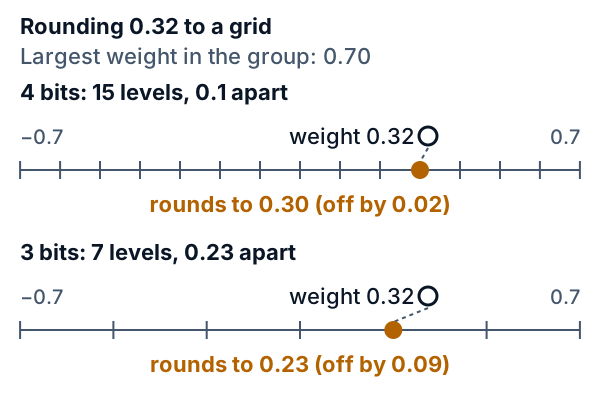
Figure 1. One weight rounded on a 4-bit and a 3-bit grid. Both reach the run’s largest weight, 0.70.
Why scales come in groups
A quantization group is a run of weights that share one scale. The scale follows the group’s largest weight, so if one weight is far larger than the rest, the steps stretch to reach it and ordinary weights round to zero.
Figure 2 uses a made-up matrix (a grid of numbers) of 262,144 weights at 4 bits. Error is the typical gap between a weight and its rounded value, as a share of a typical weight. With one scale for the whole matrix, setting one weight to 1.0, fifty times a typical weight, lifts the error from 19.5% to 99.5%. With a scale for each group of 128 weights, the damage stays in one group: 11.8% to 11.9%.
Each 16-bit scale is shared by 128 weights, which adds 0.125 bits per weight: 4 bits become 4.125.
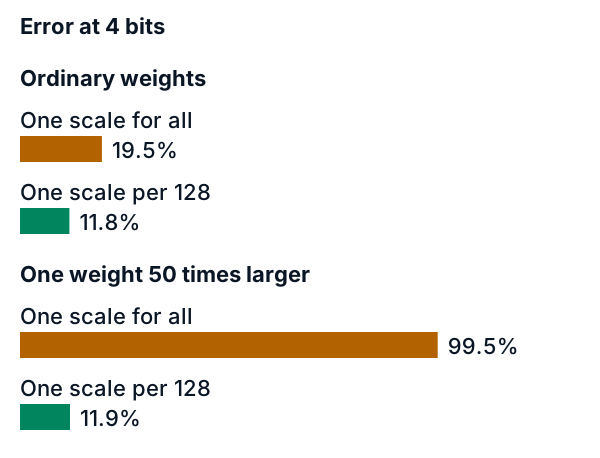
Figure 2. Error at 4 bits on a made-up matrix, without and with one weight set to 1.0.
Smaller and faster
Figure 3 counts Llama 3.1 8B at four bit widths, scales included. The token table (which turns tokens into numbers) and the output matrix (which scores the next token) stay at 16 bits, as in published files. Bits alone would give 3.74 GiB at 4 bits; the scales and the 16-bit parts add the rest.
Speed follows from Why a fast AI chip spends most of its time waiting. To write a token the card reads the weights from its memory, so memory speed (bandwidth) divided by the bytes read per token caps the tokens a second for one user. An H100 reads 3.35 terabytes (trillions of bytes) a second, so the cap is 223 tokens a second at 16 bits and 721 at 4 bits, 3.2 times more. It is a ceiling, not a forecast.
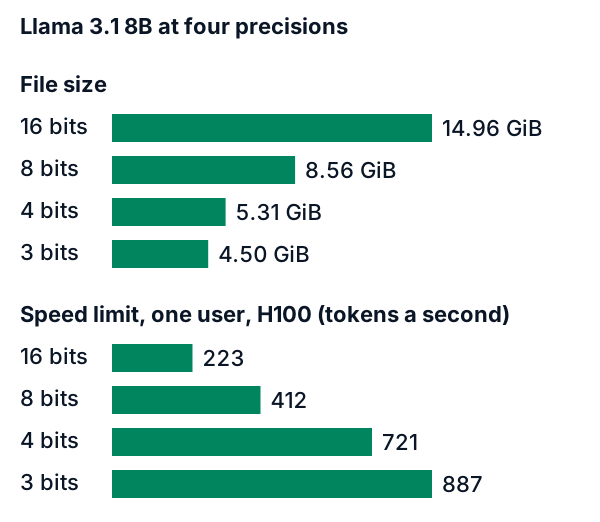
Figure 3. Llama 3.1 8B with a 16-bit scale per 128 weights, and the one-user speed limit on a socketed (SXM) H100 card (3.35 TB/s). The limit comes from bandwidth alone.
What it costs in quality
The widget’s error is a proxy: it measures how far rounded numbers sit from the originals, not whether answers change. The real test runs the finished model. Perplexity is one such test: a score of how surprised a model is by real text, where lower is better.
One study rounded three models in groups of 128 with plain rounding. Perplexity rose 2.0% to 4.8% at 4 bits and 13.1% to 21.8% at 3 bits (Figure 4). Methods that round with care do better: at 3 bits one reached 6.24 on Llama-2 7B where plain rounding gave 6.66 (16 bits: 5.47). Two published copies of Llama 3.1 8B Instruct (its chat version), both made with one such method, GPTQ, each tested against its own 16-bit run, scored an average of benchmarks (fixed test sets) 74.3 to 73.5 at 4 bits and 74.05 to 74.12 at 8.
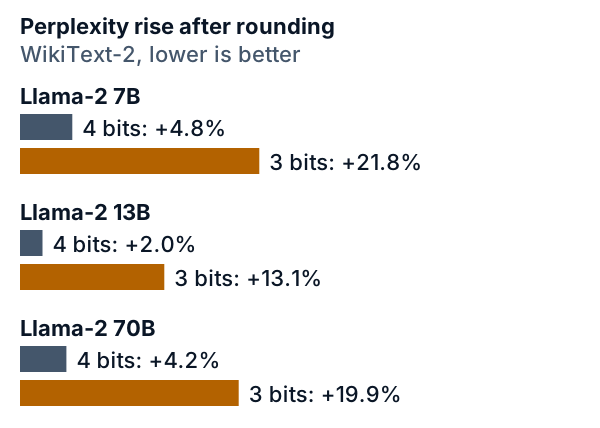
Figure 4. Rise in perplexity on WikiText-2 (a standard Wikipedia text sample) over 16 bits, round-to-nearest in groups of 128. Source: Lin et al., AWQ (2023), Table 4.
What this means when you build
- Try 8 bits first, then 4. The 8-bit GPTQ copy lost nothing visible on the average score and the 4-bit GPTQ copy lost 0.8 points. Test any copy on your own task.
- Read a score by its parts. On that 4-bit copy a maths test (GSM-8K) held at 82.9 against 82.8, while a harder test (MMLU-Pro) fell from 30.8 to 28.8. An average hides which skill dropped.
- Budget the file with scales and kept weights. At 4 bits the 8B model is 5.31 GiB, not the 3.74 GiB that half a byte per weight suggests. How much memory does an AI model need? adds the attention cache (a chat’s notes) and the rest of the bill.
- Expect a ceiling, not a speed. Going from 16 bits to 4 raises the one-user limit by at most 3.2 times on the same card. A real server also reads the attention cache and serves many users.
- Go below 4 bits with care. At 3 bits, plain rounding raised perplexity by 13% to 22%. Ask which method made a 3-bit file.
Optionalabout 22 min
Go deeper
Optional. For readers who write Python. The code is in the code/ folder; every number below was printed by python3 show_numbers.py, worked out by hand, or comes from a cited source read on 2026-10-19.
The naive approach: one scale for the whole matrix
The simplest quantizer finds the largest weight in the matrix, divides it by the largest whole number that fits in the bits, and rounds everything on that grid:
def naive(w, bits):
    scale = np.abs(w).max() / (2 ** (bits - 1) - 1)
    return np.rint(w / scale) * scale
The tables below come from the full version in quantize.py, which also stores the scale as a 16-bit float. It ran on a seeded matrix of 256 x 1,024 bell-curve weights with standard deviation 0.02 (the initializer_range of the Llama config; a stand-in, not a trained matrix). The largest weight is 0.0946, 4.7 standard deviations. Error is the root-mean-square gap between the weights and their rounded versions, divided by the root-mean-square size of the weights:
| bits | one scale | one per 128 |
|---|---|---|
| 8 | 1.1% | 0.6% |
| 4 | 19.5% | 11.8% |
| 3 | 45.5% | 27.5% |
Groups already help on ordinary weights, because each group’s largest weight is smaller than the matrix’s. The gap opens when one weight is large. Here is the same matrix at 4 bits with its top-left weight set to the value in the first column. The standard deviations are the weight divided by 0.02:
| that weight | one scale | one per 128 |
|---|---|---|
| none | 19.5% | 11.8% |
| 0.1 (5 std) | 20.6% | 11.8% |
| 0.2 (10 std) | 41.2% | 11.8% |
| 0.5 (25 std) | 88.6% | 11.9% |
| 1.0 (50 std) | 99.5% | 11.9% |
With 1.0 the one scale is 1.0 / 7 = 0.143, seven times a typical weight, so only 98 of the 262,144 weights keep a nonzero code. The 50 standard deviations are an illustration, not a measurement. At 8 bits the same weight gives 11.3% with one scale and 0.7% per group. Without any large weight, 4 bits send 26.3% of the weights to zero with one scale and 16.0% with groups; 3 bits send 56.9% and 36.2%.
The method, in formulas
qmax   = 2^(bits - 1) - 1                  (127 at 8 bits, 7 at 4, 3 at 3)
scale  = largest |w| in the group / qmax   (stored as a 16-bit float)
code   = round(w / scale), ties to even, kept inside -qmax..qmax
w_hat  = code x scale
size   = embeddings x 2 bytes + others x bits / 8 + others / 128 x 2 bytes
tokens a second <= bandwidth / bytes read for one token
This is round-to-nearest with a symmetric (absmax) scale. The most negative code, −2^(bits−1), goes unused so that the grid is symmetric around zero. Ties round to even, as numpy.rint does, because JavaScript’s Math.round rounds them up and the widget must give the same numbers as the Python. The code is also clipped to the range as a safeguard, because a 16-bit scale can round down slightly. A group of zeros gets a scale of zero and codes of zero.
A hand-worked example
One group of four weights, [0.32, -0.10, 0.04, -0.70].
- The largest size is 0.70. At 4 bits qmax is 7, so the scale is 0.70 / 7 = 0.1 (stored as a 16-bit float it is 0.0999756).
- Divide and round: 3.2 gives 3, −1.0 gives −1, 0.4 gives 0, −7.0 gives −7.
- Multiply back: 0.30, −0.10, 0 and −0.70. The gaps are 0.02, 0, 0.04 and 0.
- At 3 bits qmax is 3, so the scale is 0.70 / 3 = 0.233. The codes are 1, 0, 0 and −3, and the weights come back as 0.23, 0, 0 and −0.70. The gaps are 0.09, 0.10, 0.04 and 0.
Each cell below is the code, then the weight it comes back as.
| weight | 4 bits | 3 bits |
|---|---|---|
| 0.32 | 3, 0.30 | 1, 0.23 |
| −0.10 | −1, −0.10 | 0, 0 |
| 0.04 | 0, 0 | 0, 0 |
| −0.70 | −7, −0.70 | −3, −0.70 |
The root-mean-square gap is 0.022 at 4 bits and 0.069 at 3 bits. The weights’ own root-mean-square size is 0.389, so the errors are 5.8% and 17.8%. At 3 bits the two small weights vanish: both round to zero.
The real implementation
quantize, dequantize and two of the size and speed functions from code/quantize.py, with docstrings and input checks left out (qmax returns 2 ** (bits - 1) - 1, and _blocks reshapes a tensor into groups):
def quantize(w, bits, group=None):
    w = np.asarray(w, dtype=np.float64)
    top = qmax(bits)
    blocks = _blocks(w, group)
    scales = (np.abs(blocks).max(axis=-1, keepdims=True) / top).astype(np.float16)
    step = scales.astype(np.float64)
    step[step == 0] = 1.0
    codes = np.clip(np.rint(blocks / step), -top, top).astype(np.int32)
    return codes.reshape(w.shape), scales


def dequantize(codes, scales, group=None):
    return (_blocks(codes, group) * scales.astype(np.float64)).reshape(codes.shape)


def weight_bytes(cfg, bits, group=GROUP):
    embeddings = embedding_params(cfg)
    others = param_count(cfg) - embeddings
    total = embeddings * FULL_BITS // 8 + others * bits // 8
    if bits != FULL_BITS and group is not None:
        total += others // group * SCALE_BITS // 8
    return total


def tokens_per_second_bound(bytes_read, bandwidth):
    return bandwidth / bytes_read
For Llama 3.1 8B, 1,050,673,152 weights are embeddings (the token table and the output matrix) and 6,979,588,096 are not. The model shape comes from a saved copy of its config.json, and the weight count is the one from lesson 18. The scales add 109,056,064 bytes (109.1 MB): 1.2% of the 8-bit file, 1.9% of the 4-bit file and 2.3% of the 3-bit file.
| bits | per weight | file |
|---|---|---|
| 16 | 16 | 14.96 GiB |
| 8 | 8.125 | 8.56 GiB |
| 4 | 4.125 | 5.31 GiB |
| 3 | 3.125 | 4.50 GiB |
The bits per weight stored count only the quantized weights. Without scales the files would be 8.46, 5.21 and 4.39 GiB.
The speed ceiling divides bandwidth by the bytes read for one token. An untied model such as this one looks up a single row of its token table (4,096 weights, 8,192 bytes) instead of reading all 1,050,673,152 bytes of it, so bytes_per_token is the file minus the token table plus one row. That gives 15,009,857,536 bytes at 16 bits, 8,139,325,504 at 8, 4,649,531,456 at 4 and 3,777,082,944 at 3, so the ceilings sit above bandwidth divided by file size: by 7% at 16 bits and 28% at 3 bits. Bandwidths: 3.35 TB/s for the H100 SXM and 4.8 TB/s for the H200 (NVIDIA product pages, which mark the H200 figures as preliminary), and 2,039 GB/s for the A100 80 GB SXM (NVIDIA data sheet), all read 2026-10-19.
| bits | H100 SXM | A100 80 GB SXM |
|---|---|---|
| 16 | 223 | 136 |
| 8 | 412 | 251 |
| 4 | 721 | 439 |
| 3 | 887 | 540 |
On an H200 the ceilings are 320, 590, 1,032 and 1,271 tokens a second. A simpler rule, that every token reads the whole file, gives 209, 365, 588 and 694 on an H100, because it counts the token table in every token. None of these counts the attention cache or anything else the chip reads, so all are ceilings.
Checked against published files
The sizes are checked against the .safetensors files of published copies of Llama 3.1 8B (sizes from the Hugging Face API, read 2026-10-19; both columns are in bytes and the gap is the file minus the formula). The 16-bit file is the base model and the others the Instruct version, which has the same shape. The 4-bit AWQ and GPTQ files appear to hold a 4-bit zero point beside each scale (half a byte a group), so the formula adds it for them.
| copy | file | gap |
|---|---|---|
| 16-bit | 16,060,556,376 | 33,880 |
| 8-bit | 9,084,040,952 | 354,040 |
| AWQ | 5,727,938,576 | 478,144 |
| GPTQ | 5,735,719,888 | 3,278,720 |
For the 8-bit copy the formula uses one 16-bit scale for each output row (1,376,256 scales, 2,752,512 bytes) instead of one for each group, because its card says so. For the AWQ copy it adds those zero points, 27,264,016 bytes. The gap is 0.0083% of the AWQ file and 0.057% of the GPTQ file. For the GPTQ copy the formula also adds a 4-byte column index (called g_idx) for each of 1,245,184 columns, 4,980,736 bytes; the remaining 3,278,720 bytes are not accounted for.
What the accuracy studies measured
The three-model results in Figure 4 come from Table 4 of the AWQ paper (Lin et al., arXiv 2306.00978, version 6), measured as WikiText-2 perplexity; lower is better. Plain rounding in groups of 128 is the paper’s “RTN” rows. Figure 4 shows the rise over 16 bits.
| Llama-2 | 16 bits | 4 bits | 3 bits |
|---|---|---|---|
| 7B | 5.47 | 5.73 | 6.66 |
| 13B | 4.88 | 4.98 | 5.52 |
| 70B | 3.32 | 3.46 | 3.98 |
For Llama-2 7B the same table gives GPTQ 5.69 and AWQ 5.60 at 4 bits, and 6.43 and 6.24 at 3 bits, against 5.73 and 6.66 for plain rounding. The paper’s plain-rounding baseline may use a different scale rule from this lesson’s symmetric code (for example, one that also shifts by a zero point), so treat the match as close, not exact.
Which weights get extra care matters. In the paper’s Table 1, for OPT-6.7B at 3 bits in groups of 128, plain rounding scores 23.54 against 10.86 at 16 bits. Keeping 1% of the channels at 16 bits brings it to 11.39 when the channels are chosen by the size of the numbers flowing through them, and only to 22.37 when chosen by the size of their weights and 24.23 when chosen at random. A related finding, in the LLM.int8() paper (Dettmers et al., arXiv 2208.07339), is about activations rather than weights: from about 6.7 billion parameters, models carry about 0.1% of feature dimensions up to 20 times larger than the rest, and setting them to zero raises perplexity by 600% to 1,000%. On Llama-2 7B GSM8K in the AWQ paper’s Table 8, 4-bit plain rounding scores 11.07 against 13.87 at 16 bits, GPTQ 12.13 and AWQ 13.57.
For the Llama 3.1 8B Instruct copies, each model card reports its own 16-bit run, so compare only within a card. The average is the Open LLM Leaderboard version 1 average:
| benchmark | 16 bits | 4 bits |
|---|---|---|
| average (v1) | 74.3 | 73.5 |
| MMLU, 5-shot | 68.3 | 66.9 |
| GSM-8K | 82.8 | 82.9 |
| TruthfulQA | 54.5 | 52.8 |
| MMLU-Pro | 30.8 | 28.8 |
| IFEval | 77.9 | 76.3 |
Both copies were made with GPTQ. The 4-bit copy uses groups of 128 and rounds only the linear layers inside the transformer blocks. The 8-bit copy uses one scale for each output row. Its card gives 74.05 and 74.12 for the average, 80.47 and 80.48 for Hellaswag, 78.06 and 77.51 for Winogrande and 54.48 and 54.41 for TruthfulQA, as 16-bit and 8-bit.
Proof it works
PYTHONDONTWRITEBYTECODE=1 python3 -B -m pytest -q -p no:cacheprovider code/The tests check these claims. The hand-worked group above comes out as the table says, at 4 and at 3 bits. Ties round to even. Codes stay inside their range and the largest weight survives, at 8, 4 and 3 bits, with one scale and with groups. A group of zeros does not divide by zero, even with floating-point errors set to raise, and a group size that does not divide the row is refused. Error rises as bits fall, and groups beat one scale. One weight of 1.0 pushes the shared-scale error above 90% and moves the per-group error by less than half a point, and the four errors the lesson quotes (19.5%, 11.8%, 99.5% and 11.9%) are pinned to the seed. Stored bits per weight come to 4.125, 8.125 and 3.125. The sizes agree with lesson 18’s weight count, with the AWQ file to within 0.01% and with the 8-bit file between the formulas with no scales and with one scale a group. A token reads one row of the token table, and the speed ceilings come out at 223, 412, 721 and 887.
The widget is a separate copy of the arithmetic in JavaScript, so its tests keep it honest. Its data block must equal what embed_widget.py writes from the Python constants; every element its script looks up must exist; it must stay under 40 KiB and make no network call. A parity test runs the widget’s number code under Node and compares it with Python for 567 quantizer cases (63 weight vectors, 3 bit widths, 3 group settings), for 16-bit rounding of 406 values, for ties to even, and for the sizes and speeds on each card. A render test runs the page script under Node and reads the three readouts: 5.31 GiB, 721 tokens a second and 4.7% on opening, 19.1% with the big weight, and 34.7% after choosing “One for all”, with size and speed unchanged.
What the tests do not show: that a trained matrix behaves like a bell curve, or that a real server reaches the ceiling. To check the second, time one user’s decoding and compare it with the ceiling.
Where it is used
- Published 4-bit copies. The AWQ and GPTQ copies of Llama 3.1 8B Instruct from hugging-quants are the files checked above, and the 4-bit copy from Red Hat’s model hub uses groups of 128, as its card states.
- Published 8-bit copies. The Red Hat 8-bit copy keeps the output matrix at 16 bits (its config ignores only
lm_head) and uses a scale for each output row. - A real example from this site. The dynamic GGUF copy of Qwen3.8-27B-OBLITERATED gives each group of matrices its own number of bits, more where measurement shows rounding hurts most. At the same 16.81 GB as the upstream 4-bit Q4_K_M file, its next-word probabilities drift less from the 16-bit model’s: mean KL divergence 0.0195 against 0.0348. The Research page has the full table.
- The papers. GPTQ (Frantar et al., arXiv 2210.17323) reports that plain rounding collapses at 3 bits where its method stays usable. AWQ (above) picks the channels to protect from the activations. LLM.int8() (above) splits the large dimensions out and keeps them at 16 bits.
Skills this lesson builds
- Round weights onto a signed grid with a scale for each group, and write the rounding and the dequantizing in numpy.
- Count the stored bits for each weight including scales and predict a quantized file’s size, then check the prediction against a published file.
- Measure rounding error on a seeded matrix, show how one large weight changes it, and say why that error is a proxy rather than model accuracy.
- Bound the decoding speed of a model from the bytes read for each token and a card’s memory bandwidth.
- Read a published quality claim: which baseline, which benchmark, which rounding method and which weights were rounded.
Portfolio project: round a small open model to 8, 4 and 3 bits with plain round-to-nearest in groups, using your own code. Measure the file size, the perplexity on a text file the model has not seen, and the decoding speed on hardware you own. Publish a table that sets each speed against the bandwidth ceiling and each perplexity against the 16-bit original, and say which weights you left at 16 bits.
Check yourself
- What does quantization trade away, and what does it buy?
Answer
It gives up exactness: each weight is rounded, so answers can shift a little, and more at 3 bits. It buys a smaller file (Llama 3.1 8B goes from 14.96 GiB to 5.31 GiB at 4 bits) and a higher speed limit, because fewer bytes are read for each token (223 to 721 tokens a second on an H100).
- Why does one very large weight hurt a matrix with one shared scale but hardly touch one with a scale for every 128 weights?
Answer
The scale follows the largest weight in its group. One huge weight stretches a shared scale, so the steps become wider than most weights and they round to zero (in the made-up matrix the error rose from 19.5% to 99.5%). With groups of 128, only the group holding that weight is stretched, and the error stayed at 11.8% to 11.9%.
- Round the group
[0.50, -0.20, 0.07, -0.90]to 3 bits with one scale for all four weights. What do the weights become?
Answer
The largest size is 0.90 and qmax at 3 bits is 3, so the scale is 0.30. Divide and round: 0.50 / 0.30 = 1.67 gives 2, −0.20 / 0.30 = −0.67 gives −1, 0.07 / 0.30 = 0.23 gives 0, and −0.90 / 0.30 = −3 gives −3. Multiply back: 0.60, −0.30, 0 and −0.90. The gaps are 0.10, 0.10, 0.07 and 0.
- A model has 7,000,000,000 weights, all stored in 4 bits with a 16-bit scale for each group of 128. How large is the file? On a card that reads 2,039 GB a second, what is the most tokens a second one user can get if each token reads the whole file?
Answer
Each weight takes 4 + 16 / 128 = 4.125 bits, so the file is 7,000,000,000 x 4.125 / 8 = 3,609,375,000 bytes, which is 3.61 GB. The ceiling is 2,039 / 3.609 = about 565 tokens a second. It is a ceiling because the chip also reads other things and may not reach its full bandwidth.
- A teammate says: “The 4-bit matrix has 11.8% error, so the model will be 11.8% less accurate.” What is wrong with that?
Answer
The error measures how far rounded numbers are from the originals in a made-up matrix. It is a proxy, not accuracy. Accuracy depends on which weights matter and has to be measured on the finished model. For real models, the published 4-bit perplexity rose by 2.0% to 4.8% with plain rounding in groups of 128, and the average benchmark score of a 4-bit GPTQ copy of Llama 3.1 8B Instruct fell by 0.8 points.
Further reading
Gentle
- Llama 3.1 8B Instruct, 4-bit copy and 8-bit copy (Red Hat; model cards with benchmark tables, read 2026-10-19)
- Memory bandwidth of the cards: H100 and H200 (NVIDIA product pages) and the A100 data sheet (NVIDIA)
Deep
- AWQ: Activation-aware Weight Quantization for LLM Compression and Acceleration (Lin et al., version 6; Tables 1, 4 and 8)
- GPTQ: Accurate Post-Training Quantization for Generative Pre-trained Transformers (Frantar et al.)
- LLM.int8(): 8-bit Matrix Multiplication for Transformers at Scale (Dettmers et al.)
- Published file sizes the formula is checked against: 16 bits, 4-bit AWQ and 4-bit GPTQ (Hugging Face model pages, read 2026-10-19)
Optional
Code
Each file runs on its own. Download it, or read it here.
Show code
"""Keep the numbers and model shape inside ../widget.html equal to quantize.py.

    python3 embed_widget.py          rewrite the data block in widget.html
    python3 embed_widget.py --check  exit 1 if widget.html differs (test_widget.py runs the same check)
"""
import json
import re
import sys
from pathlib import Path

import quantize as qz

WIDGET = Path(__file__).resolve().parent.parent / "widget.html"
DATA_BLOCK = re.compile(r'(<script type="application/json" id="qnt-data">)(.*?)(</script>)', re.S)


def widget_data() -> dict:
    cfg = qz.load_config()
    return {"model": {"name": "Llama 3.1 8B", "layers": cfg["num_hidden_layers"], "hidden": cfg["hidden_size"],
                      "ffn": cfg["intermediate_size"], "heads": cfg["num_attention_heads"], "kv_heads": cfg["num_key_value_heads"],
                      "head_dim": cfg.get("head_dim"), "vocab": cfg["vocab_size"], "tied": bool(cfg.get("tie_word_embeddings"))},
            "bits": list(qz.BITS), "full_bits": qz.FULL_BITS, "scale_bits": qz.SCALE_BITS, "group": qz.GROUP,
            "sample": {"weights": qz.sample_weights(), "outlier_slot": qz.SAMPLE_OUTLIER_SLOT, "outlier": qz.SAMPLE_OUTLIER,
                       "group": qz.SAMPLE_GROUP},
            "gpus": [[name, int(bw)] for name, bw in qz.BANDWIDTHS.items()]}


def embed(html: str) -> str:
    """html with the data block rewritten from quantize.py."""
    block = json.dumps(widget_data(), indent=1)
    return DATA_BLOCK.sub(lambda m: m.group(1) + "\n" + block + "\n" + m.group(3), html, count=1)


if __name__ == "__main__":
    current = WIDGET.read_text(encoding="utf-8")
    updated = embed(current)
    if "--check" in sys.argv:
        sys.exit(0 if updated == current else 1)
    WIDGET.write_text(updated, encoding="utf-8")
print("widget.html data block now matches quantize.py")Show code
{
  "architectures": [
    "LlamaForCausalLM"
  ],
  "attention_bias": false,
  "attention_dropout": 0.0,
  "bos_token_id": 128000,
  "eos_token_id": 128001,
  "hidden_act": "silu",
  "hidden_size": 4096,
  "initializer_range": 0.02,
  "intermediate_size": 14336,
  "max_position_embeddings": 131072,
  "mlp_bias": false,
  "model_type": "llama",
  "num_attention_heads": 32,
  "num_hidden_layers": 32,
  "num_key_value_heads": 8,
  "pretraining_tp": 1,
  "rms_norm_eps": 1e-05,
  "rope_scaling": {
    "factor": 8.0,
    "low_freq_factor": 1.0,
    "high_freq_factor": 4.0,
    "original_max_position_embeddings": 8192,
    "rope_type": "llama3"
  },
  "rope_theta": 500000.0,
  "tie_word_embeddings": false,
  "torch_dtype": "bfloat16",
  "transformers_version": "4.43.0.dev0",
  "use_cache": true,
  "vocab_size": 128256
}Show code
"""Round weights to fewer bits and measure what that costs in error, size and decoding speed.

numpy only. The method is round-to-nearest with a symmetric (absmax) scale: each group of weights
shares one 16-bit scale, and every weight becomes a small signed whole number times that scale.
The model shape comes from llama31_8b_config.json, a copy of the config.json of Llama 3.1 8B on
Hugging Face (read 2026-10-19). Sizes are in bytes unless a name says GiB; bandwidths are in
bytes per second (GB and TB mean 10^9 and 10^12 bytes).
"""
import json
from pathlib import Path

import numpy as np

HERE = Path(__file__).parent
GIB = 1024**3

BITS = (16, 8, 4, 3)      # bits stored per weight the lesson compares; 16 is the unquantized reference
FULL_BITS = 16            # the token table and output matrix stay at 16 bits in published 8-bit and 4-bit files
SCALE_BITS = 16           # each scale is stored as a 16-bit float
GROUP = 128               # weights that share one scale in the usual 4-bit files

# Graphics-card memory bandwidth, bytes per second. Sources (read 2026-10-19):
#   H100 SXM  3.35 TB/s  NVIDIA H100 page, specification table
#   H200      4.8 TB/s   NVIDIA H200 page
#   A100 80 GB SXM  2,039 GB/s  NVIDIA A100 data sheet (June 2021 revision), same figure as lesson 19
BANDWIDTHS = {"H100 SXM": 3.35e12, "H200": 4.8e12, "A100 80 GB SXM": 2.039e12}

# Sixteen example weights for the widget: seed, size, and where the optional outlier goes.
SAMPLE_SEED = 18
SAMPLE_GROUP = 4          # the picture shows groups of 4; real files use 128
SAMPLE_OUTLIER_SLOT = 5
SAMPLE_OUTLIER = 1.0


def load_config() -> dict:
    return json.loads((HERE / "llama31_8b_config.json").read_text())


# ---------- the quantizer

def qmax(bits: int) -> int:
    """Largest whole number a signed `bits`-bit code uses: 127 at 8 bits, 7 at 4, 3 at 3.
    The most negative code, -2**(bits-1), goes unused so that the range is symmetric around zero."""
    if not 2 <= bits <= 8:
        raise ValueError("bits must be between 2 and 8")
    return 2 ** (bits - 1) - 1


def _blocks(a: np.ndarray, group: int | None) -> np.ndarray:
    """View `a` as (..., groups, weights per group). group=None makes the whole tensor one group."""
    if group is None:
        return a.reshape(1, -1)
    width = a.shape[-1]
    if width % group:
        raise ValueError(f"group {group} does not divide the row length {width}")
    return a.reshape(*a.shape[:-1], width // group, group)


def quantize(w, bits: int, group: int | None = None) -> tuple[np.ndarray, np.ndarray]:
    """Return whole-number codes (same shape as `w`) and one 16-bit scale per group.

    scale = largest |weight| in the group / qmax, stored as float16. code = round(weight / scale), ties to even,
    kept inside [-qmax, qmax] (the 16-bit scale can round down, which would push the largest weight past qmax).
    group=None uses one scale for the whole tensor; otherwise a group is `group` neighbours along the last axis."""
    w = np.asarray(w, dtype=np.float64)
    top = qmax(bits)
    blocks = _blocks(w, group)
    scales = (np.abs(blocks).max(axis=-1, keepdims=True) / top).astype(np.float16)
    step = scales.astype(np.float64)
    step[step == 0] = 1.0   # a group of zeros has codes of 0 whatever the step is
    codes = np.clip(np.rint(blocks / step), -top, top).astype(np.int32)
    return codes.reshape(w.shape), scales


def dequantize(codes: np.ndarray, scales: np.ndarray, group: int | None = None) -> np.ndarray:
    """The weights the model computes with: code times its group's scale."""
    out = _blocks(codes, group) * scales.astype(np.float64)
    return out.reshape(codes.shape)


def roundtrip(w, bits: int, group: int | None = None) -> np.ndarray:
    codes, scales = quantize(w, bits, group)
    return dequantize(codes, scales, group)


def rms(a) -> float:
    return float(np.sqrt(np.mean(np.asarray(a, dtype=np.float64) ** 2)))


def relative_rms_error(w, w_hat, typical: float | None = None) -> float:
    """Root-mean-square gap between the weights and their rounded versions, as a share of a typical weight's size
    (by default the weights' own root-mean-square size)."""
    w = np.asarray(w, dtype=np.float64)
    return rms(w - w_hat) / (rms(w) if typical is None else typical)


def error(w, bits: int, group: int | None = None) -> float:
    return 0.0 if bits == FULL_BITS else relative_rms_error(w, roundtrip(w, bits, group))


def bits_per_weight(bits: int, group: int | None = GROUP) -> float:
    """Stored bits per weight including the scales: 4 bits and a 16-bit scale per 128 weights is 4.125."""
    if bits == FULL_BITS or group is None:
        return float(bits)   # one scale per whole tensor is a few bytes in all
    return bits + SCALE_BITS / group


# ---------- the data

def synthetic_weights(rows: int = 256, cols: int = 1024, seed: int = 0, outlier: float = 0.0) -> np.ndarray:
    """Bell-curve weights with standard deviation 0.02 (the initializer_range of the Llama config; a stand-in,
    not a trained matrix). outlier > 0 sets the top-left weight to that value."""
    w = np.random.default_rng(seed).normal(0.0, 0.02, size=(rows, cols))
    if outlier:
        w[0, 0] = outlier
    return w


def sample_weights() -> list[float]:
    """Sixteen weights of the widget, three decimals, none larger than 0.3 in size."""
    w = np.random.default_rng(SAMPLE_SEED).normal(0.0, 0.1, size=16)
    return [float(x) for x in np.round(np.clip(w, -0.3, 0.3), 3)]


def sample_with_outlier() -> list[float]:
    w = sample_weights()
    w[SAMPLE_OUTLIER_SLOT] = SAMPLE_OUTLIER
    return w


def sample_error(bits: int, group: int | None, outlier: bool) -> float:
    """The widget's error figure. With the outlier in, one weight of 1.0 would dominate the root-mean-square of
    sixteen, so the gap is always compared with the size of the ordinary sample weights."""
    w = sample_with_outlier() if outlier else sample_weights()
    if bits == FULL_BITS:
        return 0.0
    return relative_rms_error(w, roundtrip(w, bits, group), typical=rms(sample_weights()))


# ---------- the model

def head_dim(cfg: dict) -> int:
    return cfg.get("head_dim") or cfg["hidden_size"] // cfg["num_attention_heads"]


def param_count(cfg: dict) -> int:
    """Weights of a Llama-style model from its shape (as in lesson 18): attention, feed-forward and two norms per layer,
    the token table, an output matrix the size of the table unless tied, and the final norm."""
    h, ffn = cfg["hidden_size"], cfg["intermediate_size"]
    kv_width = cfg["num_key_value_heads"] * head_dim(cfg)
    per_layer = 2 * h * h + 2 * h * kv_width + 3 * h * ffn + 2 * h
    return cfg["num_hidden_layers"] * per_layer + embedding_params(cfg) + h


def table_params(cfg: dict) -> int:
    return cfg["vocab_size"] * cfg["hidden_size"]


def embedding_params(cfg: dict) -> int:
    """The token table, plus an output matrix of the same size unless the model reuses the table ("tied")."""
    return table_params(cfg) * (1 if cfg.get("tie_word_embeddings") else 2)


def weight_bytes(cfg: dict, bits: int, group: int | None = GROUP) -> int:
    """Embeddings stay at 16 bits; every other weight uses `bits`, plus one 16-bit scale per `group` of them.
    16 bits means no quantization, so no scales. group=None adds none (a scale per matrix is a few hundred bytes)."""
    if bits not in BITS:
        raise ValueError(f"bits must be one of {BITS}")
    embeddings = embedding_params(cfg)
    others = param_count(cfg) - embeddings
    total = embeddings * FULL_BITS // 8 + others * bits // 8
    if bits != FULL_BITS and group is not None:
        if others % group:
            raise ValueError(f"group {group} does not divide {others}")
        total += others // group * SCALE_BITS // 8
    return total


def bytes_per_token(cfg: dict, bits: int, group: int | None = GROUP) -> int:
    """Bytes read from memory to produce one token for one user.
    Every weight is read once, except that an untied model looks up one row of its token table (hidden x 2 bytes)
    instead of reading the whole table. The attention cache and working memory are not counted."""
    total = weight_bytes(cfg, bits, group)
    if cfg.get("tie_word_embeddings"):
        return total
    return total - table_params(cfg) * FULL_BITS // 8 + cfg["hidden_size"] * FULL_BITS // 8


def tokens_per_second_bound(bytes_read: int, bandwidth: float) -> float:
    """Ceiling for one user: the card cannot read the weights faster than its memory bandwidth."""
return bandwidth / bytes_readShow code
"""Print every number the lesson quotes. Run: python3 show_numbers.py"""
import numpy as np

import quantize as qz

CFG = qz.load_config()
OTHERS = qz.param_count(CFG) - qz.embedding_params(CFG)

# Sizes of the .safetensors files of published copies of Llama 3.1 8B Instruct (Hugging Face API, blobs=true, read 2026-10-19).
FILES = (
    ("16-bit", "NousResearch/Meta-Llama-3.1-8B", 16_060_556_376),
    ("8-bit, one scale per output row (w8a16)", "RedHatAI/Meta-Llama-3.1-8B-Instruct-quantized.w8a16", 9_084_040_952),
    ("4-bit AWQ, group 128", "hugging-quants/Meta-Llama-3.1-8B-Instruct-AWQ-INT4", 5_727_938_576),
    ("4-bit GPTQ, group 128", "hugging-quants/Meta-Llama-3.1-8B-Instruct-GPTQ-INT4", 5_735_719_888),
    ("4-bit GPTQ, group 128 (w4a16)", "RedHatAI/Meta-Llama-3.1-8B-Instruct-quantized.w4a16", 5_735_720_552),
)

# Perplexity on WikiText-2, lower is better (AWQ paper, arXiv 2306.00978v6, Table 4; the RTN rows are round-to-nearest, group 128).
PERPLEXITY = (
    ("Llama-2 7B", 5.47, 5.73, 6.66),
    ("Llama-2 13B", 4.88, 4.98, 5.52),
    ("Llama-2 70B", 3.32, 3.46, 3.98),
)

# Model-card results, Llama 3.1 8B Instruct, 16-bit baseline against 4-bit GPTQ (w4a16, group 128): each card reports its own baseline run.
CARD_W4 = (("OpenLLM v1 average", 74.3, 73.5), ("MMLU 5-shot", 68.3, 66.9), ("GSM-8K", 82.8, 82.9),
           ("TruthfulQA", 54.5, 52.8), ("MMLU-Pro", 30.8, 28.8), ("IFEval", 77.9, 76.3))
CARD_W8 = (("OpenLLM v1 average", 74.05, 74.12), ("Hellaswag", 80.47, 80.48), ("Winogrande", 78.06, 77.51), ("TruthfulQA", 54.48, 54.41))


def gib(n):
    return f"{n / qz.GIB:.2f}"


def main():
    print("== hand-worked examples")
    for bits, w in ((4, [0.32, -0.10, 0.04, -0.70]), (3, [0.32, -0.10, 0.04, -0.70])):
        codes, scales = qz.quantize(w, bits, group=4)
        back = qz.dequantize(codes, scales, 4)
        print(f"{bits} bits: weights {w} scale {float(scales[0, 0]):.7f} codes {codes.tolist()} back {back.round(3).tolist()} "
              f"gaps {(np.array(w) - back).round(3).tolist()}")

    print("== synthetic matrix 256 x 1024, bell curve with std 0.02, seed 0: relative root-mean-square error (%)")
    clean = qz.synthetic_weights()
    print(f"weights {clean.size:,}; groups of 128 per row: {clean.size // 128:,}; largest |weight| {abs(clean).max():.4f} "
          f"= {abs(clean).max() / 0.02:.1f} std")
    for label, w in (("no outlier", clean), ("one weight of 1.0", qz.synthetic_weights(outlier=1.0))):
        for bits in (8, 4, 3):
            tensor, group = qz.error(w, bits), qz.error(w, bits, qz.GROUP)
            zero = np.mean(qz.roundtrip(w, bits) == 0)
            print(f"{label}, {bits} bits: one scale {tensor:.1%} (weights rounded to zero {zero:.1%}); "
                  f"one per 128 {group:.1%} (zero {np.mean(qz.roundtrip(w, bits, qz.GROUP) == 0):.1%})")

    print("== outlier size sweep, 4 bits (std 0.02)")
    for size in (0.0, 0.1, 0.2, 0.5, 1.0):
        w = qz.synthetic_weights(outlier=size)
        print(f"outlier {size:.1f} ({size / 0.02:.0f} std): one scale {qz.error(w, 4):.1%}, one per 128 {qz.error(w, 4, qz.GROUP):.1%}")

    print("== bits per weight including scales (group 128)")
    print("  ".join(f"{b}-bit {qz.bits_per_weight(b):.3f}" for b in qz.BITS))

    print("== Llama 3.1 8B")
    n, e = qz.param_count(CFG), qz.embedding_params(CFG)
    print(f"weights {n:,}; embeddings (table + output) {e:,} = {e * 2:,} B = {gib(e * 2)} GiB kept at 16 bits; others {OTHERS:,}")
    base = qz.weight_bytes(CFG, 16)
    for b in qz.BITS:
        none, grp = qz.weight_bytes(CFG, b, None), qz.weight_bytes(CFG, b)
        print(f"{b:>2} bits: no scales {none:,} B = {gib(none)} GiB; with group-128 scales {grp:,} B = {gib(grp)} GiB "
              f"({base / grp:.2f}x smaller); scales alone {grp - none:,} B = {(grp - none) / 1e6:.1f} MB = {(grp - none) / grp:.1%} of the file")

    print("== decoding ceiling for one user: tokens per second = bandwidth / bytes read per token")
    print(f"token table {qz.table_params(CFG) * 2:,} B; one row {CFG['hidden_size'] * 2:,} B")
    for b in qz.BITS:
        read = qz.bytes_per_token(CFG, b)
        row = "  ".join(f"{name} {qz.tokens_per_second_bound(read, bw):,.0f}" for name, bw in qz.BANDWIDTHS.items())
        print(f"{b:>2} bits: reads {read:,} B ({read / 1e9:.2f} GB) per token; {row}")
    h100 = qz.BANDWIDTHS["H100 SXM"]
    ref = qz.tokens_per_second_bound(qz.bytes_per_token(CFG, 16), h100)
    print("gain over 16 bits on H100 SXM: " + "  ".join(
        f"{b}-bit {qz.tokens_per_second_bound(qz.bytes_per_token(CFG, b), h100) / ref:.2f}x" for b in qz.BITS))
    whole = [qz.weight_bytes(CFG, b) for b in qz.BITS]
    print("if the whole file were read (the simpler whole-file rule): "
          + "  ".join(f"{b}-bit {h100 / w:,.0f}" for b, w in zip(qz.BITS, whole)))

    print("== size formula against published files (bytes)")
    zero_points = OTHERS // qz.GROUP // 2
    for label, repo, size in FILES:
        print(f"{label}: file {size:,} ({repo})")
    f16, w8, awq, gptq, w4 = (f[2] for f in FILES)
    print(f"16-bit: calculator {qz.weight_bytes(CFG, 16):,}; gap {f16 - qz.weight_bytes(CFG, 16):,}")
    h, kv, ffn = CFG["hidden_size"], CFG["num_key_value_heads"] * qz.head_dim(CFG), CFG["intermediate_size"]
    rows = CFG["num_hidden_layers"] * (2 * h + 2 * kv + 2 * ffn + h)   # output rows of q, o, k, v, gate, up, down
    print(f"w8a16: no scales {qz.weight_bytes(CFG, 8, None):,}; group-128 scales {qz.weight_bytes(CFG, 8):,}; file {w8:,}; "
          f"above no-scales {w8 - qz.weight_bytes(CFG, 8, None):,}; one 16-bit scale per output row: {rows:,} scales = {rows * 2:,} B")
    print(f"AWQ: formula + zero points {qz.weight_bytes(CFG, 4) + zero_points:,}; file {awq:,}; gap {awq - qz.weight_bytes(CFG, 4) - zero_points:,} "
          f"({(awq - qz.weight_bytes(CFG, 4) - zero_points) / awq:.4%})")
    columns = CFG["num_hidden_layers"] * (6 * CFG["hidden_size"] + CFG["intermediate_size"])
    rest = gptq - qz.weight_bytes(CFG, 4) - zero_points - columns * 4
    print(f"GPTQ: file above group-128 formula {gptq - qz.weight_bytes(CFG, 4):,}; zero points {zero_points:,}; "
          f"column index 4 B x {columns:,} = {columns * 4:,}; unitemised remainder {rest:,} ({rest / gptq:.3%} of the file)")
    print(f"Red Hat w4a16 vs hugging-quants GPTQ: {w4 - gptq:+,} B")

    print("== perplexity on WikiText-2 (AWQ paper), 16-bit | 4-bit RTN g128 | 3-bit RTN g128; rise over 16-bit")
    for name, f, i4, i3 in PERPLEXITY:
        print(f"{name}: {f:.2f} | {i4:.2f} (+{i4 - f:.2f}, +{(i4 - f) / f:.1%}) | {i3:.2f} (+{i3 - f:.2f}, +{(i3 - f) / f:.1%})")
    print("OPT-6.7B 3-bit g128 (Table 1): 16-bit 10.86, RTN 23.54, keep 1% of channels in 16 bits chosen by activations 11.39, by weight size 22.37, at random 24.23")
    print("Llama-2 7B GSM8K, 4-bit g128 (Table 8): 16-bit 13.87, RTN 11.07, GPTQ 12.13, AWQ 13.57")

    print("== model cards (Llama 3.1 8B Instruct; each card has its own 16-bit run)")
    for title, rows in (("4-bit GPTQ, group 128", CARD_W4), ("8-bit, one scale per output row", CARD_W8)):
        print(title)
        for name, a, b in rows:
            print(f"  {name}: {a} -> {b} ({b - a:+.2f} points, recovery {b / a:.1%})")

    print("== widget sample: 16 weights, groups of 4; error as a share of a typical weight (%)")
    print("weights", qz.sample_weights(), "typical", f"{qz.rms(qz.sample_weights()):.4f}")
    for outlier in (False, True):
        for group, label in ((None, "one scale"), (qz.SAMPLE_GROUP, "one per 4")):
            print(f"outlier {outlier}, {label}: " + "  ".join(f"{b} bits {qz.sample_error(b, group, outlier):.1%}" for b in (8, 4, 3)))


if __name__ == "__main__":
main()Show code
"""Tests for quantize.py: the hand-worked examples of the lesson, the claims it makes, and the sizes it quotes."""
import numpy as np
import pytest

import quantize as qz

CFG = qz.load_config()


def test_hand_worked_four_bit_example():
    """Guards the scale or rounding rule drifting from the table in the lesson: absmax 0.70 / 7 = 0.1, then round."""
    w = [0.32, -0.10, 0.04, -0.70]
    codes, scales = qz.quantize(w, 4, group=4)
    assert codes.tolist() == [3, -1, 0, -7]
    assert float(scales[0, 0]) == pytest.approx(0.1, rel=1e-3)   # stored as a 16-bit float, so 0.0999756
    assert qz.dequantize(codes, scales, group=4).round(2).tolist() == [0.3, -0.1, 0.0, -0.7]


def test_hand_worked_three_bit_example():
    """Guards the 3-bit row of the lesson: only seven codes (-3 to 3), so small weights fall to zero."""
    codes, _ = qz.quantize([0.32, -0.10, 0.04, -0.70], 3, group=4)
    assert codes.tolist() == [1, 0, 0, -3]


def test_ties_round_to_even():
    """Guards round-half-up creeping in (Python's round and numpy's rint agree; JavaScript's Math.round does not)."""
    codes, scales = qz.quantize([3.0, 2.5, 0.5, -0.5, -1.5, -2.5], 3)
    assert float(scales[0, 0]) == 1.0
    assert codes.tolist() == [3, 2, 0, 0, -2, -2]


@pytest.mark.parametrize("bits", [8, 4, 3])
@pytest.mark.parametrize("group", [None, 128])
def test_codes_stay_in_range_and_the_largest_weight_survives(bits, group):
    """Guards a scale cut by qmax = 2**bits (too wide) or a 16-bit scale that rounds down and overflows the range."""
    w = qz.synthetic_weights(8, 256, seed=3, outlier=0.5)
    codes, scales = qz.quantize(w, bits, group)
    assert np.abs(codes).max() == qz.qmax(bits)
    back = qz.dequantize(codes, scales, group)
    assert abs(back).max() == pytest.approx(0.5, rel=2e-3)


def test_a_group_of_zeros_does_not_divide_by_zero():
    """Guards the zero-step guard: 0 / 0 is NaN, which numpy casts to 0 on arm64 but to INT_MIN on x86, so only a raised error shows it."""
    w = np.zeros((2, 8))
    w[1, :4] = [0.1, -0.2, 0.3, 0.05]
    with np.errstate(invalid="raise", divide="raise"):
        codes, scales = qz.quantize(w, 4, group=4)
        back = qz.dequantize(codes, scales, 4)
    assert not np.isnan(back).any()
    assert codes[0].tolist() == [0] * 8


def test_group_must_divide_the_row():
    with pytest.raises(ValueError):
        qz.quantize(np.ones((2, 10)), 4, group=4)


def test_error_grows_as_bits_fall_and_groups_help():
    w = qz.synthetic_weights()
    per_tensor = [qz.error(w, b) for b in (8, 4, 3)]
    per_group = [qz.error(w, b, qz.GROUP) for b in (8, 4, 3)]
    assert per_tensor == sorted(per_tensor) and per_group == sorted(per_group)
    assert all(g < t for g, t in zip(per_group, per_tensor))
    assert qz.error(w, 16) == 0.0


def test_one_outlier_ruins_a_shared_scale_but_not_groups():
    """Guards the lesson's central picture: 1 weight in 262,144 stretches the shared scale until most weights round to zero.
    Also pins the four errors the lesson quotes (19.5, 11.8, 99.5, 11.9), which move if the seed of the made-up matrix changes."""
    clean, spiked = qz.synthetic_weights(), qz.synthetic_weights(outlier=1.0)
    assert [round(100 * qz.error(w, 4, g), 1) for w in (clean, spiked) for g in (None, qz.GROUP)] == [19.5, 11.8, 99.5, 11.9]
    assert qz.error(spiked, 4) > 0.9
    assert qz.error(spiked, 4, qz.GROUP) - qz.error(clean, 4, qz.GROUP) < 0.005
    assert np.count_nonzero(qz.roundtrip(spiked, 4)) < 0.01 * spiked.size


def test_widget_sample_opens_on_the_numbers_the_lesson_quotes():
    """Guards the sample weights or outlier slot drifting from the lesson's 4.7%, 19.1% (big weight) and 34.7% (big weight, one scale)."""
    assert max(map(abs, qz.sample_weights())) == 0.283
    assert [round(100 * qz.sample_error(4, 4, False), 1), round(100 * qz.sample_error(4, 4, True), 1),
            round(100 * qz.sample_error(4, None, True), 1)] == [4.7, 19.1, 34.7]


def test_bits_per_weight_counts_the_scale():
    assert qz.bits_per_weight(4, 128) == 4.125 and qz.bits_per_weight(8, 128) == 8.125 and qz.bits_per_weight(3, 128) == 3.125
    assert qz.bits_per_weight(16, 128) == 16 and qz.bits_per_weight(4, None) == 4


def test_llama_sizes_match_lesson_18_plus_scales():
    """Guards the size formula against lesson 18's weights (8,030,261,248; 16 bits is 14.96 GiB) and the added scales."""
    assert qz.param_count(CFG) == 8_030_261_248
    assert qz.weight_bytes(CFG, 16) == 16_060_522_496
    others = qz.param_count(CFG) - qz.embedding_params(CFG)
    assert qz.weight_bytes(CFG, 4, None) == qz.embedding_params(CFG) * 2 + others // 2
    assert qz.weight_bytes(CFG, 4) - qz.weight_bytes(CFG, 4, None) == others // 128 * 2
    assert [round(qz.weight_bytes(CFG, b) / qz.GIB, 2) for b in qz.BITS] == [14.96, 8.56, 5.31, 4.50]


# Sizes of the `.safetensors` files on Hugging Face (Hub API, read 2026-10-19), Llama 3.1 8B Instruct.
AWQ_INT4_FILE = 5_727_938_576          # AutoAWQ, 4 bits, group 128, scale and 4-bit zero point per group
W8A16_FILE = 9_084_040_952            # llm-compressor, 8 bits, one scale per output row


def test_formula_lands_on_published_files():
    """Guards the size formula against what real files weigh. AWQ stores a 4-bit zero point beside each scale (half a byte)."""
    others = qz.param_count(CFG) - qz.embedding_params(CFG)
    awq = qz.weight_bytes(CFG, 4) + others // 128 // 2
    assert abs(awq - AWQ_INT4_FILE) / AWQ_INT4_FILE < 1e-4
    assert qz.weight_bytes(CFG, 8, None) < W8A16_FILE < qz.weight_bytes(CFG, 8, 128)


def test_decode_reads_one_row_of_the_token_table_not_all_of_it():
    """Guards counting the 1.05 GB token table as read per token when only one 8 KB row is."""
    table = qz.table_params(CFG) * 2
    assert qz.bytes_per_token(CFG, 16) == qz.weight_bytes(CFG, 16) - table + 4096 * 2
    tied = dict(CFG, tie_word_embeddings=True)
    assert qz.bytes_per_token(tied, 16) == qz.weight_bytes(tied, 16)   # a tied table is also the output matrix: read in full


def test_speed_ceiling_rises_as_bits_fall():
    h100 = qz.BANDWIDTHS["H100 SXM"]
    ceilings = [qz.tokens_per_second_bound(qz.bytes_per_token(CFG, b), h100) for b in qz.BITS]
    assert ceilings == sorted(ceilings)
assert [round(c) for c in ceilings] == [223, 412, 721, 887]Show code
"""Guards for ../widget.html: its data block, its size, and that its JavaScript computes what quantize.py does."""
import json
import re
import subprocess

import numpy as np

import quantize as qz
from embed_widget import WIDGET, embed

HTML = WIDGET.read_text(encoding="utf-8")
CFG = qz.load_config()

# Reads the number code out of the widget between its marker comments, runs it, and compares with the
# values Python wrote into the fixture. Rounding must agree to the last bit; only sums may differ by rounding noise.
PARITY = r"""
import fs from 'node:fs';
const [fixture, widget] = process.argv.slice(2);
const fx = JSON.parse(fs.readFileSync(fixture, 'utf8'));
const html = fs.readFileSync(widget, 'utf8');
const DATA = JSON.parse(html.match(/<script type="application\/json" id="qnt-data">([\s\S]*?)<\/script>/)[1]);
const js = html.slice(html.indexOf('/* ---------- the numbers'), html.indexOf('/* ---------- the page'));
const api = new Function('DATA', "'use strict';" + js + '; return {rne, f16, quantize, sampleError, weightBytes, bytesPerToken, ceiling};')(DATA);
const bad = [];
const close = (a, b) => Math.abs(a - b) <= 1e-12 * Math.max(1, Math.abs(b));
fx.f16.forEach(([x, want]) => { if (api.f16(x) !== want) bad.push(['f16', x, api.f16(x), want]); });
fx.rne.forEach(([x, want]) => { if (api.rne(x) !== want) bad.push(['rne', x, api.rne(x), want]); });
fx.quant.forEach((c) => {
  const q = api.quantize(c.w, c.bits, c.group);
  if (JSON.stringify(q.codes) !== JSON.stringify(c.codes) || JSON.stringify(q.scales) !== JSON.stringify(c.scales)) bad.push(['quantize', c.bits, c.group, c.w, q.codes, c.codes]);
  if (!q.back.every((v, i) => close(v, c.back[i]))) bad.push(['back', c.bits, c.group]);
});
fx.sample.forEach((c) => { if (!close(api.sampleError(c.bits, c.group, c.outlier), c.error)) bad.push(['sampleError', c]); });
fx.model.forEach((c) => {
  if (api.weightBytes(c.bits, c.group) !== c.weights || api.bytesPerToken(c.bits, c.group) !== c.read) bad.push(['bytes', c]);
  c.gpus.forEach((g) => { if (api.ceiling(c.bits, c.group, g.bandwidth) !== g.tps) bad.push(['tps', c.bits, c.group, g]); });
});
console.log(JSON.stringify({ f16: fx.f16.length, quant: fx.quant.length, sample: fx.sample.length, model: fx.model.length, bad: bad.slice(0, 5) }));
process.exit(bad.length ? 1 : 0);
"""


def test_widget_data_block_matches_quantize():
    """Guards an edit to the constants or sample weights that was not copied into the widget (run embed_widget.py)."""
    assert embed(HTML) == HTML


def test_every_element_the_script_looks_up_exists():
    """Guards a widget that never starts: a lookup of an id the page does not contain throws in the browser."""
    page = HTML[:HTML.index("<script")]
    lookups = set(re.findall(r"\$\('([\w-]+)'\)", HTML[HTML.index("<script>"):]))
    assert lookups and all(f'id="{i}"' in page for i in lookups), sorted(i for i in lookups if f'id="{i}"' not in page)
    assert 'id="qnt-data"' in HTML and 'id="qnt-root"' in page


def test_widget_is_small_and_asks_for_nothing_online():
    assert len(HTML.encode("utf-8")) < 40 * 1024
    for banned in ("http://", "https://", "fetch(", "XMLHttpRequest", "WebSocket", "sendBeacon", "import("):
        assert banned not in HTML, banned
    assert " src=" not in HTML and "@import" not in HTML


def test_widget_numbers_match_the_python_code(tmp_path):
    """Guards the widget's JavaScript drifting from quantize.py: rounding (ties to even), 16-bit scales, errors, sizes and speeds."""
    rng = np.random.default_rng(5)
    f16 = [[float(x), float(np.float16(x))] for x in np.concatenate([10 ** rng.uniform(-9, 3, 400), [0.0, 1.0, 2.0**-14, 2.0**-24, 1.0009765625, 65504.0]])]
    rne = [[x, float(np.rint(x))] for x in [-2.5, -1.5, -0.5, 0.5, 1.5, 2.5, 3.5, -0.4, 0.51, 7.0] + list(rng.uniform(-130, 130, 200))]
    quant = []
    vectors = [qz.sample_weights(), qz.sample_with_outlier(), [3.0, 2.5, 0.5, -0.5, -1.5, -2.5, 1.0, 0.0]]
    vectors += [list(np.round(rng.normal(0, s, 16), 4)) for s in (0.001, 0.1, 5.0) for _ in range(20)]
    for w in vectors:
        for bits in (8, 4, 3):
            for group in (None, 4, 8):
                codes, scales = qz.quantize(w, bits, group)
                quant.append({"w": [float(x) for x in w], "bits": bits, "group": group, "codes": codes.ravel().tolist(),
                              "scales": scales.astype(np.float64).ravel().tolist(), "back": qz.dequantize(codes, scales, group).ravel().tolist()})
    sample = [{"bits": b, "group": g, "outlier": o, "error": qz.sample_error(b, g, o)}
              for b in qz.BITS for g in (None, qz.SAMPLE_GROUP) for o in (False, True)]
    model = [{"bits": b, "group": g, "weights": qz.weight_bytes(CFG, b, g), "read": qz.bytes_per_token(CFG, b, g),
              "gpus": [{"bandwidth": bw, "tps": qz.tokens_per_second_bound(qz.bytes_per_token(CFG, b, g), bw)} for bw in qz.BANDWIDTHS.values()]}
             for b in qz.BITS for g in (None, qz.GROUP)]
    (tmp_path / "fixture.json").write_text(json.dumps({"f16": f16, "rne": rne, "quant": quant, "sample": sample, "model": model}), encoding="utf-8")
    (tmp_path / "parity.mjs").write_text(PARITY, encoding="utf-8")
    run = subprocess.run(["node", str(tmp_path / "parity.mjs"), str(tmp_path / "fixture.json"), str(WIDGET)],
                         capture_output=True, text=True, timeout=120)
    assert run.returncode == 0, run.stdout + run.stderr
    assert json.loads(run.stdout)["quant"] == len(vectors) * 9 == 567
    assert any(c["codes"].count(0) > 10 for c in quant) and any(max(map(abs, c["codes"])) == 127 for c in quant)


# Runs the widget's page code under Node against a minimal stand-in for the document, reads the three readouts, then clicks
# the outlier checkbox and picks "One for all" as the lesson tells the reader to.
RENDER = r"""
import fs from 'node:fs';
const html = fs.readFileSync(process.argv[2], 'utf8');
const json = html.match(/<script type="application\/json" id="qnt-data">([\s\S]*?)<\/script>/)[1];
const code = html.slice(html.indexOf('<script>', html.indexOf('</script>')) + 8, html.lastIndexOf('</script>'));
const els = {}, handlers = {};
const el = (id) => els[id] ||= { textContent: id === 'qnt-data' ? json : '', innerHTML: '', style: {}, checked: false,
  addEventListener(type, fn) { (handlers[id] ||= {})[type] = fn; }, getBoundingClientRect: () => ({ height: 0 }), querySelectorAll: () => [] };
const win = { addEventListener() {} };
new Function('document', 'window', 'parent', code)({ getElementById: el }, win, win);
const read = () => ({ size: els['qnt-size'].textContent, speed: els['qnt-speed'].textContent, error: els['qnt-err'].textContent });
const out = { open: read() };
handlers['qnt-big'].change({ target: { checked: true } });
out.outlier = read();
handlers['qnt-mode'].change({ target: { value: '0' } });
out.oneForAll = read();
console.log(JSON.stringify(out));
"""


def test_widget_readouts_follow_the_lesson(tmp_path):
    """Guards the page code the parity test cannot reach: size and speed always use groups of 128 (picking "One for all" changed
    them before), GiB is 2**30 bytes, and the opening state, the big-weight box and the scale choice reach the readouts."""
    (tmp_path / "render.mjs").write_text(RENDER, encoding="utf-8")
    run = subprocess.run(["node", str(tmp_path / "render.mjs"), str(WIDGET)], capture_output=True, text=True, timeout=60)
    assert run.returncode == 0, run.stdout + run.stderr
    out = json.loads(run.stdout)
    assert out["open"] == {"size": "5.31 GiB", "speed": "721 tokens/s", "error": "4.7%"}
    assert out["outlier"] == {"size": "5.31 GiB", "speed": "721 tokens/s", "error": "19.1%"}
    assert out["oneForAll"] == {"size": "5.31 GiB", "speed": "721 tokens/s", "error": "34.7%"}