On this page
A model server is three small parts around the model: a cache that keeps each chat’s memory between words (lesson 22), a batcher that steps many chats together (lesson 24), and metrics that tell you how fast each user is served (lesson 27). All three fit in one 141-line Python program, with a toy in place of the model. At 10 chats a second, 1 chat in 100 (p99) waits more than 0.042 s for its first word. At 40 a second the cache fills 0.39 s in, new chats queue, and that wait is 3.49 s, about 80 times longer, while the p99 gap between two words grows only from 21.0 to 31.3 ms. Doubling the cache moves the limit that binds and cuts the wait to 0.93 s.
In one minute
Picture a restaurant kitchen. The dining room sends the orders, which hang on a rail: the queue. One cook works several plates at once, adding one step to every plate on each pass: the batcher. Each table’s order holds shelf space while it cooks: the cache. A manager with a clipboard notes how long each table waited for its first dish and how long between dishes: the metrics.
The cook takes an order off the rail only if two things hold: the shelf has room for it, and a plate is free. If the shelf is full, memory is the wall. If the cook already has as many plates as one pass allows, the batch limit is the wall. From the dining room both look the same, a long wait. The clipboard tells them apart: how long the rail is, and how full the shelf. Read the slowest 1 in 100 (p99), not the average, because that is the table that leaves.
Explore the numbers
Open the widget. It runs the program’s server on 400 invented chats and opens on the heavy run: 40 chats a second, 240 cache pages, 16 chats at most per step. The sentence on top says the cache fills at 0.39 s and 1 chat in 100 waits more than 3.49 s for its first word. Drag Cache pages to 480: the wall becomes the batch limit and the wait falls to 0.93 s. Drag Chats a second to 10: the queue vanishes and the wait is 0.042 s. Under More settings, Shuffle the chats puts the same chats in another order. The numbers shift: 0.93 s at 480 pages becomes 0.39 to 1.22 s, and about 80 times becomes 74 to 108. At limit 16, the order of the settings and the walls at 240 and 480 pages stay.
How it works
The picture, step by step
A kitchen is a model server. Here are its six steps, numbered as in Figure 1. TTFT, time to first token, is a chat’s wait for its first word. TBT, time between tokens, is the gap between its words.
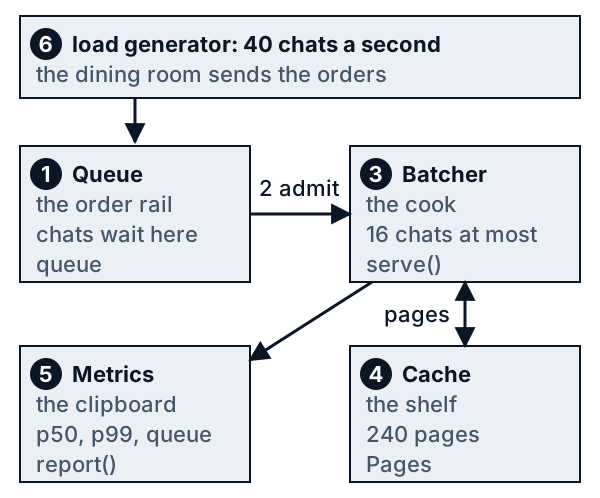
Figure 1. The tiny server as a kitchen. Each number is a step below.
- A request arrives and waits. It joins the queue, the order rail, until the batcher has room.
- The batcher admits it when the cache has pages free. A chat gets in when the batch has a place and the cache can promise every page the chat will need. The toy knows each reply’s length, so it can promise all of its pages; a real server cannot, and fills later (Go deeper). The cache is lesson 22’s pool of 16-token pages.
- One step gives every admitted chat its next word, together. A step costs lesson 24’s formula, and a step with 16 chats of 220 tokens takes 8.1 ms where 1 chat of 34 tokens takes 7.9 ms.
- The cache grows a page when a chat fills its last one. When the chat ends, all its pages go back.
- Metrics record the waits: TTFT and TBT for every chat, the queue length and the cache pages in use.
- The load generator sends chats at random times at a stated rate, and the server reports p50 and p99, the waits that 50 and 99 in 100 stay within.
Each step in code
One real line of the program does each step. The files are in code/, and the line numbers are those of this lesson’s files.
| Step | The code line | What it does |
|---|---|---|
| 1. Queue the request | tiny_server.py:85queue.append(sent) |
The chat joins the back of the queue. |
| 2. Admit it if it fits | tiny_server.py:90no_place, no_pages = len(running) + len(joining) == limit, promised + need > pages |
The chat is held out if the batch is full, or if the pages it needs are not free. |
| 3. Step everyone together | tiny_server.py:96seconds = step_seconds([prompts[i] + made[i] for i in running], sum(prompts[i] for i in joining)) |
One step takes lesson 24’s time for every running chat plus the prompts being read. |
| 4. Take a page | tiny_server.py:57table.append(self.free.popleft()) |
A chat that fills its last page takes the next free one. Line 60 gives them all back. |
| 5. Record the waits | tiny_server.py:120ttft = [f - a for f, a in zip(run.first, arrive)] |
The wait for the first word is the time of the first word minus the time of arrival. |
| 6. Send load, read the clipboard | tiny_server.py:131return report(workload, rate, serve(workload, rate, pages, limit)) |
One call sends the chats at a rate and returns p50, p99 and the rest. |
A real run
trace.py runs the heavy rate on the 400 chats and prints what the server does. Run it from the repository root:
cd lessons/build-a-tiny-model-server/code && python3 trace.pyPhone readers: slide the box sideways to see every column.
heavy load: 40 chats a second, a cache of 240 pages, at most 16 chats per step

the first chats arrive
  chat 0: sent at 0.000 s, prompt 34 tokens, reply 10 tokens, needs 3 pages
  chat 1: sent at 0.003 s, prompt 157 tokens, reply 27 tokens, needs 12 pages
  chat 2: sent at 0.018 s, prompt 457 tokens, reply 23 tokens, needs 30 pages
  chat 3: sent at 0.019 s, prompt 248 tokens, reply 41 tokens, needs 19 pages

the first steps
  step  start     took     chats  new  queue  pages held + owed  left
     1  0.000 s    7.9 ms      1    1      0    3 + 0    237
     2  0.008 s    8.1 ms      2    1      0   13 + 2    225
     3  0.016 s    7.9 ms      2    0      0   13 + 2    225
     4  0.024 s   36.4 ms      4    2      0   58 + 6    176
     5  0.060 s   29.5 ms      6    2      0   96 + 8    136

the cache fills at step 35
  step  start     took     chats  new  queue  pages held + owed  left
    34  0.381 s    8.1 ms     11    0      0  181 + 57     2
    35  0.389 s    8.1 ms     11    0      2  181 + 57     2  next chat waits for: cache
    36  0.397 s    8.1 ms     11    0      2  181 + 57     2  next chat waits for: cache
    37  0.405 s    8.1 ms     11    0      2  182 + 56     2  next chat waits for: cache

the clipboard: the same 400 chats, three runs
  run                  rate  first word p50 / p99   between words p50 / p99   queue  pages  wall
  light                 10     0.014 s   0.042 s         7.9 ms   21.0 ms      0    182  none
  heavy                 40     2.206 s   3.492 s         8.1 ms   31.3 ms     94    225  cache
  heavy, 480 pages      40     0.317 s   0.928 s         8.1 ms   31.6 ms     40    343  batch
Read it against the six steps.
- Steps 1 and 2. The first four chats arrive within 19 ms and each is admitted at once, with all its pages promised: chat 0 needs 3 (44 tokens at 16 a page), chat 2 needs 30. In
held + owed, held pages are in use, owed pages are promised but not yet taken, andleftis what remains of the 240. - Step 3. Trace step 1 takes 7.9 ms with one chat. Trace step 4 takes 36.4 ms, not because it has 4 chats but because 2 are new and the step reads their prompts, 457 and 248 tokens. Every running chat waits through it.
- Step 4. At trace step 35, 181 pages are held and 57 more are owed to chats still growing. Only 2 of 240 are left and the next chat in line needs 3, so it waits, with 11 of the 16 places used. The cache is full by promise, before it is full by use. Figure 2 shows it: pages promised reach the ceiling at 0.39 s and stay there, and the queue reaches 45 chats by 3 s.
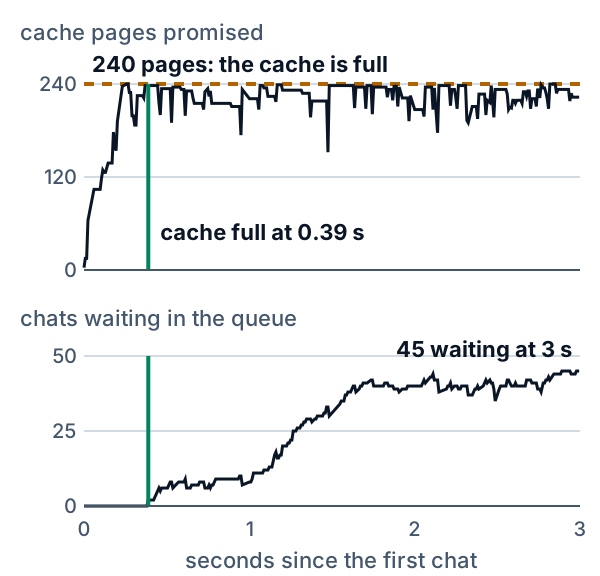
Figure 2. The cache fills 0.39 s in, and the queue grows from then on.
- Step 5. The last block is the clipboard. At 10 a second no chat waits for a place and the p99 wait for the first word is 0.042 s. At 40 it is 3.49 s, about 80 times as long, while the p99 gap between words grows by about half, from 21.0 to 31.3 ms (Figure 3). A chat waits in the queue before its first word. Once admitted it is stepped every time. A step with no new chat takes about 8 ms, so the slow gaps are the steps that read new prompts.
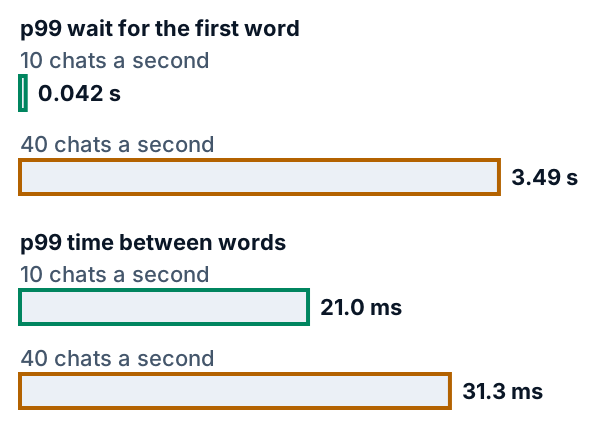
Figure 3. At 240 pages and 16 chats, the wait for the first word grows about 80 times; the gap between words grows by about half.
- Step 6. The last row gives the same chats 480 pages. They peak at 343 pages in use, no step is held out for pages, and the 16-chat limit is the wall: the p99 wait is 0.93 s. Figure 4 adds the other moves. 960 pages gives the same 0.93 s, and raising the limit to 24 as well cuts the wait to 0.16 s, at a small price: the p99 gap between words rises from 31.3 to 31.6 to 33.8 ms.
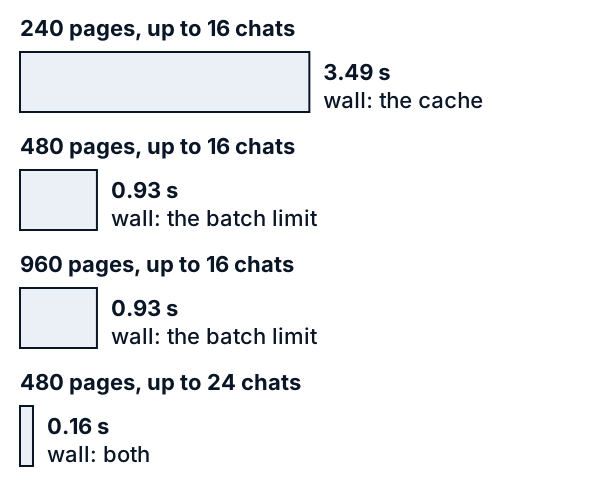
Figure 4. More cache moves the wall, more again changes nothing, and a bigger batch moves it further.
Hands on
Your turn
The third run doubled the cache. See what doubling it again does.
- In
code/trace.py, change line 7 toMORE_PAGES = 960. - Run
python3 trace.pyagain in thecodefolder.
Look at the last row. Is the wait for the first word shorter than with 480 pages? What does the pages column say about why?
What you should see
Only the last block changes, and only in the label:
the clipboard: the same 400 chats, three runs
  run                  rate  first word p50 / p99   between words p50 / p99   queue  pages  wall
  light                 10     0.014 s   0.042 s         7.9 ms   21.0 ms      0    182  none
  heavy                 40     2.206 s   3.492 s         8.1 ms   31.3 ms     94    225  cache
  heavy, 960 pages      40     0.317 s   0.928 s         8.1 ms   31.6 ms     40    343  batch
The p99 wait is 0.928 s again, digit for digit. The server used at most 343 of the 960 pages, so the cache was never the wall and the 16-chat limit is. More pages cannot help now. A higher batch limit can (Figure 4).
What this means when you build
- Read the queue and the cache together. A growing queue with a nearly full cache means memory binds: here 225 of 240 pages held. A growing queue with free pages means the batch binds: 343 of 480 held. More cache helps only in the first case.
- Keep the first word and the words between apart. At 40 a second the p99 wait for the first word grew about 80 times and the p99 gap between words by about half. Averaging each chat’s gaps would show 10.4 to 11.8 ms and hide the slow steps.
- Watch the slowest 1 in 100. Even the median chat waited 2.21 s here. The p99 says how bad it gets.
- Change one setting, then measure again. 480 pages moved the wall, 960 changed nothing, and a limit of 24 cut the wait to 0.16 s while the p99 gap between words rose to 33.8 ms.
- Read a real server’s metrics the same way. The vLLM documentation (read 2026-10-20) lists the same four readings: requests waiting and running, KV cache use, time to first token and inter-token latency.
- Load-test before launch with random arrivals at the planned rate, as lesson 29 did. Lesson 30 asks whether to rent a model API or run your own.
Optionalabout 19 min
Go deeper
Optional. This part is for readers who write Python. The code is in the code/ folder next to this lesson. From inside that folder, python3 show_numbers.py prints the numbers below, python3 trace.py prints the run above, and python3 -B -m pytest -q -p no:cacheprovider runs the tests.
tiny_server.py is 141 lines, with its comments and blank lines: a cache, a batcher, the metrics and a load test. It loads lesson 27’s seeded chats, percentile and send times, and through them lesson 24’s step time, by path. The chats are the first 400 of lesson 27’s 2,000: prompts of 30 to 599 tokens, replies of 8 to 360, and 222 tokens on average for a whole chat.
The cache
class Pages:
    """Lesson 22's free list and page tables, as counts only: no keys and values are stored."""

    def __init__(self, total: int):
        self.total, self.free, self.tables = total, deque(range(total)), {}

    def grow(self, chat: int, tokens: int) -> None:
        """A chat holding `tokens` tokens needs enough pages for them: it takes one more whenever its last page is full."""
        table = self.tables.setdefault(chat, [])
        while len(table) * PAGE_TOKENS < tokens:
            table.append(self.free.popleft())

    def release(self, chat: int) -> None:
        self.free.extend(self.tables.pop(chat))

    def used(self) -> int:
        return self.total - len(self.free)
This is the bookkeeping of lesson 22’s BlockManager: a free list that gives pages from the left and takes them back on the right, and a page table for each chat. Lesson 22’s manager also stores the keys and values, one token at a time with NumPy, which is too slow for 400 chats and their 88,935 tokens. Pages keeps only the counts, and a test runs both on the same script of adds, appends and frees to check that their tables and free lists stay equal. A page holds 16 tokens, which is also the paper’s default (below), and at 128 KiB of cache a token that is 2 MiB. Lesson 22 and lesson 28 call a page a block. The toy’s 240 pages are 480 MiB. A real card at lesson 28’s 90% share holds 25,720 pages. The toy cache is small on purpose, so that the wall shows within 400 chats.
The batcher
        while sent < n and arrive[sent] <= now:
            queue.append(sent)                                          # 1. a request arrives and waits in the queue
            sent += 1
        joining, blocked = [], ""
        while queue:                                                    # 2. admit it when a place and all its pages are free
            need = pages_for(prompts[queue[0]] + replies[queue[0]])
            no_place, no_pages = len(running) + len(joining) == limit, promised + need > pages
            blocked = " and ".join(wall for wall, hit in (("cache", no_pages), ("batch", no_place)) if hit)
            if blocked:
                break
            promised += need
            joining.append(queue.popleft())
These lines open every trip round the loop in serve. Only the chat at the front of the queue is looked at, so the queue is first come, first served, as in the paper’s scheduler (below). The test for a free place is limit, the most chats in one step. The test for pages counts what is promised, not what is in use. The toy knows how long each reply will be, so it promises a chat every page it will ever need: chat 0 is promised 3 pages when it is admitted, chat 2 is promised 30. blocked records which test failed, or both, and the metrics count it.
        seconds = step_seconds([prompts[i] + made[i] for i in running], sum(prompts[i] for i in joining))      # 3. one step, all together
        start, now = now, now + seconds
        running += joining
        for i in running:
            made[i] += 1
            cache.grow(i, prompts[i] + made[i])                         # 4. a page more when the last one is full
        for i in joining:
            first[i] = now
        stepped, ended = len(running), [i for i in running if made[i] == replies[i]]
        for i in ended:
            done[i] = now
            cache.release(i)                                            # 4. all its pages back when the chat ends
            promised -= pages_for(prompts[i] + replies[i])
            running.remove(i)
        finished += len(ended)
        steps.append(Step(start, seconds, stepped, len(joining), len(queue), cache.used(), promised - cache.used(), blocked))
A step has the shape of lesson 24’s continuous batching. Chats already running read their notes, which is the context argument of step_seconds; chats joining have their prompts read in the same step, the second argument. The step lasts as long as lesson 24’s roofline says (the larger of the compute time and the memory time) and every chat in it gets one word. A chat that just joined gets its first word at the end of that step, so TTFT includes the prompt. Each running chat then grows its page table to hold the new token, and a chat that has all its words releases its pages and its promise. The last line records one row for the trace and the metrics.
The metrics
def report(workload: dict, rate: float, run: Run) -> dict:
    """5. What the manager's clipboard shows: time to first token and time between tokens (every gap of every chat, pooled; p50, p99), the longest queue, the most pages used."""
    arrive = intended_times(workload["gaps"], rate)
    ttft = [f - a for f, a in zip(run.first, arrive)]
    tbt = [s.seconds for s in run.steps for _ in range(s.stepped - s.joined)]       # a running chat gets a word every step: its gap is the step's length
    cache_full = [s.start for s in run.steps if "cache" in s.blocked]
TTFT counts from the time a chat was sent, so waiting in the queue is included, as in lesson 27. TBT pools every gap between two words of every chat, 16,655 of them. A chat that is running gets a word in every step, so its gap is that step’s length, and a chat that just joined has no gap yet (stepped - joined). The percentile is lesson 27’s nearest rank, so the p99 of 400 first words is the 396th shortest and 4 chats are slower. The rest of report takes the longest queue, the most pages in use, the first step blocked by the cache and the chats served a second. bottleneck reads two counts, the steps that the cache held a chat out and the steps that the batch limit did, and the longest queue:
    c, b = metrics["cache_steps"], metrics["batch_steps"]
    return "none" if metrics["queue_max"] < MIN_QUEUE else "both" if 2 * min(c, b) >= max(c, b) else "cache" if c > b else "batch"
Both numbers are choices. A wall is named only if at least 4 chats (MIN_QUEUE, 1 in 100 of the 400) ever waited at once, and then alone only when it held chats out in more than twice as many steps as the other. Without the floor, 10 chats a second at 240 pages and 8 chats per step, where one chat ever waited, would blame the batch limit. With it, the widget says that no wall binds. At 120 pages the same rate still names the cache: 13 chats queue and the p99 wait is 1.18 s. The settings of Figure 4, at 40 chats a second:
| Pages | Limit | Wall | p99 first word (s) | p99 gap (ms) |
|---|---|---|---|---|
| 240 | 16 | cache | 3.49 | 31.3 |
| 480 | 16 | batch | 0.93 | 31.6 |
| 960 | 16 | batch | 0.93 | 31.6 |
| 480 | 24 | both | 0.16 | 33.8 |
At 240 pages the cache held a chat out in 1,291 steps and the batch limit in 121. At 480 the cache held none out, the limit 920 steps. At 480 pages and a limit of 24, the counts are 44 and 37: both. The last wall is borderline. When the widget shuffles the chats, this setting reads “both” in 4 of 6 orders and “the cache” in the others, while the first three never change.
What was adapted
- Counts for keys and values. As above: the page tables and free list are lesson 22’s, the stored numbers are not.
- A promise for the whole chat. A real server does not reserve a chat’s whole length in advance. The paper (below) says it reserves only the blocks for the prompt and adds one as tokens come. When the pool runs dry, it must pause a chat and rebuild its notes later. The toy never runs dry, because it promised, and so it holds chats back that a real server would let in. The wall at 240 pages would come later and more softly.
- A small cache. 240 pages rather than 25,720, as above.
- Two kinds of TBT, side by side. The toy reports every gap, pooled: at 10 and 40 chats a second the p99 is 21.0 and 31.3 ms. The other kind is one average per chat: the time from its first word to its last, divided by the reply length minus one. Its p99 is 10.4 and 11.8 ms, because a chat’s few slow steps are averaged with its fast ones. That is the averaging trap of lesson 27, and it hides the stalls. The vLLM documentation (below) records both: a histogram with one sample per streamed output, and a per-request time per output token, defined as the end-to-end latency minus TTFT, divided by the output tokens minus one.
- No network. The “load generator” is a list of send times, and the server and the load run in one process on a simulated clock. Nothing in the code opens a connection, and nothing in it could be pointed at a real service.
What the toy leaves out
- Prompt chunking. A long prompt is read in one step, as in lesson 24’s plain continuous batching. Real servers read long prompts in pieces across several steps (chunked prefill, described on the vLLM Optimization page below), so that a long prompt stalls the running chats less.
- Pausing and rebuilding. When a real pool runs dry the server must give up some chat’s pages and later swap them back or compute them again. The toy cannot reach that case.
- Shared prefixes. Chats that start with the same text could share pages (lesson 8 and lesson 22). Here every chat has its own.
- Streaming. A real user sees each word when it is sent, so network delay adds to the gap between words and to the first word. The toy stops the clock at the server.
- Many GPUs. A big model spreads over several chips (lesson 26), and a service runs several copies (lesson 29).
- Real traffic. The chats are invented, the chip is one A100 at its peak speed, and the arrivals are steady random.
Proof it works
test_tiny_server.py guards what a reader would see go wrong. Pages agrees with lesson 22’s manager on the same script. Across several settings, including a cache that only just fits the longest chat, no step promises more pages than exist, none steps more chats than the limit, every reply gets exactly its tokens, and the last step holds no pages. With a cache too big to matter, the toy’s times equal lesson 24’s simulate for every chat, so no chat is skipped or served twice. A tiny hand-worked case pins TTFT, the single gaps, p99 and the wall labels, and a sweep of the widget’s 384 runs checks that a step with no new chat takes 7.8 to 8.5 ms and that a step reading prompts takes longer on average. The light and heavy runs, the move of the wall at 480 pages, the same result at 960 and the mixed wall at a limit of 24 all reproduce. One test checks that every number quoted in the prose, the trace and the four figures comes from the code, that each code block is a slice of the real file, that each file:line in the table points at its line, and that the trace is the block printed above. test_widget.py runs the widget’s JavaScript in Node against the Python on a grid of settings and drives the page with a stand-in for the browser.
Where this is used in practice
Kwon et al., the PagedAttention paper (SOSP 2023, doi 10.1145/3600006.3613165; read 2026-10-20), is the source of lesson 22’s pool. It says a block size of 16 is large enough to use the GPU well and small enough to avoid much waste in most workloads, and that 16 is vLLM’s default. It reserves only the blocks the prompt needs and adds more as tokens are generated (section 4.3). It serves requests first come, first served; when the physical blocks run out it evicts all or none of a sequence’s blocks, and recovers them by swapping or by computing them again (section 4.5). Of a system pushed past its capacity it says that “the queue length continues to grow infinitely and so does the latency of the requests” (section 6.2). The toy shows the start of that: at 40 a second the run finishes 27.3 chats a second on average, fewer than the 40 sent, so a stream that never ended would keep the queue growing, and the run ends only because the 400 chats do. The paper’s abstract reports 2 to 4 times the throughput at the same latency as the systems it compares with, which depends on its own workloads and not on this toy.
The vLLM documentation (latest version, read 2026-10-20) describes a Prometheus-compatible /metrics endpoint with these names: vllm:num_requests_waiting (requests waiting to be processed), vllm:num_requests_running (requests in model execution batches), vllm:kv_cache_usage_perc (KV-cache usage, where 1 means 100 percent), vllm:time_to_first_token_seconds, vllm:inter_token_latency_seconds (time between consecutive streamed outputs) and vllm:request_time_per_output_token_seconds. They line up with the toy’s queue_max, chats stepped, pages in use and TTFT. The toy’s TBT, every gap pooled, lines up with vllm:inter_token_latency_seconds, which records one sample per streamed output; the per-chat average above lines up with vllm:request_time_per_output_token_seconds. Names and defaults change between versions, so check the version you run.
Skills this lesson builds
- Name the three parts of a model server and say what each one does for the user.
- Follow a request through admission, steps and release, and say what it waits for.
- Tell a full cache from a full batch by reading the queue length and the cache use together.
- Report time to first token and time between tokens at p50 and p99, and say why they move differently.
- Change one setting, measure again and say what moved and what it cost.
Portfolio project: feed a recorded request log (arrival time, prompt tokens, reply tokens) through serve and chart the queue and the pages in use over time. Report which wall binds at three arrival rates and what one setting change does to the p99 TTFT and TBT. Publish the code, the charts, and a note on how the metrics of a server you run yourself compare.
Check yourself
-
A chat has a prompt of 100 tokens and a reply of 50. How many 16-token pages does the server promise it?
Answer
150 tokens / 16 = 9.4, which rounds up to 10 pages.
-
A server’s queue keeps growing. Its cache is at 225 of 240 pages. Which wall is it, and what would help?
Answer
The cache: memory binds. More pages would help (480 moved the p99 wait from 3.49 s to 0.93 s). With the cache at 343 of 480 the batch limit would bind, and only a higher limit would help.
-
At 40 chats a second, 240 pages and 16 chats, the p99 wait for the first word grows about 80 times, and the p99 gap between words only by about half. Why?
Answer
A chat waits in the queue before its first word. Once admitted it is stepped every step, and a step with no new chat takes about 8 ms. Only steps that read new prompts are slow, and every running chat waits through them.
-
Going from 480 to 960 pages changes nothing. Why, and what would change it?
Answer
The 16-chat limit is the wall. Peak use is 343 pages of 960. Raising the limit to 24 cuts the p99 wait to 0.16 s, and raises the p99 gap between words from 31.6 to 33.8 ms.
-
At step 35 the server has 11 of 16 places in use and 2 pages left. The next chat needs 3 pages. Does it join the step?
Answer
No. The server admits a chat only when every page it will need can be promised. The chat waits for the cache, though places are free, until chats end and give pages back.
Further reading
Gentle
- Why AI servers waste memory, and how paging fixes it (lesson 22, the pool of pages)
- How does an AI server answer many people at once? (lesson 24, the batcher and the step time)
- Why is the average speed of an AI service a misleading number? (lesson 27, percentiles and the load generator)
- What do a model server’s settings change? (lesson 28, the pool and the cap)
- How many GPUs do I need for 1,000 users? (lesson 29, sizing and the load test)
- Should I rent a model API or run my own? (lesson 30, what running the server costs against renting)
- Metrics (vLLM documentation, latest version; how a real server publishes its metrics; read 2026-10-20)
Deep
- Efficient Memory Management for Large Language Model Serving with PagedAttention (Woosuk Kwon et al., SOSP 2023; block size, growth on demand, scheduling and preemption; read 2026-10-20)
- Production Metrics (vLLM documentation, latest version; the list of metric names and what each one counts; read 2026-10-20)
- Optimization and Tuning (vLLM documentation, latest version; chunked prefill, which reads large prompts in smaller chunks next to the running chats; read 2026-10-20)
Optional
Code
Each file runs on its own. Download it, or read it here.
Show code
"""Keep the copy of the model, the chip and the 400 invented chats inside ../widget.html equal to the ones in tiny_server.py.

    python3 embed_widget.py          rewrite the data block in widget.html
    python3 embed_widget.py --check  exit 1 if widget.html differs (test_widget.py runs the same check)
"""
import json
import re
import sys
from pathlib import Path

import show
import tiny_server as ts

WIDGET = Path(__file__).resolve().parent.parent / "widget.html"
CONFIG_BLOCK = re.compile(r'(<script type="application/json" id="ts-config">)(.*?)(</script>)', re.S)


def config():
    """What the page needs to run the same toy server: the model, the chip, the drawn chats and the settings it offers."""
    b = ts.tail.batching
    return {
        "params": b.PARAMS, "bytesPerWeight": b.FP16_BYTES, "kvBytes": b.KV_BYTES_PER_TOKEN, "peak": b.A100_PEAK_FLOPS, "bandwidth": b.A100_BANDWIDTH,
        "pageTokens": ts.PAGE_TOKENS, "minQueue": ts.MIN_QUEUE, "columns": show.COLUMNS, "gaps": ts.WORKLOAD["gaps"], "prompts": ts.WORKLOAD["prompts"], "replies": ts.WORKLOAD["replies"],
        "rates": show.RATES, "pageStops": show.PAGE_STOPS, "limitStops": show.LIMIT_STOPS, "rerolls": show.REROLLS, "opening": show.OPENING,
    }


def embed(html):
    """html with the data block rewritten from tiny_server.py."""
    settings = json.dumps(config(), ensure_ascii=False, separators=(", ", ": "))
    return CONFIG_BLOCK.sub(lambda m: m.group(1) + "\n" + settings + "\n" + m.group(3), html, count=1)


if __name__ == "__main__":
    current = WIDGET.read_text(encoding="utf-8")
    updated = embed(current)
    if "--check" in sys.argv:
        sys.exit(0 if updated == current else 1)
    WIDGET.write_text(updated, encoding="utf-8")
print("widget.html data block now matches tiny_server.py")Show code
"""Draw the four figures of lesson 31 from tiny_server.py, so that no number in a figure is typed by hand.

    python3 make_figs.py          rewrite ../figs/*.svg
    python3 make_figs.py --check  exit 1 if a figure on disk differs (test_tiny_server.py runs the same check)

All four figures are 600 units wide. Text is at least 22 units (20 for axis ticks) in ink or grey on white or a light fill; orange and green are used on marks
only, and every mark that colour tells apart is also named in words.
"""
import sys
from pathlib import Path
from xml.sax.saxutils import escape

import tiny_server as ts
from show import WALL_MOVES, WALLS, ms_text, seconds_text

FIGS = Path(__file__).resolve().parent.parent / "figs"
INK, GREY, ORANGE, GREEN, FILL, PANEL = "#0a1626", "#44566b", "#b36200", "#00855F", "#d2dae4", "#ebf0f6"
DASH = "10 8"
WINDOW = 3.0                                                                   # seconds of the heavy run that figure 2 shows


def num(x: float) -> str:
    return f"{x:.2f}".rstrip("0").rstrip(".")


# The SVG namespace is a name that every standalone .svg file must carry, not an address this program visits. It is written in two pieces so that a plain
# search of code/ for the start of a web address finds nothing (test_tiny_server.py runs that search).
NAMESPACE = "ht" + "tp://www.w3.org/2000/svg"


def frame(width: int, height: int, title: str, desc: str, body: list[str], defs: str = "") -> str:
    head = (f'<svg xmlns="{NAMESPACE}" viewBox="0 0 {width} {height}" width="{width}" height="{height}" role="img" '
            f'font-family="system-ui, sans-serif" font-size="22" fill="{GREY}">')
    return "\n".join([head, f"  <title>{escape(title)}</title>", f"  <desc>{escape(desc)}</desc>", *([f"  {defs}"] if defs else []),
                      '  <rect width="100%" height="100%" fill="#ffffff"/>', *("  " + line for line in body), "</svg>", ""])


def text(x: float, y: float, content: str, anchor: str = "start", color: str = INK, bold: bool = False, size: int = 22) -> str:
    extra = (f' text-anchor="{anchor}"' if anchor != "start" else "") + (' font-weight="bold"' if bold else "") + (f' font-size="{size}"' if size != 22 else "")
    return f'<text x="{num(x)}" y="{num(y)}"{extra} fill="{color}">{escape(content)}</text>'


ARROW = (f'<defs><marker id="head" viewBox="0 0 10 10" refX="9" refY="5" markerWidth="7" markerHeight="7" orient="auto-start-reverse">'
         f'<path d="M0 0L10 5L0 10z" fill="{INK}"/></marker></defs>')


def arrow(x1: float, y1: float, x2: float, y2: float, both: bool = False) -> str:
    start = ' marker-start="url(#head)"' if both else ""
    return f'<path d="M{num(x1)} {num(y1)}L{num(x2)} {num(y2)}" stroke="{INK}" stroke-width="3"{start} marker-end="url(#head)"/>'


def box(x: float, y: float, w: float, h: float, badge: int, lines: list[str]) -> list[str]:
    out = [f'<rect x="{x}" y="{y}" width="{w}" height="{h}" fill="{PANEL}" stroke="{INK}" stroke-width="2"/>',
           f'<circle cx="{x + 26}" cy="{y + 28}" r="16" fill="{INK}"/>', text(x + 26, y + 36, str(badge), "middle", "#ffffff", True)]
    out.append(text(x + 52, y + 36, lines[0], bold=True))
    out.extend(text(x + 16, y + 36 + 30 * k, line, color=GREY) for k, line in enumerate(lines[1:], 1))
    return out


# --- figure 1: the server as a kitchen -----------------------------------------------------------------------------------------

def fig_kitchen() -> str:
    body = box(20, 16, 560, 82, 6, [f"load generator: {ts.HEAVY} chats a second", "the dining room sends the orders"])
    body.append(arrow(135, 98, 135, 142))
    body += box(20, 146, 230, 136, 1, ["Queue", "the order rail", "chats wait here", "queue"])
    body += box(350, 146, 230, 136, 3, ["Batcher", "the cook", f"{ts.LIMIT} chats at most", "serve()"])
    body += box(350, 346, 230, 136, 4, ["Cache", "the shelf", f"{ts.PAGES} pages", "Pages"])
    body += box(20, 346, 230, 136, 5, ["Metrics", "the clipboard", "p50, p99, queue", "report()"])
    body.append(arrow(250, 214, 350, 214))
    body.append(text(300, 196, "2 admit", "middle"))
    body.append(arrow(465, 282, 465, 346, both=True))
    body.append(text(449, 322, "pages", "end"))
    body.append(arrow(372, 282, 250, 360))
    desc = (f"A map of the server as a kitchen, six numbered parts. The load generator (6), the dining room, sends {ts.HEAVY} chats a second into the queue, the order rail (1). The batcher, "
            f"the cook (3), admits a chat when a place and pages are free (2) and steps up to {ts.LIMIT} chats at once. The cache, the shelf (4), holds {ts.PAGES} pages of "
            f"{ts.PAGE_TOKENS} tokens, taken and returned by the batcher. The metrics, the clipboard (5), record each step.")
    return frame(600, 498, "A tiny model server as a kitchen: queue, batcher, cache and metrics", desc, body, ARROW)


# --- figure 2: the cache fills ------------------------------------------------------------------------------------------------

def fig_cache_fills() -> str:
    run = ts.serve(ts.WORKLOAD, ts.HEAVY)
    steps = [s for s in run.steps if s.start <= WINDOW]
    full = next(s.start for s in run.steps if "cache" in s.blocked)
    x0, x1 = 84, 580
    px = lambda t: x0 + t / WINDOW * (x1 - x0)
    top, base = 84, 270
    py = lambda pages: base - pages / ts.PAGES * (base - top)
    qtop, qbase, qmax = 356, 506, 50
    qy = lambda chats: qbase - chats / qmax * (qbase - qtop)
    body = [text(20, 40, "cache pages promised", color=GREY)]
    for tick in (0, ts.PAGES // 2, ts.PAGES):
        body.append(f'<path d="M{x0} {num(py(tick))}H{x1}" stroke="{FILL}" stroke-width="2"/>')
        body.append(text(x0 - 8, py(tick) + 7, str(tick), "end", GREY, size=20))
    body.append(f'<path d="M{x0} {num(py(ts.PAGES))}H{x1}" stroke="{ORANGE}" stroke-width="4" stroke-dasharray="{DASH}"/>')
    body.append(text(x0 + 8, py(ts.PAGES) - 12, f"{ts.PAGES} pages: the cache is full", bold=True))
    points = " L".join(f"{num(px(s.start))} {num(py(s.held + s.owed))}" for s in steps)
    body.append(f'<path d="M{points}" fill="none" stroke="{INK}" stroke-width="3"/>')
    body.append(f'<path d="M{num(px(full))} {base}V{top}" stroke="{GREEN}" stroke-width="4"/>')
    body.append(text(px(full) + 12, base - 30, f"cache full at {seconds_text(full)} s", bold=True))
    body.append(text(20, 326, "chats waiting in the queue", color=GREY))
    for tick in (0, qmax // 2, qmax):
        body.append(f'<path d="M{x0} {num(qy(tick))}H{x1}" stroke="{FILL}" stroke-width="2"/>')
        body.append(text(x0 - 8, qy(tick) + 7, str(tick), "end", GREY, size=20))
    points = " L".join(f"{num(px(s.start))} {num(qy(s.queue))}" for s in steps)
    body.append(f'<path d="M{points}" fill="none" stroke="{INK}" stroke-width="3"/>')
    body.append(f'<path d="M{num(px(full))} {qbase}V{qtop}" stroke="{GREEN}" stroke-width="4"/>')
    last = steps[-1]
    body.append(text(x1 - 8, qy(last.queue) - 14, f"{last.queue} waiting at {WINDOW:g} s", "end", bold=True))
    for base_y in (base, qbase):
        body.append(f'<path d="M{x0} {base_y}H{x1}" stroke="{GREY}" stroke-width="2"/>')
    for tick in range(int(WINDOW) + 1):
        body.append(text(px(tick), qbase + 30, str(tick), "middle", GREY, size=20))
    body.append(text((x0 + x1) / 2, qbase + 62, "seconds since the first chat", "middle", GREY))
    desc = (f"The first {WINDOW:g} seconds of the heavy run, {ts.HEAVY} chats a second. Top: cache pages promised (held plus owed) climb to the {ts.PAGES}-page limit and stay at it from "
            f"{seconds_text(full)} s, marked by a green line. Bottom: the queue is empty until then and has {last.queue} chats waiting at {WINDOW:g} s.")
    return frame(600, 576, f"The cache is full at {seconds_text(full)} s and the queue grows", desc, body)


# --- figure 3: the first word against the words between ------------------------------------------------------------------------

def fig_two_waits() -> str:
    light, heavy = ts.load_test(ts.LIGHT), ts.load_test(ts.HEAVY)
    x0 = 20
    panels = (("p99 wait for the first word", "ttft_p99", 3.5, 480, lambda v: f"{seconds_text(v)} s"),
              ("p99 time between words", "tbt_p99", 0.035, 480, lambda v: f"{ms_text(v)} ms"))
    body, y, facts = [], 36, []
    for title, key, top_value, longest, show in panels:
        body.append(text(20, y, title, bold=True))
        for k, (name, m, color) in enumerate(((f"{ts.LIGHT} chats a second", light, GREEN), (f"{ts.HEAVY} chats a second", heavy, ORANGE))):
            top = y + 40 + k * 84
            width = max(m[key] / top_value * longest, 3)
            body.append(text(20, top - 8, name, color=GREY))
            body.append(f'<rect x="{x0}" y="{top}" width="{num(width)}" height="34" fill="{PANEL}" stroke="{color}" stroke-width="4"/>')
            body.append(text(x0 + width + 12, top + 25, show(m[key]), bold=True))
        facts.append(f"{title}: {show(light[key])} at {ts.LIGHT} chats a second, {show(heavy[key])} at {ts.HEAVY}")
        y += 214
    desc = ("Two bar charts, each on its own scale, for the same toy server at a light and a heavy rate. " + "; ".join(facts) +
            f". At {ts.PAGES} pages and {ts.LIMIT} chats, the wait for the first word grows about {round(heavy['ttft_p99'] / light['ttft_p99'], -1):.0f} times; the time between words, every gap of every chat pooled, grows by about half.")
    return frame(600, y - 28, "At the heavy rate the first word waits far longer and the gaps between words grow by half", desc, body)


# --- figure 4: the wall moves ------------------------------------------------------------------------------------------------

def fig_walls() -> str:
    rows = [(pages, limit, ts.load_test(ts.HEAVY, pages, limit)) for pages, limit in WALL_MOVES]
    longest, top_value, x0 = 290, 3.5, 20
    body, y, facts = [], 36, []
    for pages, limit, m in rows:
        wall = WALLS[ts.bottleneck(m)]
        body.append(text(20, y, f"{pages} pages, up to {limit} chats", bold=True))
        width = max(m["ttft_p99"] / top_value * longest, 3)
        body.append(f'<rect x="{x0}" y="{y + 16}" width="{num(width)}" height="60" fill="{PANEL}" stroke="{INK}" stroke-width="2"/>')
        body.append(text(x0 + width + 14, y + 44, f"{seconds_text(m['ttft_p99'])} s", bold=True))
        body.append(text(x0 + width + 14, y + 72, f"wall: {wall}"))
        facts.append(f"{pages} pages and {limit} chats: {seconds_text(m['ttft_p99'])} s, wall {wall}")
        y += 118
    desc = (f"The p99 wait for the first word at {ts.HEAVY} chats a second, for four settings of cache pages and batch limit, on one scale. " + "; ".join(facts) +
            ". More cache moves the wall from the cache to the batch limit; more cache again changes nothing.")
    return frame(600, y - 8, "Changing one setting moves the wall", desc, body)


FIGURES = {
    "kitchen.svg": fig_kitchen,
    "cache-fills.svg": fig_cache_fills,
    "two-waits.svg": fig_two_waits,
    "wall-moves.svg": fig_walls,
}


def main() -> int:
    stale = []
    for name, draw in FIGURES.items():
        path, svg = FIGS / name, draw()
        if "--check" in sys.argv:
            if not path.exists() or path.read_text(encoding="utf-8") != svg:
                stale.append(name)
        else:
            FIGS.mkdir(exist_ok=True)
            path.write_text(svg, encoding="utf-8")
    if "--check" in sys.argv:
        print("figures differ from tiny_server.py: " + ", ".join(stale) if stale else "figures match tiny_server.py")
        return 1 if stale else 0
    print("wrote " + ", ".join(FIGURES))
    return 0


if __name__ == "__main__":
sys.exit(main())Show code
"""Print every number the lesson quotes. Run: python3 show_numbers.py"""
import statistics

import show
import tiny_server as ts

W = ts.WORKLOAD
ARRIVE = ts.intended_times(W["gaps"], ts.HEAVY)


def runs() -> dict:
    """The settings the lesson walks through, each as (run, metrics)."""
    out = {}
    for name, rate, pages, limit in (("light", ts.LIGHT, ts.PAGES, ts.LIMIT), ("heavy", ts.HEAVY, ts.PAGES, ts.LIMIT), ("480 pages", ts.HEAVY, 480, ts.LIMIT),
                                     ("960 pages", ts.HEAVY, 960, ts.LIMIT), ("480 pages, limit 24", ts.HEAVY, 480, 24)):
        run = ts.serve(W, rate, pages, limit)
        out[name] = (run, ts.report(W, rate, run))
    return out


def heavy_facts(run) -> dict:
    """What the heavy run does while the cache is full: the queue at set times, and how many chats waited."""
    first_full = next(k for k, s in enumerate(run.steps) if "cache" in s.blocked)
    at = lambda t: next(s for s in reversed(run.steps) if s.start <= t).queue
    waits = [f - a for f, a in zip(run.first, ARRIVE)]
    return {"full_step": first_full + 1, "full": run.steps[first_full], "queue_at": {t: at(t) for t in (0.5, 1, 2, 3, 5, 10)},
            "over_1s": sum(1 for w in waits if w > 1), "longest": max(waits), "arrive_end": ARRIVE[-1], "end": run.steps[-1].start + run.steps[-1].seconds,
            "steps": len(run.steps), "full_steps_first_3s": sum(1 for s in run.steps if s.start < 3 and "cache" in s.blocked), "steps_first_3s": sum(1 for s in run.steps if s.start < 3)}


def main() -> None:
    pages = [ts.pages_for(p + r) for p, r in zip(W["prompts"], W["replies"])]
    print(f"workload: {ts.N_CHATS} chats from lesson 27's seed; prompts {min(W['prompts'])} to {max(W['prompts'])} tokens; replies {min(W['replies'])} to {max(W['replies'])}; "
          f"whole chats {min(p + r for p, r in zip(W['prompts'], W['replies']))} to {max(p + r for p, r in zip(W['prompts'], W['replies']))} tokens, mean {statistics.fmean(p + r for p, r in zip(W['prompts'], W['replies'])):.1f}")
    print(f"pages per chat: mean {statistics.fmean(pages):.2f}, most {max(pages)}; the cache: {ts.PAGES} pages = {ts.PAGES * 2} MiB (a page is 16 tokens x 128 KiB = 2 MiB); a real card holds 25,720")
    print(f"step time with 1 chat and a 34-token prompt: {ts.step_seconds([], 34) * 1000:.2f} ms; with 16 chats of 220 tokens: {ts.step_seconds([220] * 16, 0) * 1000:.2f} ms")
    print(f"the 400 chats arrive over {ARRIVE[-1]:.1f} s at {ts.HEAVY} a second and over {ts.intended_times(W['gaps'], ts.LIGHT)[-1]:.1f} s at {ts.LIGHT}")
    print()
    for name, (run, m) in runs().items():
        print(f"{name:20} wall {ts.bottleneck(m):6} first word p50 {m['ttft_p50']:.3f} p99 {m['ttft_p99']:.3f} s | between words p50 {m['tbt_p50'] * 1000:.1f} p99 {m['tbt_p99'] * 1000:.1f} ms | "
              f"queue {m['queue_max']} pages {m['pages_max']} | full at {m['cache_full_at']} | cache steps {m['cache_steps']} batch steps {m['batch_steps']} | served {m['served']:.1f} a second | ends {run.steps[-1].start + run.steps[-1].seconds:.2f} s, {len(run.steps)} steps")
    print()
    print("the two kinds of TBT (ms): every gap pooled (the toy) / one average per chat (p50, p99 of 400), and the steps behind the gaps")
    for name, (run, m) in runs().items():
        per_chat = [(d - f) / (r - 1) for d, f, r in zip(run.done, run.first, W["replies"])]
        alone, reading = [s.seconds for s in run.steps if not s.joined], [s.seconds for s in run.steps if s.joined]
        print(f"{name:20} per gap {m['tbt_p50'] * 1000:.1f} / {m['tbt_p99'] * 1000:.1f} | per chat {ts.percentile(per_chat, 50) * 1000:.1f} / {ts.percentile(per_chat, 99) * 1000:.1f} | "
              f"steps with no new chat {len(alone)}, mean {statistics.fmean(alone) * 1000:.2f}, longest {max(alone) * 1000:.2f} | steps that read prompts {len(reading)}, "
              f"mean {statistics.fmean(reading) * 1000:.2f}, longest {max(reading) * 1000:.2f}")
    print()
    print("heavy run:", heavy_facts(runs()["heavy"][0]))
    print()
    print("widget shuffles at 40 chats a second (p99 first word, wall):")
    for pages_, limit in [(ts.PAGES, ts.LIMIT), *show.WALL_MOVES[1:]]:
        ds = [show.describe(ts.HEAVY, pages_, limit, k) for k in range(len(show.REROLLS))]
        print(f"  {pages_} pages, limit {limit}: p99 {min(d['metrics']['ttft_p99'] for d in ds):.2f} to {max(d['metrics']['ttft_p99'] for d in ds):.2f} s; walls", [d["lines"][2] for d in ds])


if __name__ == "__main__":
main()Show code
"""The settings, words and chart numbers of the widget: lesson 31 (build-a-tiny-model-server).

`describe` runs the tiny server at one setting and returns everything the widget shows. The widget (../widget.html) repeats `serve`, `report` and
`describe` in JavaScript, and test_widget.py runs both and compares them. Standard library only.
"""
from tiny_server import HEAVY, LIMIT, N_CHATS, PAGES, WORKLOAD, bottleneck, report, serve, tail

RATES, PAGE_STOPS, LIMIT_STOPS = [10, 20, 30, 40], [120, 240, 480, 960], [8, 16, 24, 48]     # the three sliders' stops
OPENING = {"rate": HEAVY, "pages": PAGES, "limit": LIMIT}                                       # the widget opens on the lesson's heavy run
REROLLS = tail.draw_rerolls(count=6, n=N_CHATS)                                                 # "Shuffle the chats": same chats, another order
COLUMNS = 48                                                                                    # slices of the run the chart shows
WALL_MOVES = [(240, 16), (480, 16), (960, 16), (480, 24)]                                       # the settings the lesson walks through, at the heavy rate
WALLS = {"none": "none", "cache": "the cache", "batch": "the batch limit", "both": "both"}

seconds_text = tail.seconds_text


def ms_text(seconds: float) -> str:
    return f"{seconds * 1000:.1f}"


def chats_text(n: int) -> str:
    return f"{n} chat" if n == 1 else f"{n} chats"


def columns(run, pages: int) -> dict:
    """The chart: for each slice of the run, the most pages promised (held plus owed) and the longest queue, and the slice where the cache first filled."""
    last = run.steps[-1]
    end = last.start + last.seconds
    promised, queue, full = [0] * COLUMNS, [0] * COLUMNS, -1
    for s in run.steps:
        c = min(COLUMNS - 1, int(s.start * COLUMNS / end))
        promised[c] = max(promised[c], s.held + s.owed)
        queue[c] = max(queue[c], s.queue)
        if full < 0 and "cache" in s.blocked:
            full = c
    return {"end": end, "promised": promised, "queue": queue, "full": full}


def headline(m: dict, rate: int, limit: int) -> str:
    slow = f"1\u00a0chat in 100 waits more than {seconds_text(m['ttft_p99'])}\u00a0s for its first word."
    wall = bottleneck(m)
    if wall == "none":
        return f"At {rate}\u00a0chats a second no wall binds. {slow}"
    if wall == "cache":
        return f"At {rate}\u00a0chats a second the cache fills at {seconds_text(m['cache_full_at'])}\u00a0s and new chats wait. {slow}"
    if wall == "batch":
        return f"At {rate}\u00a0chats a second new chats mostly wait for a place in the batch, which holds {limit}. {slow}"
    return f"At {rate}\u00a0chats a second new chats wait for cache pages and for a place in the batch. {slow}"


def key_table(m: dict) -> list:
    return [["First word", seconds_text(m["ttft_p50"]) + " s", seconds_text(m["ttft_p99"]) + " s"],
            ["Between words", ms_text(m["tbt_p50"]) + " ms", ms_text(m["tbt_p99"]) + " ms"]]


def key_lines(m: dict, pages: int) -> list:
    return [f"Longest queue: {chats_text(m['queue_max'])}", f"Cache pages used, most: {m['pages_max']} of {pages}", f"Wall: {WALLS[bottleneck(m)]}"]


def describe(rate: int, pages: int, limit: int, reroll: int = 0) -> dict:
    a, b = REROLLS[reroll]
    workload = tail.shuffled(WORKLOAD, a, b)
    run = serve(workload, rate, pages, limit)
    m = report(workload, rate, run)
    return {"head": headline(m, rate, limit), "table": key_table(m), "lines": key_lines(m, pages), "chart": columns(run, pages),
"metrics": {k: m[k] for k in ("ttft_p50", "ttft_p99", "tbt_p50", "tbt_p99", "queue_max", "pages_max", "cache_full_at", "served", "cache_steps", "batch_steps")}}Show code
"""A tiny model server you can read end to end: lesson 31 (build-a-tiny-model-server).

Three parts around a toy model: a cache of fixed-size pages (lesson 22), a batcher that steps every admitted chat together (lesson 24)
and metrics that report the waits (lesson 27). The "model" is a toy: a chat asks for a fixed number of tokens and each step gives every
admitted chat its next one, at the step time of lesson 24 (A100 80GB, Llama 3.1 8B). All of it runs in this one process on a simulated
clock, with no network code: the "load generator" is a list of send times, so nothing here can be pointed at a real service.
The widget (../widget.html) repeats `serve` and `report` in JavaScript; test_widget.py compares them. Standard library only.
"""
from __future__ import annotations

import importlib.util
import sys
from collections import deque, namedtuple
from pathlib import Path

# --- lesson 27's workload, percentiles and (through it) lesson 24's step time, loaded by path -----------------------------------

def _load_lesson_27():
    path = Path(__file__).resolve().parent.parent.parent / "why-average-speed-is-misleading" / "code" / "tail_sim.py"
    spec = importlib.util.spec_from_file_location("tail_sim_lesson27", path)
    module = importlib.util.module_from_spec(spec)
    sys.modules[spec.name] = module
    keep, sys.dont_write_bytecode = sys.dont_write_bytecode, True
    try:
        spec.loader.exec_module(module)
    finally:
        sys.dont_write_bytecode = keep
    return module


tail = _load_lesson_27()
step_seconds, percentile, intended_times = tail.step_seconds, tail.percentile, tail.intended_times

PAGE_TOKENS = 16                        # lesson 22 and lesson 28: tokens per cache page, 2 MiB of cache at 128 KiB a token
N_CHATS = 400                           # the first chats of lesson 27's seeded workload
WORKLOAD = {key: values[:N_CHATS] for key, values in tail.WORKLOAD.items()}
PAGES, LIMIT = 240, 16                  # the toy's cache (480 MiB; a real card holds 25,720 pages) and the most chats stepped together
LIGHT, HEAVY = 10, 40                   # chats sent per second


def pages_for(tokens: int) -> int:
    return -(-tokens // PAGE_TOKENS)


# --- the cache ----------------------------------------------------------------------------------------------------------------

class Pages:
    """Lesson 22's free list and page tables, as counts only: no keys and values are stored."""

    def __init__(self, total: int):
        self.total, self.free, self.tables = total, deque(range(total)), {}

    def grow(self, chat: int, tokens: int) -> None:
        """A chat holding `tokens` tokens needs enough pages for them: it takes one more whenever its last page is full."""
        table = self.tables.setdefault(chat, [])
        while len(table) * PAGE_TOKENS < tokens:
            table.append(self.free.popleft())

    def release(self, chat: int) -> None:
        self.free.extend(self.tables.pop(chat))

    def used(self) -> int:
        return self.total - len(self.free)


# --- the batcher ------------------------------------------------------------------------------------------------------------

# One row per step: when it started, how long it took, chats that got a token, of those how many just joined, chats still waiting,
# pages in use, pages promised but not yet taken, and what kept the next chat out ("cache", "batch", "cache and batch" or "" for nothing).
Step = namedtuple("Step", "start seconds stepped joined queue held owed blocked")
Run = namedtuple("Run", "first done steps")      # when each chat's first and last token came out, and every step


def serve(workload: dict, rate: float, pages: int = PAGES, limit: int = LIMIT) -> Run:
    prompts, replies, arrive = workload["prompts"], workload["replies"], intended_times(workload["gaps"], rate)
    n = len(prompts)
    assert pages >= pages_for(max(p + r for p, r in zip(prompts, replies))), "one chat needs more pages than the cache has"
    cache, queue, running, made = Pages(pages), deque(), [], [0] * n
    first, done, steps = [0.0] * n, [0.0] * n, []
    promised, now, sent, finished = 0, 0.0, 0, 0
    while finished < n:
        if not queue and not running and arrive[sent] > now:
            now = arrive[sent]                                          # nothing to do: wait for the next chat
        while sent < n and arrive[sent] <= now:
            queue.append(sent)                                          # 1. a request arrives and waits in the queue
            sent += 1
        joining, blocked = [], ""
        while queue:                                                    # 2. admit it when a place and all its pages are free
            need = pages_for(prompts[queue[0]] + replies[queue[0]])
            no_place, no_pages = len(running) + len(joining) == limit, promised + need > pages
            blocked = " and ".join(wall for wall, hit in (("cache", no_pages), ("batch", no_place)) if hit)
            if blocked:
                break
            promised += need
            joining.append(queue.popleft())
        seconds = step_seconds([prompts[i] + made[i] for i in running], sum(prompts[i] for i in joining))      # 3. one step, all together
        start, now = now, now + seconds
        running += joining
        for i in running:
            made[i] += 1
            cache.grow(i, prompts[i] + made[i])                         # 4. a page more when the last one is full
        for i in joining:
            first[i] = now
        stepped, ended = len(running), [i for i in running if made[i] == replies[i]]
        for i in ended:
            done[i] = now
            cache.release(i)                                            # 4. all its pages back when the chat ends
            promised -= pages_for(prompts[i] + replies[i])
            running.remove(i)
        finished += len(ended)
        steps.append(Step(start, seconds, stepped, len(joining), len(queue), cache.used(), promised - cache.used(), blocked))
    return Run(first, done, steps)


# --- the metrics ------------------------------------------------------------------------------------------------------------

def report(workload: dict, rate: float, run: Run) -> dict:
    """5. What the manager's clipboard shows: time to first token and time between tokens (every gap of every chat, pooled; p50, p99), the longest queue, the most pages used."""
    arrive = intended_times(workload["gaps"], rate)
    ttft = [f - a for f, a in zip(run.first, arrive)]
    tbt = [s.seconds for s in run.steps for _ in range(s.stepped - s.joined)]       # a running chat gets a word every step: its gap is the step's length
    cache_full = [s.start for s in run.steps if "cache" in s.blocked]
    return {"ttft_p50": percentile(ttft, 50), "ttft_p99": percentile(ttft, 99), "tbt_p50": percentile(tbt, 50), "tbt_p99": percentile(tbt, 99),
            "queue_max": max(s.queue for s in run.steps), "pages_max": max(s.held for s in run.steps),
            "cache_full_at": cache_full[0] if cache_full else None, "served": len(ttft) / max(run.done),
            "cache_steps": len(cache_full), "batch_steps": sum(1 for s in run.steps if "batch" in s.blocked)}


def load_test(rate: float, pages: int = PAGES, limit: int = LIMIT, workload: dict = WORKLOAD) -> dict:
    """6. The in-process load generator: chats arrive at random times that average `rate` a second, and the server reports."""
    return report(workload, rate, serve(workload, rate, pages, limit))


MIN_QUEUE = 4                           # a wall is named only if this many chats (1 in 100 of the 400) waited at once


def bottleneck(metrics: dict) -> str:
    """Which wall held the next chat out in more steps: "cache" (memory binds), "batch" (the batch limit binds), "both" (neither more than twice
    as often as the other) or "none" (fewer than MIN_QUEUE chats ever waited at once)."""
    c, b = metrics["cache_steps"], metrics["batch_steps"]
return "none" if metrics["queue_max"] < MIN_QUEUE else "both" if 2 * min(c, b) >= max(c, b) else "cache" if c > b else "batch"Show code
"""Follow chats through the tiny server, step by step, then read its metrics. Run it from this folder: python3 trace.py

It uses the lesson's own functions and adds no rules of its own: serve() runs the server and report() reads the clipboard.
"""
from tiny_server import HEAVY, LIGHT, LIMIT, PAGES, WORKLOAD, bottleneck, intended_times, load_test, pages_for, serve

MORE_PAGES = 480  # the cache of the second heavy run

arrive = intended_times(WORKLOAD["gaps"], HEAVY)
run = serve(WORKLOAD, HEAVY)
print(f"heavy load: {HEAVY} chats a second, a cache of {PAGES} pages, at most {LIMIT} chats per step")
print("\nthe first chats arrive")
for i in range(4):
    prompt, reply = WORKLOAD["prompts"][i], WORKLOAD["replies"][i]
    print(f"  chat {i}: sent at {arrive[i]:.3f} s, prompt {prompt} tokens, reply {reply} tokens, needs {pages_for(prompt + reply)} pages")


def show(k):
    s = run.steps[k]
    wait = f"  next chat waits for: {s.blocked}" if s.blocked else ""
    print(f"  {k + 1:>4}  {s.start:.3f} s  {s.seconds * 1000:>5.1f} ms  {s.stepped:>5}  {s.joined:>3}  {s.queue:>5}  {s.held:>3} + {s.owed:<3}  {PAGES - s.held - s.owed:>3}{wait}")


header = "  step  start     took     chats  new  queue  pages held + owed  left"
print(f"\nthe first steps\n{header}")
for k in range(5):
    show(k)
full = next(k for k, s in enumerate(run.steps) if "cache" in s.blocked)
print(f"\nthe cache fills at step {full + 1}\n{header}")
for k in range(full - 1, full + 3):
    show(k)

print(f"\nthe clipboard: the same {len(WORKLOAD['gaps'])} chats, three runs")
print("  run                  rate  first word p50 / p99   between words p50 / p99   queue  pages  wall")
for name, rate, pages in (("light", LIGHT, PAGES), ("heavy", HEAVY, PAGES), (f"heavy, {MORE_PAGES} pages", HEAVY, MORE_PAGES)):
    m = load_test(rate, pages)
    print(f"  {name:<19} {rate:>4}  {m['ttft_p50']:>8.3f} s {m['ttft_p99']:>7.3f} s  "
f"{m['tbt_p50'] * 1000:>10.1f} ms {m['tbt_p99'] * 1000:>6.1f} ms {m['queue_max']:>5} {m['pages_max']:>5} {bottleneck(m)}")Show code
"""Guards for tiny_server.py: the cache against lesson 22's, the batcher's promises and counts, the server against lesson 24's, the metrics on a case worked by hand,
the story the lesson tells, and that every number the lesson, its trace and its figures print is the one the code gives."""
import importlib.util
import io
import itertools
import math
import re
import statistics
import subprocess
import sys
import xml.etree.ElementTree as ET
from contextlib import redirect_stdout
from functools import lru_cache
from pathlib import Path

import numpy as np
import pytest

import make_figs
import show
import tiny_server as ts

HERE = Path(__file__).resolve().parent
LESSON = HERE.parent
LESSONS = LESSON.parent
W = ts.WORKLOAD
N = ts.N_CHATS
SOURCE = (HERE / "tiny_server.py").read_text(encoding="utf-8")
secs, ms = show.seconds_text, show.ms_text
SHORT, LONG = 0.0078, 0.0085             # a step with no new chat takes between these many seconds, in all of the widget's runs


@lru_cache(maxsize=None)
def run(rate, pages=ts.PAGES, limit=ts.LIMIT):
    return ts.serve(W, rate, pages, limit)


@lru_cache(maxsize=None)
def metrics(rate, pages=ts.PAGES, limit=ts.LIMIT):
    return ts.report(W, rate, run(rate, pages, limit))


def load_by_path(name, relative):
    spec = importlib.util.spec_from_file_location(name, LESSONS / relative)
    module = importlib.util.module_from_spec(spec)
    sys.modules[name] = module
    keep, sys.dont_write_bytecode = sys.dont_write_bytecode, True
    try:
        spec.loader.exec_module(module)
    finally:
        sys.dont_write_bytecode = keep
    return module


def test_pages_follow_lesson_22_block_manager():
    """Guards the cache drifting from the pool lesson 22 explained: on one seeded script of chats that grow a token at a time and end, the page tables and the
    free list (its order too) of `Pages` equal those of lesson 22's `BlockManager` after every single step."""
    paged = load_by_path("paged_kv_lesson22", "paged-kv-cache/code/paged_kv.py")
    rng = np.random.default_rng(31)
    total = 40
    manager, pages = paged.BlockManager(total, ts.PAGE_TOKENS, 1), ts.Pages(total)
    lengths = [int(x) for x in rng.integers(1, 90, size=14)]            # tokens each chat will hold when it ends
    live, promised, nxt, tokens, checked = {}, 0, 0, {}, 0
    while nxt < len(lengths) or live:
        while nxt < len(lengths) and promised + ts.pages_for(lengths[nxt]) <= total:
            manager.add_request(nxt)
            live[nxt], tokens[nxt] = lengths[nxt], 0
            promised += ts.pages_for(lengths[nxt])
            nxt += 1
        for chat in list(live):
            manager.append(chat, np.zeros(1), np.zeros(1))
            tokens[chat] += 1
            pages.grow(chat, tokens[chat])
            if tokens[chat] == live[chat]:
                manager.free(chat)
                pages.release(chat)
                promised -= ts.pages_for(live.pop(chat))
            started = {c: t for c, t in manager.tables.items() if t}       # lesson 22 opens an empty table at admission, `Pages` at the first token
            assert pages.tables == started and list(pages.free) == list(manager.free_list), (chat, tokens[chat])
            checked += 1
    assert checked == sum(lengths) and pages.used() == 0


SETTINGS = [(10, ts.PAGES, ts.LIMIT), (40, ts.PAGES, ts.LIMIT), (40, 480, 24), (40, 52, 48), (40, 60, 3), (25, 120, 8)]


def test_every_chat_is_served_once_and_no_step_over_admits():
    """Guards a request admitted with no free page, pages leaked after a chat ends, a step serving a chat twice or skipping one, and a step with more chats than the
    limit. The cache of 52 pages only just fits the longest chat, so any over-admission would run the free list dry."""
    arrive = {rate: ts.intended_times(W["gaps"], rate) for rate, _, _ in SETTINGS}
    for rate, pages, limit in SETTINGS:
        r, steps = run(rate, pages, limit), run(rate, pages, limit).steps
        where = (rate, pages, limit)
        assert all(0 <= s.held and 0 <= s.owed and s.held + s.owed <= pages and s.stepped <= limit for s in steps), where
        assert sum(s.stepped for s in steps) == sum(W["replies"]) and sum(s.joined for s in steps) == N, where
        assert steps[-1].held == 0 and steps[-1].owed == 0, where
        assert all(a < f <= d for a, f, d in zip(arrive[rate], r.first, r.done)), where


def test_toy_gives_the_times_of_lesson_24_continuous_batching():
    """Guards the toy drifting from the scheduler lesson 24 explained: with a cache that never fills and 8 places, every chat's first word and last word must equal
    that lesson's `simulate`."""
    b = ts.tail.batching
    for rate in (10, 40):
        arrive = ts.intended_times(W["gaps"], rate)
        reference = b.simulate([b.Request(t, p, r) for t, p, r in zip(arrive, W["prompts"], W["replies"])], 8, "continuous")
        mine = run(rate, 5000, 8)
        assert mine.first == reference.first_token and mine.done == reference.finished and len(mine.steps) == len(reference.steps), rate


def test_a_case_worked_by_hand():
    """Guards the metrics and the wall labels: two chats of 10 prompt tokens and 2 and 3 reply tokens, sent together, with room for one chat at a time (batch), one
    chat's pages (cache) or both. The times are sums of lesson 24's step times, the gaps between words are the three single gaps (not each chat's average), and the
    label follows the steps held out once enough chats queued."""
    work = {"gaps": [0.0, 0.0], "prompts": [10, 10], "replies": [2, 3]}
    read, step11, step12 = ts.step_seconds([], 10), ts.step_seconds([11], 0), ts.step_seconds([12], 0)
    first = [read, read + step11 + read]
    done = [read + step11, first[1] + step11 + step12]
    for pages, limit, wall, held_out in [(100, 1, "batch", (0, 2)), (1, 8, "cache", (2, 0)), (1, 1, "both", (2, 2))]:
        r = ts.serve(work, 1, pages, limit)
        m = ts.report(work, 1, r)
        assert r.first == pytest.approx(first, abs=1e-12) and r.done == pytest.approx(done, abs=1e-12), wall
        assert (m["cache_steps"], m["batch_steps"]) == held_out and ts.bottleneck({**m, "queue_max": ts.MIN_QUEUE}) == wall and ts.bottleneck(m) == "none", wall
        assert m["ttft_p99"] == pytest.approx(first[1]) and m["ttft_p50"] == pytest.approx(first[0])
        assert (m["tbt_p50"], m["tbt_p99"]) == pytest.approx((step11, step12)) and m["queue_max"] == 1 and m["pages_max"] == 1       # gaps: step11, step11, step12
    wall_of = lambda c, b, q: ts.bottleneck({"cache_steps": c, "batch_steps": b, "queue_max": q})
    assert [wall_of(c, b, ts.MIN_QUEUE) for c, b in [(10, 5), (10, 4), (4, 10), (5, 10), (1, 0)]] == ["both", "cache", "batch", "both", "cache"]
    assert [wall_of(10, 0, q) for q in (0, 1, ts.MIN_QUEUE - 1, ts.MIN_QUEUE)] == ["none", "none", "none", "cache"] and ts.MIN_QUEUE == 4     # the floor: fewer than 4 chats queued names no wall
    assert [ts.pages_for(t) for t in (1, 16, 17, 150)] == [1, 1, 2, 10]


def test_a_cache_smaller_than_the_longest_chat_is_refused():
    """Guards a server that would wait forever: a chat that can never fit must stop the run at the start, not hang it."""
    longest = max(p + r for p, r in zip(W["prompts"], W["replies"]))
    assert ts.pages_for(longest) == 52
    with pytest.raises(AssertionError, match="needs more pages"):
        ts.serve(W, 40, 51, 16)


def test_the_story_reproduces():
    """Guards the lesson's claims: no wall at the light rate, the cache at the heavy one, the batch limit once the cache doubles, nothing more from 960 pages, both walls at
    a limit of 24, a first-word wait that grows about 80 times where the gap between words grows by about half, and the same walls under every one of the widget's 6 orders.
    The sweep of all 384 widget runs guards the reason given for the gaps: a step with no new chat takes about 8 ms, a step that reads prompts takes longer on average."""
    light, heavy, more, most, high = metrics(10), metrics(40), metrics(40, 480), metrics(40, 960), metrics(40, 480, 24)
    assert [ts.bottleneck(m) for m in (light, heavy, more, most, high)] == ["none", "cache", "batch", "batch", "both"]
    assert more == most and light["queue_max"] == 0 and light["cache_full_at"] is None and more["cache_full_at"] is None
    assert 0.38 < heavy["cache_full_at"] < 0.40 and heavy["queue_max"] > more["queue_max"] > high["queue_max"]
    assert heavy["ttft_p99"] > 50 * light["ttft_p99"] and 1.4 < heavy["tbt_p99"] / light["tbt_p99"] < 1.6
    assert heavy["ttft_p99"] > more["ttft_p99"] > high["ttft_p99"] and heavy["tbt_p99"] < more["tbt_p99"] < high["tbt_p99"]
    assert heavy["served"] < ts.HEAVY and more["served"] > heavy["served"]
    walls = {setting: set() for setting in show.WALL_MOVES}
    for k in range(len(show.REROLLS)):
        for pages, limit in show.WALL_MOVES:
            walls[(pages, limit)].add(show.describe(ts.HEAVY, pages, limit, k)["lines"][2])
    assert [walls[s] for s in show.WALL_MOVES[:3]] == [{"Wall: the cache"}, {"Wall: the batch limit"}, {"Wall: the batch limit"}]
    assert walls[(480, 24)] == {"Wall: both", "Wall: the cache"}
    for order in show.REROLLS:
        shuffled = ts.tail.shuffled(W, *order)
        for rate, pages, limit in itertools.product(show.RATES, show.PAGE_STOPS, show.LIMIT_STOPS):
            steps = ts.serve(shuffled, rate, pages, limit).steps
            alone, reading = [s.seconds for s in steps if not s.joined], [s.seconds for s in steps if s.joined]
            assert SHORT < min(alone) and max(alone) < LONG < statistics.fmean(reading) / 1.3, (order, rate, pages, limit)


def reading():
    prose = (LESSON / "lesson.md").read_text(encoding="utf-8")
    return prose, {name: (LESSON / "figs" / name).read_text(encoding="utf-8") for name in make_figs.FIGURES}


def per_chat_p99(r):
    """The other kind of TBT, one average per chat, as the lesson's Go deeper quotes it (p99 over the 400 chats)."""
    return ts.percentile([(d - f) / (n - 1) for d, f, n in zip(r.done, r.first, W["replies"])], 99)


def test_every_number_the_lesson_and_its_figures_quote_comes_from_the_code():
    """Guards prose, trace and figure numbers drifting from the code: each fragment is built from a value computed here and must appear in the lesson or the figure."""
    prose, figures = reading()
    light, heavy, more, most, high = metrics(10), metrics(40), metrics(40, 480), metrics(40, 960), metrics(40, 480, 24)
    arrive = ts.intended_times(W["gaps"], ts.HEAVY)
    heavy_run = run(40)
    full = next(k for k, s in enumerate(heavy_run.steps) if "cache" in s.blocked)
    s35, s4, s1 = heavy_run.steps[full], heavy_run.steps[3], heavy_run.steps[0]
    at3 = next(s for s in reversed(heavy_run.steps) if s.start <= 3.0).queue
    lines = len(SOURCE.splitlines())
    whole = [p + r for p, r in zip(W["prompts"], W["replies"])]
    ratio = heavy["ttft_p99"] / light["ttft_p99"]
    next_chat = sum(s.joined for s in heavy_run.steps[:full])
    shuffled = [{show.describe(40, 480, 24, k)["lines"][2] for k in range(len(show.REROLLS))}]
    mib = ts.PAGES * ts.PAGE_TOKENS * ts.tail.batching.KV_BYTES_PER_TOKEN // 2 ** 20
    table = [f"| {p} | {l} | {w} | {secs(m['ttft_p99'])} | {ms(m['tbt_p99'])} |" for (p, l), w, m in
             zip(show.WALL_MOVES, ("cache", "batch", "batch", "both"), (heavy, more, most, high))]
    rerolled = [(show.describe(40, 480, 16, k)["metrics"]["ttft_p99"], show.describe(40, 240, 16, k)["metrics"]["ttft_p99"] / show.describe(10, 240, 16, k)["metrics"]["ttft_p99"])
                for k in range(len(show.REROLLS))]
    low120 = ts.load_test(10, 120)
    few = ts.load_test(10, 240, 8)
    per_gap = f"{ms(light['tbt_p99'])} and {ms(heavy['tbt_p99'])} ms"
    per_chat = f"{ms(per_chat_p99(run(10)))} and {ms(per_chat_p99(heavy_run))} ms"
    sweep = len(show.REROLLS) * len(show.RATES) * len(show.PAGE_STOPS) * len(show.LIMIT_STOPS)
    gaps = sum(W["replies"]) - N
    wanted = {"lesson.md": [
        f"one {lines}-line Python program", f"`tiny_server.py` is {lines} lines", f"1 chat in 100 (p99) waits more than {secs(light['ttft_p99'])} s for its first word",
        f"the cache fills {secs(heavy['cache_full_at'])} s in", f"that wait is {secs(heavy['ttft_p99'])} s, about 80 times longer", f"the p99 gap between two words grows only from {ms(light['tbt_p99'])} to {ms(heavy['tbt_p99'])} ms",
        f"cuts the wait to {secs(more['ttft_p99'])} s", f"{ts.HEAVY} chats a second, {ts.PAGES} cache pages, {ts.LIMIT} chats at most per step",
        f"the cache fills at {secs(heavy['cache_full_at'])} s and 1 chat in 100 waits more than {secs(heavy['ttft_p99'])} s", f"the wait is {secs(light['ttft_p99'])} s",
        f"{secs(more['ttft_p99'])} s at 480 pages becomes {secs(min(r[0] for r in rerolled))} to {secs(max(r[0] for r in rerolled))} s, and about 80 times becomes "
        f"{min(r[1] for r in rerolled):.0f} to {max(r[1] for r in rerolled):.0f}",
        f"takes {ms(ts.step_seconds([220] * 16, 0))} ms where 1 chat of 34 tokens takes {ms(ts.step_seconds([34], 0))} ms",
        f"arrive within {arrive[3] * 1000:.0f} ms", f"chat 0 needs {ts.pages_for(whole[0])} (44 tokens at 16 a page), chat 2 needs {ts.pages_for(whole[2])}",
        f"Trace step 1 takes {ms(s1.seconds)} ms with one chat. Trace step 4 takes {ms(s4.seconds)} ms", f"{W['prompts'][2]} and {W['prompts'][3]} tokens",
        f"At trace step {full + 1}, {s35.held} pages are held and {s35.owed} more are owed", f"Only {ts.PAGES - s35.held - s35.owed} of {ts.PAGES} are left and the next chat in line needs "
        f"{ts.pages_for(whole[next_chat])}", f"with {s35.stepped} of the {ts.LIMIT} places used", f"reach the ceiling at {secs(heavy['cache_full_at'])} s",
        f"the queue reaches {at3} chats by 3 s", "about 80 times as long", f"the p99 gap between words grows by about half, from {ms(light['tbt_p99'])} to {ms(heavy['tbt_p99'])} ms",
        "A step with no new chat takes about 8 ms, so the slow gaps are the steps that read new prompts", "Every running chat waits through it",
        f"They peak at {more['pages_max']} pages in use", f"the p99 wait is {secs(more['ttft_p99'])} s", f"960 pages gives the same {secs(most['ttft_p99'])} s",
        f"cuts the wait to {secs(high['ttft_p99'])} s", f"at a small price: the p99 gap between words rises from {ms(heavy['tbt_p99'])} to {ms(more['tbt_p99'])} to {ms(high['tbt_p99'])} ms",
        f"{heavy['pages_max']} of {ts.PAGES} pages held", f"{more['pages_max']} of 480 held", f"Even the median chat waited {secs(heavy['ttft_p50'])} s",
        f"the p99 gap between words by about half. Averaging each chat's gaps would show {ms(per_chat_p99(run(10)))} to {ms(per_chat_p99(heavy_run))} ms and hide the slow steps",
        f"a limit of 24 cut the wait to {secs(high['ttft_p99'])} s while the p99 gap between words rose to {ms(high['tbt_p99'])} ms",
        f"prompts of {min(W['prompts'])} to {max(W['prompts'])} tokens, replies of {min(W['replies'])} to {max(W['replies'])}, and {sum(whole) / N:.0f} tokens on average",
        f"their {sum(whole):,} tokens", f"The toy's {ts.PAGES} pages are {mib} MiB", f"the {math.ceil(99 * N / 100)}th shortest and {N - math.ceil(99 * N / 100)} chats are slower",
        f"TBT pools every gap between two words of every chat, {gaps:,} of them", f"chat 0 is promised {ts.pages_for(whole[0])} pages when it is admitted, chat 2 is promised {ts.pages_for(whole[2])}",
        f"at least {ts.MIN_QUEUE} chats (`MIN_QUEUE`, 1 in 100 of the {N}) ever waited at once", "where one chat ever waited, would blame the batch limit",
        f"{low120['queue_max']} chats queue and the p99 wait is {secs(low120['ttft_p99'])} s", "At 120 pages the same rate still names the cache",
        f"held a chat out in {heavy['cache_steps']:,} steps and the batch limit in {heavy['batch_steps']}", f"the limit {more['batch_steps']} steps",
        f"the counts are {high['cache_steps']} and {high['batch_steps']}: both", f"{len(shuffled[0])}", "reads \"both\" in 4 of 6 orders and \"the cache\" in the others",
        f"finishes {heavy['served']:.1f} chats a second on average, fewer than the {ts.HEAVY} sent", f"| {ts.PAGES} | {ts.LIMIT} | cache | {secs(heavy['ttft_p99'])} | {ms(heavy['tbt_p99'])} |",
        "| Pages | Limit | Wall | p99 first word (s) | p99 gap (ms) |",
        f"at 10 and 40 chats a second the p99 is {per_gap}", f"Its p99 is {per_chat}", "records both: a histogram with one sample per streamed output", "chunked prefill, described on the vLLM Optimization page below",
        f"a sweep of the widget's {sweep} runs checks that a step with no new chat takes {SHORT * 1000:.1f} to {LONG * 1000:.1f} ms",
        "`vllm:inter_token_latency_seconds`, which records one sample per streamed output; the per-chat average above lines up with `vllm:request_time_per_output_token_seconds`", "large enough to use the GPU well and small enough to avoid much waste in most workloads",
        "Lesson 22 and [lesson 28](../what-model-server-settings-change/) call a page a block", "The toy knows each reply's length, so it can promise all of its pages; a real server cannot, and fills later (Go deeper)",
        "The dining room sends the orders", "The cook takes an order off the rail only if two things hold: the shelf has room for it, and a plate is free",
        "configuration/optimization/", "read 2026-10-20)", "Figure 3. At 240 pages and 16 chats, the wait for the first word grows about 80 times; the gap between words grows by about half",
        *table, f"{ts.pages_for(150)} pages", f"{most['pages_max']} of the 960 pages", "At 480 pages and a limit of 24"] +
        ["Peak use is %d pages of 960" % most["pages_max"], f"to {secs(high['ttft_p99'])} s, and raises the p99 gap between words from {ms(more['tbt_p99'])} to {ms(high['tbt_p99'])} ms",
         "the p99 gap between words only by about half", "Only steps that read new prompts are slow, and every running chat waits through them"],
        "kitchen.svg": [f"load generator: {ts.HEAVY} chats a second", "the dining room sends the orders", "the order rail", f"{ts.LIMIT} chats at most", f"{ts.PAGES} pages", "p50, p99, queue"],
        "cache-fills.svg": [f"cache full at {secs(heavy['cache_full_at'])} s", f"{at3} waiting at 3 s", f"{ts.PAGES} pages: the cache is full", "cache pages promised"],
        "two-waits.svg": [f"{secs(light['ttft_p99'])} s", f"{secs(heavy['ttft_p99'])} s", f"{ms(light['tbt_p99'])} ms", f"{ms(heavy['tbt_p99'])} ms", "about 80 times", "grows by about half"],
        "wall-moves.svg": [f"{p} pages, up to {l} chats" for p, l in show.WALL_MOVES] + [f"{secs(m['ttft_p99'])} s" for m in (heavy, more, high)] +
                          [f"wall: {w}" for w in ("the cache", "the batch limit", "both")],
    }
    assert 75 <= ratio <= 85 and 1.4 < heavy["tbt_p99"] / light["tbt_p99"] < 1.6 and lines < 150 and "25,720" in (LESSONS / "what-model-server-settings-change" / "lesson.md").read_text(encoding="utf-8")
    assert ts.MIN_QUEUE == N // 100 and few["queue_max"] == 1 and ts.bottleneck(few) == "none" and ts.bottleneck(low120) == "cache" and 1.0 < low120["ttft_p99"] < 1.3
    assert (round(min(r[0] for r in rerolled), 2), round(max(r[0] for r in rerolled), 2)) == (0.39, 1.22) and sweep == 384
    texts = {"lesson.md": prose, **figures}
    missing = [f"{name}: {fragment!r}" for name, fragments in wanted.items() for fragment in fragments if fragment not in texts[name]]
    assert not missing, "not found: " + "; ".join(missing)


def test_the_figures_are_the_ones_the_code_draws_and_follow_the_house_style():
    """Guards a figure going stale or off-palette: the files on disk equal what make_figs draws, the lesson shows each one, and each parses, has a title and a description,
    a white ground, no script, no web address, only the house colours and no text under 20 units."""
    prose, figures = reading()
    assert set(figures) == set(re.findall(r"\]\(figs/([\w-]+\.svg)\)", prose)) == set(make_figs.FIGURES)
    allowed = {make_figs.INK, make_figs.GREY, make_figs.ORANGE, make_figs.GREEN, make_figs.FILL, make_figs.PANEL, "#ffffff"}
    web_address = re.compile("ht" + r"tps?://")
    for name, svg in figures.items():
        assert svg == make_figs.FIGURES[name](), name
        root = ET.fromstring(svg)
        assert root.find("{%s}title" % make_figs.NAMESPACE) is not None and root.find("{%s}desc" % make_figs.NAMESPACE) is not None and 'fill="#ffffff"' in svg, name
        assert "<script" not in svg and not web_address.search(svg.replace(make_figs.NAMESPACE, "")) and root.get("width") == "600", name
        assert {c.lower() for c in re.findall(r"#[0-9a-fA-F]{6}\b", svg)} <= {c.lower() for c in allowed}, name
        assert all(int(size) >= 20 for size in re.findall(r'font-size="(\d+)"', svg)), name
    for path in HERE.glob("*.py"):
        assert not web_address.search(path.read_text(encoding="utf-8")), path.name


def table_rows(prose):
    return re.findall(r"^\| \d\. [^|]+\| `(\w+\.py):(\d+)`<br>`(.+?)` \|", prose, re.M)


def test_code_blocks_are_slices_of_the_real_file_and_the_table_points_at_its_lines():
    """Guards a `file:line` in the code table pointing at the wrong line, and a code block in Go deeper that no longer matches the file."""
    prose, _ = reading()
    blocks = re.findall(r"```python\n(.*?)\n```", prose, re.S)
    assert len(blocks) == 5 and all(block in SOURCE for block in blocks)
    rows = table_rows(prose)
    assert [int(n) for _, n, _ in rows] == [85, 90, 96, 57, 120, 131]
    for name, number, code in rows:
        line = (HERE / name).read_text(encoding="utf-8").splitlines()[int(number) - 1]
        assert re.sub(r"\s+# .*$", "", line).strip() == code, (name, number)
    assert "self.free.extend(self.tables.pop(chat))" in SOURCE.splitlines()[59] and "Line 60 gives them all back" in prose


def run_trace(source):
    out = io.StringIO()
    with redirect_stdout(out):
        exec(compile(source, "trace.py", "exec"), {"__name__": "__main__"})
    return out.getvalue()


def test_trace_is_the_block_in_the_lesson_and_the_your_turn_answer_is_right():
    """Guards the pasted run drifting from `python3 trace.py` (the real command, from the code folder) and the Your turn answer: changing line 7 to 960 pages must change
    only the label of the last row, and the details block must be that block."""
    prose, _ = reading()
    real = subprocess.run([sys.executable, "-B", "trace.py"], cwd=HERE, capture_output=True, text=True, check=True).stdout
    pasted = re.search(r"python3 trace\.py\n```\n\nPhone readers: slide the box sideways to see every column\.\n\n```text\n(.*?)\n```", prose, re.S).group(1)
    assert real == pasted + "\n"
    trace = (HERE / "trace.py").read_text(encoding="utf-8")
    assert trace.splitlines()[6] == "MORE_PAGES = 480  # the cache of the second heavy run" and "change line 7 to `MORE_PAGES = 960`" in prose
    changed = run_trace(trace.replace("MORE_PAGES = 480", "MORE_PAGES = 960", 1))
    start = real.index("the clipboard")
    assert changed[:start] == real[:start] and changed[start:] == real[start:].replace("heavy, 480 pages", "heavy, 960 pages")
    answer = re.search(r"<summary>What you should see</summary>.*?```text\n(.*?)\n```", prose, re.S).group(1)
assert answer + "\n" == changed[start:] and "343" in answerShow code
"""Guards for ../widget.html: its data block, that its server gives the same numbers and words as tiny_server.py and show.py, and what a reader sees and can press."""
import json
import re
import subprocess

import show
from embed_widget import CONFIG_BLOCK, WIDGET, config, embed

HTML = WIDGET.read_text(encoding="utf-8")
# Every setting the three sliders offer, in the opening order of the chats; every other order at the opening, at the settings the lesson walks through and at the two light
# settings that test the wall floor (10 a second: 240 pages and 8 chats name no wall, 120 pages and 16 chats name the cache).
GRID = [(r, p, l, 0) for r in show.RATES for p in show.PAGE_STOPS for l in show.LIMIT_STOPS]
GRID += [(show.OPENING["rate"], p, l, k) for p, l in [(show.OPENING["pages"], show.OPENING["limit"]), *show.WALL_MOVES] for k in range(1, len(show.REROLLS))]
GRID += [(show.RATES[0], p, l, k) for p, l in [(240, 8), (120, 16)] for k in range(1, len(show.REROLLS))]

# Reads the model out of the widget between its marker comments, runs every setting of the grid with Node and compares everything the page shows with what Python wrote
# into the fixture: the words, the table, the chart columns and the numbers behind them, exactly.
PARITY = r"""
import fs from 'node:fs';
const [fixture, widget] = process.argv.slice(2);
const fx = JSON.parse(fs.readFileSync(fixture, 'utf8'));
const html = fs.readFileSync(widget, 'utf8');
const cfg = JSON.parse(html.match(/<script type="application\/json" id="ts-config">([\s\S]*?)<\/script>/)[1]);
const js = html.slice(html.indexOf('/* ---------- the model ('), html.indexOf('/* ---------- display'));
const api = new Function('cfg', "'use strict';" + js + '; return {describe};')(cfg);
const bad = [];
fx.cases.forEach((c) => {
  const got = api.describe(...c.args);
  if (JSON.stringify(got) !== JSON.stringify(c.want)) bad.push([c.args, JSON.stringify(got).slice(0, 300), JSON.stringify(c.want).slice(0, 300)]);
});
console.log(JSON.stringify({ checks: fx.cases.length, bad: bad.slice(0, 3) }));
process.exit(bad.length ? 1 : 0);
"""

# Runs the page script against a small stand-in for the DOM, moves the sliders, shuffles the chats and reads back what a reader sees.
PAGE = r"""
import fs from 'node:fs';
const [widget, fixture] = process.argv.slice(2);
const html = fs.readFileSync(widget, 'utf8');
const fx = JSON.parse(fs.readFileSync(fixture, 'utf8'));
const config = html.match(/<script type="application\/json" id="ts-config">([\s\S]*?)<\/script>/)[1];
const code = html.match(/<script>([\s\S]*?)<\/script>/)[1];
function el(tag) {
  const e = { tag, children: [], listeners: {}, value: '', style: {}, attrs: {}, textContent: '', innerHTML: '' };
  e.setAttribute = (k, v) => { e.attrs[k] = v; };
  e.getAttribute = (k) => e.attrs[k];
  e.addEventListener = (type, f) => (e.listeners[type] = e.listeners[type] || []).push(f);
  return e;
}
const page = { root: el('html'), messages: [], parent: { other: true } };
[...html.matchAll(/id="(ts-[^"]+)"/g)].forEach((m) => { page[m[1]] = el('x'); });
page['ts-config'].textContent = config;
const doc = { getElementById: (id) => page[id], documentElement: page.root, createElement: el };
const win = { addEventListener: (type, f) => page.messages.push(f) };
new Function('document', 'window', 'parent', code)(doc, win, page.parent);
const fire = (e, type) => (e.listeners[type] || []).forEach((f) => f({ target: e }));
const bad = [];
const want = (what, got, expected) => { if (JSON.stringify(got) !== JSON.stringify(expected)) bad.push([what, JSON.stringify(got).slice(0, 300), JSON.stringify(expected).slice(0, 300)]); };
const shown = () => ({ line: page['ts-line'].textContent, table: [0, 1].map((k) => [page['ts-a' + k].textContent, page['ts-b' + k].textContent]),
  lines: [page['ts-q'].textContent, page['ts-p'].textContent, page['ts-w'].textContent] });
const cfg = JSON.parse(config);
want('opening controls', [page['ts-rate'].value, page['ts-pages'].value, page['ts-limit'].value],
  [String(cfg.rates.indexOf(cfg.opening.rate)), String(cfg.pageStops.indexOf(cfg.opening.pages)), String(cfg.limitStops.indexOf(cfg.opening.limit))]);
want('opening state', shown(), fx.opening);
want('nothing spoken yet', page['ts-live'].textContent, '');
if (!page['ts-chart'].innerHTML.includes('cache full') || !page['ts-chart'].innerHTML.includes('Cache pages promised, ceiling ' + cfg.opening.pages)) bad.push(['opening chart', page['ts-chart'].innerHTML.slice(0, 200), 'cache full']);
// The picture itself, read back from the SVG text: the tallest promised bar touches the ceiling line, the queue axis ends at the longest queue and its tallest bar fills it,
// the "cache full" label sits on its green line and clear of the chart title, and nothing is drawn past the right or bottom edge of the viewBox.
const svg = page['ts-chart'].innerHTML;
const rects = [...svg.matchAll(/<rect x="([\d.]+)" y="([\d.]+)" width="([\d.]+)" height="([\d.]+)" fill="var\(--(ink|mute)\)"\/>/g)].map((m) => ({ x: +m[1], y: +m[2], w: +m[3], h: +m[4], kind: m[5] }));
const grab = (re) => { const m = svg.match(re); return m ? m.slice(1).map(Number) : [NaN, NaN, NaN]; };
const [, ceilingY, ceilingEnd] = grab(/<path d="M([\d.]+) ([\d.]+)H([\d.]+)" stroke="var\(--orange\)"/);
const [markX] = grab(/<path d="M([\d.]+) [\d.]+V[\d.]+" stroke="var\(--green\)"/);
const [labelX, labelY] = grab(/<text class="ts-t" x="([\d.]+)" y="([\d.]+)">cache full<\/text>/);
const [, titleY] = grab(/<text class="ts-t" x="(2)" y="([\d.]+)">Cache pages promised/);
const [, viewWidth, viewHeight] = grab(/viewBox="(0) 0 (\d+) (\d+)"/);
const lowest = Math.max(...rects.map((r) => r.y + r.h), ...[...svg.matchAll(/<text [^>]*? y="([\d.]+)"/g)].map((m) => +m[1]));
const axis = [...svg.matchAll(/<text class="ts-k" x="38" y="([\d.]+)" text-anchor="end">(\d+)<\/text>/g)].map((m) => [+m[1], m[2]]);
const topOf = (kind) => Math.min(...rects.filter((r) => r.kind === kind).map((r) => r.y));
const queueTop = axis.length === 4 ? axis[2][0] - 4 : NaN;
want('chart', { found: [ceilingY, ceilingEnd, markX, labelX, titleY, viewWidth, viewHeight, queueTop].every(Number.isFinite), ceiling: ceilingY, promisedTop: topOf('ink'), pagesLabel: axis[0] && axis[0][1], queueTop: topOf('mute'), queueAxis: [queueTop, axis[2] && axis[2][1]],
  label: [labelX, labelY], clear: labelY - titleY >= 20, inside: Math.max(...rects.map((r) => r.x + r.w)) <= Math.min(ceilingEnd, viewWidth) && lowest <= viewHeight },
{ found: true, ceiling: ceilingY, promisedTop: ceilingY, pagesLabel: String(cfg.opening.pages), queueTop: queueTop, queueAxis: [queueTop, String(Math.max(10, fx.chart.queueMax))],
  label: [markX + 4, ceilingY - 6], clear: true, inside: true });
page['ts-rate'].value = '0';
fire(page['ts-rate'], 'input');
want('light rate, dragging', shown(), fx.light);
want('dragging stays silent', page['ts-live'].textContent, '');
if (page['ts-chart'].innerHTML.includes('cache full')) bad.push(['light chart', 'has a cache full mark', 'none']);
fire(page['ts-rate'], 'change');
want('release speaks', page['ts-live'].textContent, fx.light.line + ' ' + fx.light.lines[2]);
want('words on the controls', [page['ts-rate-out'].textContent, page['ts-pages-out'].textContent, page['ts-limit-out'].textContent].map(String).concat([page['ts-rate'].attrs['aria-valuetext'],
  page['ts-pages'].attrs['aria-valuetext'], page['ts-limit'].attrs['aria-valuetext']]), ['10', '240', '16', '10 chats a second', '240 cache pages', '16 chats at most']);
fx.others.forEach((c) => {
  page['ts-rate'].value = String(cfg.rates.indexOf(c.args[0])); page['ts-pages'].value = String(cfg.pageStops.indexOf(c.args[1])); page['ts-limit'].value = String(cfg.limitStops.indexOf(c.args[2]));
  fire(page['ts-limit'], 'input');
  want('state ' + c.args.join('/'), shown(), c.want);
});
page['ts-rate'].value = String(cfg.rates.indexOf(cfg.opening.rate)); page['ts-pages'].value = String(cfg.pageStops.indexOf(cfg.opening.pages)); page['ts-limit'].value = String(cfg.limitStops.indexOf(cfg.opening.limit));
fire(page['ts-shuffle'], 'click');
want('shuffle shows the second order', [shown(), page['ts-order'].textContent.slice(0, 30)], [fx.shuffled, 'Same 400 chats in order 2 of ' + cfg.rerolls.length]);
want('shuffle speaks', page['ts-live'].textContent, fx.shuffled.line + ' ' + fx.shuffled.lines[2]);
const theme = (source, name) => page.messages.forEach((f) => f({ data: { type: 'spicyshark:theme', theme: name }, source }));
theme({ other: 'frame' }, 'dark');
want('theme from another sender is ignored', page.root.attrs['data-theme'], undefined);
theme(page.parent, 'dark');
want('theme from the host page', page.root.attrs['data-theme'], 'dark');
console.log(JSON.stringify({ bad: bad.slice(0, 3) }));
process.exit(bad.length ? 1 : 0);
"""


def run_node(tmp_path, script, *args):
    path = tmp_path / "check.mjs"
    path.write_text(script, encoding="utf-8")
    done = subprocess.run(["node", str(path), *args], capture_output=True, text=True, timeout=120)
    assert done.returncode == 0, done.stdout + done.stderr
    return json.loads(done.stdout)


def seen(rate, pages, limit, reroll=0):
    """What the page shows for one setting, in the form the PAGE script reads back."""
    d = show.describe(rate, pages, limit, reroll)
    return {"line": d["head"], "table": [row[1:] for row in d["table"]], "lines": d["lines"]}


def test_widget_data_block_matches_the_python_module():
    assert embed(HTML) == HTML
    assert json.loads(CONFIG_BLOCK.search(HTML).group(2)) == json.loads(json.dumps(config()))
    for name, stops in (("rate", show.RATES), ("pages", show.PAGE_STOPS), ("limit", show.LIMIT_STOPS)):     # each slider walks the stops the grid below covers
        assert re.search(r'id="ts-%s" min="0" max="%d" step="1"' % (name, len(stops) - 1), HTML), name


def test_widget_gives_the_same_numbers_and_words_as_python(tmp_path):
    cases = [{"args": list(g), "want": show.describe(*g)} for g in GRID]
    heads = " ".join(c["want"]["head"] for c in cases)
    walls = {c["want"]["lines"][2] for c in cases}
    assert {"Wall: none", "Wall: the cache", "Wall: the batch limit", "Wall: both"} <= walls and "no wall binds" in heads      # the grid reaches every kind of sentence
    wall_at = {tuple(c["args"]): c["want"]["lines"][2] for c in cases}                                                          # the floor: a handful of chats queued names no wall
    assert all(wall_at[(10, 240, 8, k)] == "Wall: none" and wall_at[(10, 120, 16, k)] == "Wall: the cache" for k in range(len(show.REROLLS)))
    assert all(wall_at[(10, p, 8, 0)] == "Wall: none" for p in (240, 480, 960))
    (tmp_path / "fx.json").write_text(json.dumps({"cases": cases}), encoding="utf-8")
    assert run_node(tmp_path, PARITY, str(tmp_path / "fx.json"), str(WIDGET))["checks"] == len(GRID)


def test_widget_page_shows_the_opening_state_and_follows_the_controls(tmp_path):
    opening = seen(**dict(zip(("rate", "pages", "limit"), (show.OPENING[k] for k in ("rate", "pages", "limit")))))
    assert opening["line"] == "At 40\u00a0chats a second the cache fills at 0.39\u00a0s and new chats wait. 1\u00a0chat in 100 waits more than 3.49\u00a0s for its first word."
    others = [(30, 120, 8), (20, 480, 24), (40, 960, 48), (10, 960, 16), (10, 240, 8), (10, 120, 16)]
    fixture = {"opening": opening, "light": seen(10, 240, 16), "shuffled": seen(40, 240, 16, 1), "others": [{"args": list(o), "want": seen(*o)} for o in others],
               "chart": {"queueMax": max(show.describe(*(show.OPENING[k] for k in ("rate", "pages", "limit")))["chart"]["queue"])}}
    (tmp_path / "fx.json").write_text(json.dumps(fixture), encoding="utf-8")
    run_node(tmp_path, PAGE, str(WIDGET), str(tmp_path / "fx.json"))


def test_widget_is_small_themed_and_uses_only_the_site_palette():
    body = HTML[HTML.index('<div class="ts-root">'):HTML.index("<script")]
    visible = re.sub(r"<details.*?</details>", "", body, flags=re.S)
    assert len(re.findall(r"<input|<select|<button", visible)) <= 5 and "More settings" in body and "A toy server and 400 invented chats" in visible   # at most five controls on show, and the caveat is always on show
    stops = {"rate": show.RATES, "pages": show.PAGE_STOPS, "limit": show.LIMIT_STOPS}
    labels = re.findall(r'<label class="ts-lab" for="ts-(\w+)">(.*?)</label>', visible)
    assert [name for name, _ in labels] == list(stops)
    for name, label in labels:                                                                          # a label and its longest value fit one line at 340 px
        text = re.sub(r"<[^>]+>", "", label) + str(max(stops[name]))
        assert len(text) <= 22, text
    assert len(HTML.splitlines()) < 300 and "light-dark(#ffffff, #0a0f17)" in HTML and "spicyshark:theme" in HTML and "prefers-reduced-motion" in HTML
    assert not re.search(r"0072B2|56B4E9|D55E00|ht" r"tps?://|<img|@import", HTML, re.I)