On this page
A short question to an AI service (60 tokens in, 30 out) costs $0.00042. A long document (50,000 in, 2,000 out) costs $0.12, about 286 times as much. So “5 calls a minute” cannot cap what a user costs. In a toy day with ten users, one sends a long document every few minutes and never meets that limit: that user is 94% of a $9.93 bill. A budget of $0.25 a day for each user cuts the bill to $0.85 and the heavy user’s share to 28%, and refuses none of the nine other users’ 204 calls. Prices are lesson 7’s examples. Every number comes from this lesson’s code and describes the toy.
In one minute
Give each signed-in user a budget counted in money, and make your server check it before every call to the AI service: it sets aside the most the call could cost, refuses the call if that does not fit, and afterwards charges what the call really cost. A limit on the number of calls cannot do this, because one call can cost hundreds of times another. Think of the hold a card machine puts on your card at a fuel pump: it reserves a large amount, then charges the real price and releases the rest. The budget belongs to the account, not the internet address: one person can change address, and many share one. A user who runs out gets a clear message and the time the budget refills, not a bare error.
Explore the numbers
Open the widget. It shows one simulated day for ten users: one heavy (orange) and nine ordinary (green). It opens on Requests per minute, with each user’s share of the day’s bill. Compare No limit: nothing changes, because the heavy user never nears the limit. Then pick Daily cost budget: the heavy share falls and the ordinary users stay served. Another day draws new calls. More settings changes the calls per minute and the budget.
How it works
A call count is not a cost cap
A request limit counts calls. It suits a flood or a stuck loop, and lesson 9 builds one. It says nothing about what a call costs. In the toy, the heavy user sends a long document every 4 to 6 minutes, from 06:00 to 22:00. That is far under 5 a minute, so the limit never fires. Lowering the limit does not help: at 1 call a minute the heavy user is still never refused, and the nine ordinary users lose 69 calls. The heavy user makes 190 of the day’s 394 calls, 48%, and 94% of the bill.
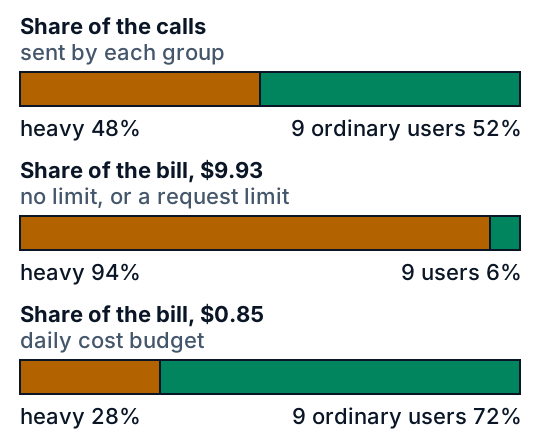
A daily budget changes the bill and not the calls. The heavy user is refused 185 of 190 calls. The nine ordinary users never come near $0.25, so they are refused none of their 204.
Count money, per signed-in user
The budget is an amount of money (or of model tokens) that one account may use in a period. Key it to an account id your server trusts, read from the sign-in check and never from a field the browser sends. A network address is a poor key: one person can change it, and an office or phone network shares one. The per-address limit from lesson 9 keeps its job for visitors who are not signed in. For them, ask for a sign-in before the costly features, or give all signed-out visitors one small shared budget, so a flood cannot spend more than that; the cost is that one visitor can use it up for everyone signed out.
Set aside first, then charge
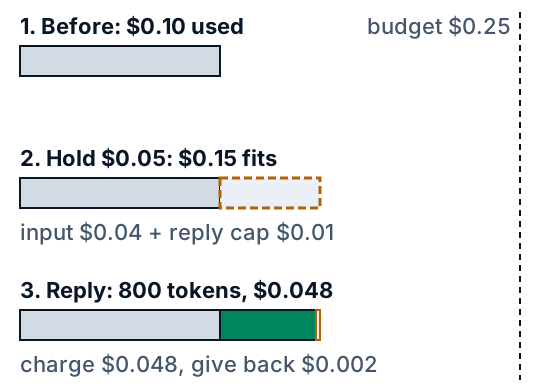
Before it calls the AI service, the server works out the most the call can cost. That is the input it can count, priced as input, plus the reply cap (the longest reply it will allow, lesson 9’s max_tokens) priced as output. If that does not fit in what is left of the user’s budget, the call is refused. If it fits, the amount is set aside and the call goes ahead. The reply carries usage numbers (input and output token counts), which give the real cost; the server charges that and gives back the rest.
Why checking is not enough
Suppose the server only checks what is already charged. A user opens 20 calls at once, from a script or a retry loop. Each check sees $0 used, so all 20 pass, and each costs $0.048. The bill is $0.96, almost four times the $0.25 budget. With the set-aside, the first 5 calls each hold $0.05, so five fill the budget, and the other 15 are refused. Each of the 5 then costs $0.048, so the bill is $0.24. The set-aside makes the check count calls that are still running.
What the user sees
A refused user gets a message such as “Your AI budget has $0.03 left and this call needs up to $0.11. It refills in 1 h 0 min.” Add a short code the app can test, budget_used_up. Send no short Retry-After header: it tells clients to retry soon, and the budget is back in hours. Lesson 10 explains why a used-up quota is not a retry case, and Anthropic says its own spend-cap 429 has no retry-after header (read 2026-10-19). A call bigger than the whole budget gets another code and the message “Send less text”, because waiting never helps.
What this means when you build
- Count money, per account. Multiply the input and output counts that come back with each reply by your prices, and add them to the account’s total.
- Put a cap on every reply. Without one, a call has no top cost, so there is nothing to set aside. Hidden reasoning is billed as output but counts toward the cap (lesson 7), so the set-aside is still the most a call can cost. For a provider that lesson does not name, check its docs.
- Size the budget so ordinary users never meet it. Set it well above what they spend. In the toy, $0.15 to $0.50 a day turned away none of them on any of 200 days. At $0.05, the day shown turns away 77 of their calls.
- Tell the user when it refills. A message and a code, not a bare 429.
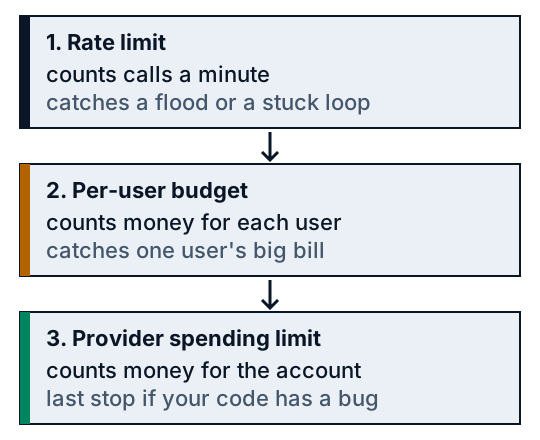
- Keep the AI company’s spending limit as the last stop. Check that it is a hard limit, not only an alert. It covers the whole account, so when it trips, every user stops.
Optionalabout 13 min
Go deeper
Optional, for readers who write Python. The code is in the code/ folder: budget.py is the budget and the server step, inflight.py fires many calls at once, sim.py is the toy day, test_budget.py, test_sim.py and test_widget.py are the tests, and python3 show_numbers.py prints every number above.
Money as whole numbers
Decimal dollars drift in floating point (0.1 + 0.2 is not 0.3), so a budget that adds many small charges would drift too. The code counts micro-dollars, millionths of a dollar, as whole numbers. At the example prices of $2 and $10 per million tokens, one input token is exactly 2 micro-dollars and one output token exactly 10.
PRICE_IN = 2  # micro-dollars per input token
PRICE_OUT = 10  # micro-dollars per output token
def cost(input_tokens, output_tokens):
"""Micro-dollars a call costs."""
return input_tokens * PRICE_IN + output_tokens * PRICE_OUTThe short question is 60 × 2 + 30 × 10 = 420. The long document is 50,000 × 2 + 2,000 × 10 = 120,000, and 120,000 / 420 is 285.7. The daily budget of $0.25 is 250,000.
Reserve, settle, release
A Budget keeps, for each user, what has been used so far. reserve checks and sets aside, settle swaps the set-aside for the real cost, and release gives everything back when the call failed.
def reserve(self, user, amount, now):
"""Set `amount` aside, or raise OverBudget. The check and the set-aside happen under one lock, so two calls cannot both take the last of it."""
with self._lock:
used, stamp = self._fresh(user, now)
if used + amount > self.limit:
excess = used + amount - self.limit
if amount > self.limit:
wait = None # bigger than the whole budget: waiting never helps
elif self.refill == "daily":
wait = DAY - now % DAY
else:
wait = excess * DAY / self.limit
raise OverBudget(amount, max(0, self.limit - used), wait)
self._state[user] = (used + amount, stamp)
return Hold(user, amount, stamp if self.refill == "daily" else 0)
def settle(self, hold, actual, now):
"""Replace the set-aside with the real cost. If the real cost is higher, the user is charged it all and may go over."""
with self._lock:
used, stamp = self._fresh(hold.user, now)
if self.refill == "daily" and hold.period != stamp:
return # the day this call was set aside in has ended, and its count with it
self._state[hold.user] = (max(0, used + actual - hold.amount), stamp)
def release(self, hold, now):
"""The service answered with an error, or never got the call: give the whole set-aside back."""
self.settle(hold, 0, now)The test is used + amount > limit, so a call that fits exactly is allowed. The hand example from the figure has a budget of 250,000, an input of 20,000 tokens, a reply cap of 1,000 and a reply of 800 tokens. The reserve is 20,000 × 2 + 1,000 × 10 = 50,000. The settle is 20,000 × 2 + 800 × 10 = 48,000. The used amount moves like this:
| Step | Used |
|---|---|
| Before | 100,000 |
| Reserve | 150,000 |
| Settle | 148,000 |
If the real cost is higher than the set-aside, settle charges all of it and the user can end above the limit. That can only happen when the input count was too low or the reply broke the cap. The set-aside is a promise that is only as good as its estimate.
One call through the server
handle_chat is the step from lesson 9, with the budget added. user is the account id from your sign-in check. upstream calls the AI service and returns the text and its usage numbers; on a timeout it raises Python’s own TimeoutError.
def handle_chat(budget, upstream, user, request, now, max_reply=MAX_REPLY, count_tokens=input_tokens_upper_bound):
"""Run one chat call for a signed-in user. Returns (status, body).
`user` is the account id from your sign-in check, never a value the browser sends. `upstream(request, max_reply)`
calls the AI service and returns {"text": ..., "usage": {"input_tokens": ..., "output_tokens": ...}}. On a
timeout it must raise Python's own TimeoutError, so map your HTTP library's timeout error to it.
"""
if user is None:
return 401, {"error": "sign_in", "message": "Sign in to use the assistant."}
amount = cost(count_tokens(request["messages"]), max_reply) # the most this call can cost
try:
hold = budget.reserve(user, amount, now)
except OverBudget as refused:
return 429, refusal(refused, budget.limit, now) # no short Retry-After: it tells clients to retry soon, and the budget is back in hours
try:
answer = upstream(request, max_reply)
except TimeoutError:
# the provider may still bill a call that timed out, so keep the set-aside: the safe side.
# It stays counted until the daily reset, or drains with a steady refill.
return 502, {"error": "upstream_timeout", "message": "The AI service did not answer in time. The call may still count against your budget."}
except Exception:
budget.release(hold, now) # the service answered with an error, so give the set-aside back
return 502, {"error": "upstream_failed", "message": "The AI service failed. Try again in a moment."}
usage = answer["usage"]
actual = cost(usage["input_tokens"], usage["output_tokens"])
budget.settle(hold, actual, now)
return 200, {"text": answer["text"], "charged": actual}A visitor who is not signed in gets 401 and costs nothing. A refused call gets 429 with the body from refusal: the code budget_used_up or request_too_big, a message, and for the first one resets_at, the time the budget is back as seconds since 1 January 1970. There is no Retry-After key, and a test checks that no key in the body mentions retry.
The overrun, in code
CheckOnlyBudget is the first version most people write. It looks at what is already charged and sets nothing aside. It is the same class with one change: it reserves 0.
class CheckOnlyBudget(Budget):
"""The first version most people write: look at what is already charged, make the call, charge afterwards. Nothing is set aside."""
def reserve(self, user, amount, now):
return super().reserve(user, 0, now)fire in inflight.py starts 20 threads that each send handle_chat a call of 20,000 input tokens and 800 output tokens. Every call that gets past the budget waits inside the fake AI service until each other call is either inside or refused, so no call has been charged when the last one is checked. That holds the overlap steady, so the result does not depend on timing.
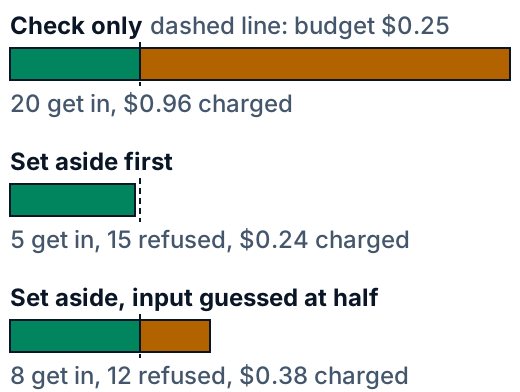
| Version | In | Charged |
|---|---|---|
| Check only | 20 | $0.96 |
| Set aside first | 5 | $0.24 |
| Half estimate | 8 | $0.38 |
Of the 20 calls, the rest are refused. The last row guesses the input at half its size, so the set-aside shrinks and more calls fit. The section on estimating the input comes back to it.
Refill rules
When does the used amount go back to 0? _fresh brings a user’s count up to the current time, in one of two ways.
def _fresh(self, user, now):
"""(used, stamp) for this user brought up to `now`. Call it with the lock held."""
used, stamp = self._state.get(user, (0, None))
if self.refill == "daily":
day = int(now // DAY)
return (used if stamp == day else 0), day
if stamp is not None:
used = max(0, used - (now - stamp) * self.limit / DAY)
return used, nowA daily reset wipes the count at 00:00 UTC. It is easy to state (“$0.25 a day”) but it has a cliff: a user can spend a full budget just before midnight and another just after. A steady refill drains the count by limit / 86400 a second, so a spent budget is all back a day later and there is no cliff. Its cost is that “when is it back” depends on how much the next call needs. The widget uses the daily rule; the tests cover both. A hold carries the day it was set aside in. If the day has changed by the time the reply arrives, settle and release ignore it, because the count it belonged to is gone.
Where the count lives
The lock in reserve makes the check and the set-aside one step, but only inside one process. With two server processes, each with its own count, a user can spend the whole budget in each. The test sends the same 20 calls to two separate Budget objects: 10 get in and $0.48 is charged, 1.9 times the budget. A read of the count followed by a write is the check-only bug again, now spread over machines. The count has to live in one shared store that offers an atomic step: check that the amount fits and add it, as one operation that no other call can slip into. Most databases and caches have one, such as a conditional update or a transaction. A count held in memory is also lost when the process restarts, and on hosting where each request may run in a new process there is no memory to share.
Estimating the input
The set-aside needs the input size before the call. handle_chat takes it from count_tokens, a function you pass in. The best source is the provider’s own counter. Anthropic’s token-counting page (read 2026-10-19) says its endpoint takes the same inputs as creating a message and returns the total input tokens, and that the count is an estimate that may differ by a small amount. Google’s tokens page (read 2026-10-19) describes a count call before you send. The default here is an upper bound that needs no network:
def input_tokens_upper_bound(messages):
"""A count that never falls short for the text in `messages`: a token covers at least one byte of text, so bytes >= tokens (plus the per-message extra). The caller adds the system prompt and tool definitions."""
return sum(len(m["content"].encode("utf-8")) + MESSAGE_OVERHEAD for m in messages)MESSAGE_OVERHEAD = 10 is an assumption for the extra tokens a chat format adds to each message; check your provider’s counter. The bound over-reserves, by several times for ordinary English, because a token usually covers more than a byte. That costs the user nothing: settle gives the surplus back. It only makes the budget look fuller while calls are in flight.
A low estimate is the dangerous one. With the input guessed at half its size, 8 calls fit in place of 5, and the bill is $0.384, 1.5 times the budget. In general, the overshoot is at most the sum of the shortfalls of the calls in flight. A model may also bill input in parts. Anthropic’s rate-limits page (read 2026-10-19) says that when prompt caching is on, the input_tokens in the usage numbers counts only the tokens after the last cache breakpoint, and the total is cache_read_input_tokens + cache_creation_input_tokens + input_tokens. The toy prices all input at one price, so it ignores that.
Proof it works
cd lessons/how-to-stop-one-user-running-up-the-bill/code && python3 -m pytest -q -xThe tests need no network. Each one guards a failure that the others would miss.
- One call can cost hundreds of times another:
test_one_call_can_cost_hundreds_of_times_another - A call that fits exactly is allowed and one micro-dollar more is not:
test_reserve_allows_an_exact_fit_and_refuses_one_micro_dollar_more - Settle gives back the surplus, and a reply over the set-aside is charged in full:
test_settle_charges_the_real_cost_and_gives_back_the_restandtest_a_reply_that_costs_more_than_the_set_aside_is_charged_in_full - A day change drops a stale hold:
test_daily_budget_restarts_at_midnight_and_a_hold_from_yesterday_is_ignored - The refusal has a message, a refill time and no retry hint:
test_refused_call_gets_a_clear_message_and_the_refill_time_not_a_bare_429 - 20 calls at once pass a check-only budget and not the set-aside:
test_twenty_calls_at_once_all_pass_a_check_made_before_any_is_charged - Two separate counts each allow the whole budget, and a low estimate overshoots:
test_two_server_processes_with_their_own_counts_each_allow_the_whole_budgetandtest_a_low_estimate_lets_more_calls_in_and_the_budget_is_overshot - The check and the set-aside are one step under threads:
test_the_check_and_the_set_aside_are_one_step_under_threadsmakes the read slow on purpose, so a lock that is missing shows up - The toy day:
test_the_numbers_the_lesson_names_for_the_day_it_showsandtest_over_many_days_the_budget_cuts_the_heavy_share_and_turns_no_ordinary_user_away
The last test checks the claim that matters most over 200 seeds, not one lucky day: under no limit the heavy user is at least 90% of the bill, under the budget at most 35%, and neither the budget nor 5 calls a minute turns away an ordinary call; nor does any budget from $0.15 to $0.50. Another test adds up the worst day an ordinary user can have in the toy: 40 calls of the dearest size plus the largest set-aside is 195,800 micro-dollars, under the 250,000 budget, so none of them can reach it. The widget’s JavaScript is run under Node.js against the Python on 300 runs, and every Python block in this lesson is checked to be a verbatim excerpt of the code.
What the toy leaves out
- Streaming. A reply that streams can be cut off, and the usage numbers arrive at the end. Decide in advance what a cut-off call is charged. The cautious choice is the whole set-aside, which
handle_chatkeeps when a call times out. - One price. Real prices differ by model, and cached input has its own price.
- Hidden reasoning. It is billed as output, but the reply cap bounds reasoning and visible reply together (lesson 7), so the set-aside stays a true maximum. A cap set too low can cut the visible reply short, so size it for the longest answer you want.
- A refused call is lost. The toy’s user does not retry or shorten the request.
- Many accounts per person. A budget for each account does not stop one person from opening many. Sign-up checks, and the AI company’s spending limit, cover that.
- The clock. A reset at 00:00 UTC falls at an odd hour for most users, so the message should give the time left, not “tomorrow”.
Where this is used in practice
OWASP’s API Security Top 10 (2023), in API4 “Unrestricted Resource Consumption” (read 2026-10-19), says some resources are paid for per request by third-party providers, and lists missing or badly set limits, including the third-party provider’s spending limit, as a way for an API to be vulnerable. OWASP’s Top 10 for LLM Applications (2025), in LLM10 “Unbounded Consumption” (read 2026-10-19), names Denial of Wallet, an attack on the cost-per-use model of cloud AI services, and lists rate limiting and user quotas as a mitigation. OpenAI’s rate-limits page (read 2026-10-19) says spend limits can be set for an organization or a project, that a spend alert only notifies, and that with a hard spend limit the affected requests return a 429. Its error-codes page (read 2026-10-19) lists project_spend_limit_exceeded, a 429 that means the project has reached its enforced monthly limit while other projects continue. Anthropic’s rate-limits page (read 2026-10-19) says each usage tier has a monthly spend cap and that you may set a lower limit of your own. At the tier cap, requests return 429 with a message that says when access resumes; at a limit you set yourself they return 400 invalid_request_error. So read the error body, not only the status.
Skills this lesson builds
- Explain why a request limit does not cap cost, and show it with numbers from a simulated day.
- Write a per-user budget that sets aside the most a call can cost, refuses what does not fit, and settles the real cost.
- Reproduce a concurrency bug (calls in flight that all pass a check) in a test, and show that the fix closes it.
- Design a refusal that tells the user what is left and when the budget refills, without inviting a retry loop.
- Choose where the count lives and which layer catches what: rate limit, per-user budget, provider spending limit.
Portfolio project: add a per-user daily budget to a small chat server that calls a fake AI service. Publish a seeded test that runs one heavy user and nine ordinary users under three rules, a table of each user’s share of the bill and the calls refused, and a note on how your server counts when it runs more than one process.
Check yourself
-
A user stays under 5 calls a minute all day and still runs up most of the bill. How, and what rule would have stopped it?
Answer
A request limit counts calls, not cost, and one call can cost hundreds of times another. The heavy user sent long documents, one every few minutes, so no call was refused while each cost far more than an ordinary one. A budget counted in money for each signed-in user stops it, because it adds up what the calls cost and refuses the call that no longer fits.
-
Before and after each call, what does the server do with the user’s budget?
Answer
Before the call, it sets aside the most the call can cost: the input it can count priced as input, plus the reply cap priced as output. It refuses the call if that amount does not fit in what is left. After the reply, it charges the real cost from the usage numbers and gives back the rest of the set-aside.
-
A user has a $0.25 budget and has used $0.10. A call has 20,000 input tokens, the reply cap is 1,000 tokens, and the reply has 800 tokens. At $2 and $10 per million tokens, what is set aside, does it fit, and what is the user’s count afterwards?
Answer
The set-aside is 20,000 × 2 + 1,000 × 10 = 50,000 micro-dollars, $0.05. 100,000 + 50,000 = 150,000 is below 250,000, so it fits. The real cost is 20,000 × 2 + 800 × 10 = 48,000, so 2,000 ($0.002) is given back and the count is 148,000, $0.148.
-
Your app runs on two server processes, and each keeps its own count in memory. What happens to a $0.25 budget, and what is the fix?
Answer
Each process thinks the user has the whole budget, so the user can spend it in each. In the lesson’s test, 20 calls at once spread over two counts let 10 in and charge $0.48, 1.9 times the budget. The fix is one shared store with an atomic step that checks that the amount fits and adds it in one operation.
-
The server’s count of input tokens is half the real size. Twenty calls arrive at once. What goes wrong, and what are two ways to lower the risk?
Answer
Each set-aside is too small, so 8 calls get in and not 5, and the charge is about $0.384, 1.5 times the budget. Use the provider’s own token counter, or an upper bound that never falls short (bytes of text plus a per-message extra). Also leave room between the budget and the provider’s spending limit.
Further reading
Web pages were read on 2026-10-19; providers change them.
Gentle
- Why the AI bill is high (lesson 7)
- A key in the browser (lesson 9)
- What “too many requests” means (lesson 10)
- Rate limits (Anthropic documentation)
- Token counting (Anthropic documentation)
- Rate limits (OpenAI documentation)
- Understand and count tokens (Google AI for Developers)
Deep
- API4:2023 Unrestricted Resource Consumption (OWASP API Security Top 10)
- LLM10:2025 Unbounded Consumption (OWASP Top 10 for LLM Applications)
- Error codes (OpenAI documentation)
Optional
Code
Each file runs on its own. Download it, or read it here.
Show code
"""A budget for each signed-in user, counted in money and checked before each AI call. Python standard library only.
Prices are the example prices from lesson 7 ($2 and $10 per million tokens), not a quote. Money is counted in
micro-dollars (millionths of a dollar) as whole numbers, so $2 per million tokens is exactly 2 micro-dollars per token.
A call goes through three steps. reserve() sets aside the most the call can cost and refuses if that does not fit.
settle() charges what the call really cost and gives the rest back. release() gives everything back when the service answered with an error.
Time is a parameter (seconds) so a test can move it without waiting.
"""
import math
import threading
from dataclasses import dataclass
PRICE_IN = 2 # micro-dollars per input token
PRICE_OUT = 10 # micro-dollars per output token
MAX_REPLY = 1000 # the reply cap the server sends with every call (lesson 9's max_tokens)
DAY = 86_400 # seconds
MESSAGE_OVERHEAD = 10 # tokens added per message by the chat format: an assumption; check your provider's counter
def cost(input_tokens, output_tokens):
    """Micro-dollars a call costs."""
    return input_tokens * PRICE_IN + output_tokens * PRICE_OUT
def dollars(micro):
"""Text such as "$0.25". Whole cents, halves round up (widget.html does the same sum)."""
cents = (micro + 5_000) // 10_000
return f"${cents // 100}.{cents % 100:02d}"
def how_long(seconds):
"""Text such as "9 h 20 min", rounded up to a whole minute."""
hours, minutes = divmod(max(1, math.ceil(seconds / 60)), 60)
return f"{hours} h {minutes} min" if hours else f"{minutes} min"
def input_tokens_upper_bound(messages):
"""A count that never falls short for the text in `messages`: a token covers at least one byte of text, so bytes >= tokens (plus the per-message extra). The caller adds the system prompt and tool definitions."""
return sum(len(m["content"].encode("utf-8")) + MESSAGE_OVERHEAD for m in messages)
class OverBudget(Exception):
"""reserve() refused. `left` is what is still free, `wait` the seconds until the call fits (None: it never will)."""
def __init__(self, amount, left, wait):
super().__init__(f"needs {amount}, {left} left")
self.amount, self.left, self.wait = amount, left, wait
@dataclass(frozen=True)
class Hold:
user: str
amount: int # micro-dollars set aside
period: int # the day it was set aside in (steady refill: always 0)
class Budget:
"""Each user may use `limit` micro-dollars. refill="daily": the count restarts at 00:00 UTC.
refill="steady": the count drains by limit/86400 per second, so the whole budget is back after a day of no use."""
def __init__(self, limit, refill="daily"):
if refill not in ("daily", "steady"):
raise ValueError("refill is daily or steady")
self.limit, self.refill = limit, refill
self._state = {} # user -> (used, stamp); stamp is the day number (daily) or the time of the last update (steady)
self._lock = threading.Lock() # one process only: with two processes the state must live in one shared store
def _fresh(self, user, now):
"""(used, stamp) for this user brought up to `now`. Call it with the lock held."""
used, stamp = self._state.get(user, (0, None))
if self.refill == "daily":
day = int(now // DAY)
return (used if stamp == day else 0), day
if stamp is not None:
used = max(0, used - (now - stamp) * self.limit / DAY)
return used, now
def used(self, user, now):
with self._lock:
return self._fresh(user, now)[0]
    def reserve(self, user, amount, now):
        """Set `amount` aside, or raise OverBudget. The check and the set-aside happen under one lock, so two calls cannot both take the last of it."""
        with self._lock:
            used, stamp = self._fresh(user, now)
            if used + amount > self.limit:
                excess = used + amount - self.limit
                if amount > self.limit:
                    wait = None  # bigger than the whole budget: waiting never helps
                elif self.refill == "daily":
                    wait = DAY - now % DAY
                else:
                    wait = excess * DAY / self.limit
                raise OverBudget(amount, max(0, self.limit - used), wait)
            self._state[user] = (used + amount, stamp)
            return Hold(user, amount, stamp if self.refill == "daily" else 0)

    def settle(self, hold, actual, now):
        """Replace the set-aside with the real cost. If the real cost is higher, the user is charged it all and may go over."""
        with self._lock:
            used, stamp = self._fresh(hold.user, now)
            if self.refill == "daily" and hold.period != stamp:
                return  # the day this call was set aside in has ended, and its count with it
            self._state[hold.user] = (max(0, used + actual - hold.amount), stamp)

    def release(self, hold, now):
        """The service answered with an error, or never got the call: give the whole set-aside back."""
        self.settle(hold, 0, now)
class CheckOnlyBudget(Budget):
"""The first version most people write: look at what is already charged, make the call, charge afterwards. Nothing is set aside."""
def reserve(self, user, amount, now):
return super().reserve(user, 0, now)
def refusal(refused, limit, now):
"""The JSON body for a refused call: a code the app can test, a message a person can read, and when the budget is back."""
if refused.wait is None:
return {"error": "request_too_big",
"message": f"This request could cost up to {dollars(refused.amount)}, more than your whole {dollars(limit)} budget. Send less text."}
return {"error": "budget_used_up", "resets_at": int(now + refused.wait),
"message": f"Your AI budget has {dollars(refused.left)} left and this call needs up to {dollars(refused.amount)}. "
f"It refills in {how_long(refused.wait)}."}
def handle_chat(budget, upstream, user, request, now, max_reply=MAX_REPLY, count_tokens=input_tokens_upper_bound):
    """Run one chat call for a signed-in user. Returns (status, body).

    `user` is the account id from your sign-in check, never a value the browser sends. `upstream(request, max_reply)`
    calls the AI service and returns {"text": ..., "usage": {"input_tokens": ..., "output_tokens": ...}}. On a
    timeout it must raise Python's own TimeoutError, so map your HTTP library's timeout error to it.
    """
    if user is None:
        return 401, {"error": "sign_in", "message": "Sign in to use the assistant."}
    amount = cost(count_tokens(request["messages"]), max_reply)  # the most this call can cost
    try:
        hold = budget.reserve(user, amount, now)
    except OverBudget as refused:
        return 429, refusal(refused, budget.limit, now)  # no short Retry-After: it tells clients to retry soon, and the budget is back in hours
    try:
        answer = upstream(request, max_reply)
    except TimeoutError:
        # the provider may still bill a call that timed out, so keep the set-aside: the safe side.
        # It stays counted until the daily reset, or drains with a steady refill.
        return 502, {"error": "upstream_timeout", "message": "The AI service did not answer in time. The call may still count against your budget."}
    except Exception:
        budget.release(hold, now)  # the service answered with an error, so give the set-aside back
        return 502, {"error": "upstream_failed", "message": "The AI service failed. Try again in a moment."}
    usage = answer["usage"]
    actual = cost(usage["input_tokens"], usage["output_tokens"])
    budget.settle(hold, actual, now)
return 200, {"text": answer["text"], "charged": actual}Show code
"""Keep the data inside ../widget.html equal to the data in sim.py and budget.py.

    python3 embed_widget.py          rewrite the data block in widget.html
    python3 embed_widget.py --check  exit 1 if widget.html differs (test_widget.py runs the same check)
"""
import json
import re
import sys
from pathlib import Path

import sim
from budget import DAY, MAX_REPLY, PRICE_IN, PRICE_OUT

WIDGET = Path(__file__).resolve().parent.parent / "widget.html"
CONFIG_BLOCK = re.compile(r'(<script type="application/json" id="qb-config">)(.*?)(</script>)', re.S)


def config():
    return {"users": sim.USERS, "day": DAY, "seed": sim.SEED, "rpm": sim.RPM, "budget": sim.BUDGET, "start": sim.START_RULE,
            "priceIn": PRICE_IN, "priceOut": PRICE_OUT, "maxReply": MAX_REPLY,
            "heavyFrom": sim.HEAVY_FROM, "heavyTo": sim.HEAVY_TO, "heavyIn": sim.HEAVY_IN, "heavyOut": sim.HEAVY_OUT, "heavyGap": sim.HEAVY_GAP,
            "ordinaryIn": sim.ORDINARY_IN, "ordinaryOut": sim.ORDINARY_OUT, "sessions": sim.SESSIONS, "sessionCalls": sim.SESSION_CALLS,
            "callGap": sim.CALL_GAP, "longestSession": sim.LONGEST_SESSION, "rules": [{"id": i, "name": name} for i, name in sim.RULES]}


def embed(html):
    """html with the config block rewritten from sim.py."""
    block = "{\n" + ",\n".join(f" {json.dumps(key)}: {json.dumps(value)}" for key, value in config().items()) + "\n}"
    return CONFIG_BLOCK.sub(lambda m: m.group(1) + "\n" + block + "\n" + m.group(3), html, count=1)


if __name__ == "__main__":
    current = WIDGET.read_text(encoding="utf-8")
    updated = embed(current)
    if "--check" in sys.argv:
        sys.exit(0 if updated == current else 1)
    WIDGET.write_text(updated, encoding="utf-8")
print("widget.html data block now matches sim.py")Show code
"""Many calls in flight at once, against a budget with the set-aside and one without. Python standard library only.

fire() starts all the calls together. Each call that gets past the budget waits inside the (fake) AI service until every
other call has either got in or been refused, so no call has been charged yet when the last one is checked.
"""
import threading
import time

from budget import MAX_REPLY, handle_chat

CALLS = 20  # calls started at the same moment by one user
BURST_INPUT = 20_000  # input tokens in each call
BURST_OUTPUT = 800  # output tokens each reply really has (the cap is 1,000)
USER = "user-1"


def fire(budget, calls=CALLS, estimate=BURST_INPUT, input_tokens=BURST_INPUT, output_tokens=BURST_OUTPUT):
    """Run `calls` chat calls at once. Returns (statuses, charged micro-dollars). `estimate` is the input count the server believes."""
    gate, lock = threading.Event(), threading.Lock()
    inside = [0]
    statuses = [None] * calls
    request = {"messages": [{"role": "user", "content": "a long document"}]}

    def upstream(req, max_reply):
        with lock:
            inside[0] += 1
        if not gate.wait(10):
            raise TimeoutError("the gate never opened")
        return {"text": "ok", "usage": {"input_tokens": input_tokens, "output_tokens": output_tokens}}

    def call(i):
        statuses[i] = handle_chat(budget, upstream, USER, request, 0.0, MAX_REPLY, lambda messages: estimate)[0]

    threads = [threading.Thread(target=call, args=(i,)) for i in range(calls)]
    for thread in threads:
        thread.start()
    deadline = time.monotonic() + 10
    while inside[0] + sum(s is not None for s in statuses) < calls:  # every call is either inside or already refused
        if time.monotonic() > deadline:
            gate.set()
            raise TimeoutError("calls did not settle into inside or refused")
        time.sleep(0.001)
    gate.set()
    for thread in threads:
        thread.join()
return statuses, budget.used(USER, 0.0)Show code
"""Print the numbers the lesson quotes. Run: python3 show_numbers.py"""
from budget import Budget, CheckOnlyBudget, cost, dollars
from inflight import BURST_INPUT, fire
from sim import RULES, SEED, simulate_day

LIMIT = 250_000

print(f"A short question (60 in, 30 out) costs {cost(60, 30)} micro-dollars; a long document (50,000 in, 2,000 out) costs {cost(50_000, 2_000)}: "
      f"{cost(50_000, 2_000) / cost(60, 30):.1f} times as much.")
print(f"\nOne simulated day (seed {SEED}), ten users, one heavy:")
for rule, name in RULES:
    day = simulate_day(rule)
    print(f"  {name:20} bill {dollars(day.bill)}  heavy share {day.percent(0)}%  heavy calls refused {day.refused[0]} of {day.served[0] + day.refused[0]}"
          f"  ordinary calls refused {day.ordinary_refused} of {day.ordinary_asked}  ordinary users {min(day.percent(u) for u in range(1, 10))}-{max(day.percent(u) for u in range(1, 10))}% each")
print(f"\n20 calls at once, each costing ${cost(BURST_INPUT, 800) / 1e6:.3f}; the budget is {dollars(LIMIT)}:")
for label, budget, kwargs in (("check only", CheckOnlyBudget(LIMIT), {}), ("set aside first", Budget(LIMIT), {}), ("set aside, input guessed at half", Budget(LIMIT), {"estimate": BURST_INPUT // 2})):
    statuses, charged = fire(budget, **kwargs)
print(f" {label:34} admitted {statuses.count(200):2} refused {statuses.count(429):2} charged {dollars(charged)} ({charged / LIMIT:.2f} times the budget)")Show code
"""One day of AI calls from ten users, one of them heavy, under three rules. Python standard library only.

A toy, not a model of any real app. Ordinary users chat in a few short sessions; the heavy user sends long documents
all day, one call every few minutes. The three rules differ only in what the server checks before it makes a call:
nothing, a number of calls per minute for each user, or a daily budget in money for each user. A refused call is lost
(the user is told and does not retry). The same seed always gives the same day; widget.html has the same code.
"""
from dataclasses import dataclass

from budget import DAY, MAX_REPLY, Budget, OverBudget, cost

USERS = 10  # user 0 is the heavy user, users 1 to 9 are ordinary
HEAVY = 0
SEED = 7  # the day the lesson shows
RPM = 5  # calls per minute each user may make under the "requests per minute" rule
BUDGET = 250_000  # micro-dollars each user may spend in a day under the budget rule ($0.25)
HEAVY_FROM, HEAVY_TO = 6 * 3600, 22 * 3600  # the heavy user works from 06:00 to 22:00
RULES = (("none", "No limit"), ("rpm", "Requests per minute"), ("budget", "Daily cost budget"))
START_RULE = "rpm"  # the widget opens on this rule

# What one call is made of, as (lowest, highest) token counts. Ordinary users: 3 to 5 sessions a day of 4 to 8 calls, 20 to 89 s apart.
ORDINARY_IN, ORDINARY_OUT = (300, 900), (80, 280)
HEAVY_IN, HEAVY_OUT = (16_000, 24_000), (700, 1000)
HEAVY_GAP = (240, 360)  # seconds between the heavy user's calls
SESSIONS, SESSION_CALLS, CALL_GAP = (3, 5), (4, 8), (20, 89)
LONGEST_SESSION = 8 * 89  # seconds; a session starts early enough to end inside the day

MASK = 0xFFFFFFFF


def random_numbers(seed):
    """Endless numbers in [0, 1), the same on every machine (the mulberry32 generator, as in lesson 10; widget.html has the same code)."""
    state = seed & MASK
    while True:
        state = (state + 0x6D2B79F5) & MASK
        t = ((state ^ (state >> 15)) * (state | 1)) & MASK
        t ^= (t + (((t ^ (t >> 7)) * (t | 61)) & MASK)) & MASK
        yield ((t ^ (t >> 14)) & MASK) / 4294967296


class TokenBucket:
    """From lesson 9: holds up to `capacity` tickets and gains `rate` tickets per second. A call spends one."""

    def __init__(self, capacity, rate, now):
        self.capacity, self.rate = capacity, rate
        self.level, self.last = float(capacity), now

    def take(self, now):
        """Spend one ticket if there is one. Return True if the call is allowed."""
        self.level = min(self.capacity, self.level + (now - self.last) * self.rate)
        self.last = now
        if self.level >= 1:
            self.level -= 1
            return True
        return False


def between(draw, low, high):
    """A whole number from low to high, both included."""
    return low + int(draw() * (high - low + 1))


def make_day(seed):
    """Every call of the day as (second, user, input tokens, output tokens), in time order."""
    draw = random_numbers(seed).__next__
    calls = []
    t = HEAVY_FROM
    while t < HEAVY_TO:
        calls.append((t, HEAVY, between(draw, *HEAVY_IN), between(draw, *HEAVY_OUT)))
        t += between(draw, *HEAVY_GAP)
    for user in range(1, USERS):
        for _ in range(between(draw, *SESSIONS)):
            t = between(draw, 0, DAY - LONGEST_SESSION)
            for _ in range(between(draw, *SESSION_CALLS)):
                calls.append((t, user, between(draw, *ORDINARY_IN), between(draw, *ORDINARY_OUT)))
                t += between(draw, *CALL_GAP)
    return sorted(calls, key=lambda c: (c[0], c[1]))  # equal times keep the order they were made in


@dataclass(frozen=True)
class Day:
    rule: str
    served: tuple  # per user: calls answered
    refused: tuple  # per user: calls refused
    spent: tuple  # per user: micro-dollars charged

    @property
    def bill(self):
        return sum(self.spent)

    def percent(self, user):
        """The user's share of the bill in whole percent, halves round up (whole-number arithmetic, so JavaScript agrees)."""
        return (200 * self.spent[user] + self.bill) // (2 * self.bill) if self.bill else 0

    @property
    def ordinary_refused(self):
        return sum(self.refused[1:])

    @property
    def ordinary_asked(self):
        return sum(self.served[1:]) + self.ordinary_refused


def simulate_day(rule, seed=SEED, rpm=RPM, budget=BUDGET):
    served, refused, spent = [0] * USERS, [0] * USERS, [0] * USERS
    buckets = [TokenBucket(rpm, rpm / 60, 0) for _ in range(USERS)]
    wallet = Budget(budget)
    for t, user, tokens_in, tokens_out in make_day(seed):
        allowed = True
        if rule == "rpm":
            allowed = buckets[user].take(t)
        elif rule == "budget":
            try:
                wallet.settle(wallet.reserve(user, cost(tokens_in, MAX_REPLY), t), cost(tokens_in, tokens_out), t)
            except OverBudget:
                allowed = False
        if allowed:
            served[user] += 1
            spent[user] += cost(tokens_in, tokens_out)
        else:
            refused[user] += 1
return Day(rule, tuple(served), tuple(refused), tuple(spent))Show code
"""Tests for budget.py and inflight.py. Each test names the failure it guards."""
import re
import textwrap
import threading
import time
from pathlib import Path

import pytest

from budget import (DAY, MAX_REPLY, Budget, CheckOnlyBudget, OverBudget, cost, dollars, handle_chat, how_long, input_tokens_upper_bound, refusal)
from inflight import BURST_INPUT, BURST_OUTPUT, CALLS, fire
from sim import simulate_day

LIMIT = 250_000  # $0.25
REQUEST = {"messages": [{"role": "user", "content": "hello"}]}


def ok_upstream(tokens_in=100, tokens_out=50):
    return lambda request, max_reply: {"text": "hi", "usage": {"input_tokens": tokens_in, "output_tokens": tokens_out}}


def test_one_call_can_cost_hundreds_of_times_another():
    """The lesson's reason a request limit is not a cost limit: a short question and a long document, same price list."""
    short, long_ = cost(60, 30), cost(50_000, 2_000)
    assert (short, long_) == (420, 120_000)
    assert 285 < long_ / short < 286


def test_reserve_allows_an_exact_fit_and_refuses_one_micro_dollar_more():
    """Guards >= instead of > in the check: a user could never spend the last of the budget."""
    budget = Budget(1000)
    budget.reserve("a", 1000, 0)
    with pytest.raises(OverBudget):
        budget.reserve("a", 1, 0)
    with pytest.raises(OverBudget):
        Budget(1000).reserve("a", 1001, 0)


def test_settle_charges_the_real_cost_and_gives_back_the_rest():
    budget = Budget(LIMIT)
    hold = budget.reserve("a", 50_000, 0)
    assert budget.used("a", 0) == 50_000
    budget.settle(hold, 48_000, 0)
    assert budget.used("a", 0) == 48_000


def test_a_reply_that_costs_more_than_the_set_aside_is_charged_in_full():
    """Guards a settle that clamps to the hold: a wrong estimate would then be free, and the budget would drift low."""
    budget = Budget(100)
    hold = budget.reserve("a", 60, 0)
    budget.settle(hold, 90, 0)
    assert budget.used("a", 0) == 90
    budget.settle(budget.reserve("a", 10, 0), 30, 0)  # 90 + 10 fits; the real cost takes the user to 120
    assert budget.used("a", 0) == 120
    with pytest.raises(OverBudget):
        budget.reserve("a", 1, 0)


def test_release_gives_back_the_whole_set_aside():
    """Guards a failed call that keeps its hold: the user would pay for nothing."""
    budget = Budget(LIMIT)
    budget.release(budget.reserve("a", 50_000, 0), 0)
    assert budget.used("a", 0) == 0


def test_users_have_separate_budgets():
    """Guards one shared counter: one heavy user would lock everyone out."""
    budget = Budget(100)
    budget.reserve("heavy", 100, 0)
    budget.reserve("light", 100, 0)
    with pytest.raises(OverBudget):
        budget.reserve("heavy", 1, 0)


def test_daily_budget_restarts_at_midnight_and_a_hold_from_yesterday_is_ignored():
    """Guards a settle that lands after the reset: it would subtract yesterday's hold from today's fresh count and go negative."""
    budget = Budget(100)
    hold = budget.reserve("a", 50, DAY - 5)
    budget.settle(hold, 80, DAY + 3)  # a call that started before midnight ends after it
    assert budget.used("a", DAY + 3) == 0
    old = budget.reserve("b", 50, DAY - 5)
    budget.reserve("b", 40, DAY + 1)
    budget.release(old, DAY + 3)  # and a call that failed after midnight gives nothing back from today's count
    assert budget.used("b", DAY + 3) == 40
    today = budget.reserve("c", 50, DAY + 10)  # a call set aside and settled on the same day after the first midnight still settles
    budget.settle(today, 30, DAY + 20)
    assert budget.used("c", DAY + 20) == 30
    budget.settle(today, 0, DAY + 30)  # a hold settled twice must not take the count below zero and bank free credit
    assert budget.used("c", DAY + 30) == 0


def test_steady_refill_drains_by_limit_over_a_day_and_says_how_long_to_wait():
    budget = Budget(86_400, refill="steady")  # 1 micro-dollar back per second
    budget.reserve("a", 86_400, 0)
    assert budget.used("a", 1000) == 85_400
    with pytest.raises(OverBudget) as refused:
        budget.reserve("a", 2000, 1000)  # 1,000 is free, so the call is 1,000 too big
    assert refused.value.wait == 1000  # at 1 micro-dollar back per second
    budget.reserve("a", 1000, 1000)
    assert budget.used("a", 1000 + DAY) == 0
    budget.reserve("a", 86_400, 1000 + 10 * DAY)  # ten idle days bank no credit: the whole budget is free and not a unit more
    with pytest.raises(OverBudget):
        budget.reserve("a", 1, 1000 + 10 * DAY)


def test_a_call_bigger_than_the_whole_budget_is_told_to_send_less_not_to_wait():
    """Guards a message that says "try again later" for a call that can never fit."""
    status, body = handle_chat(Budget(LIMIT), ok_upstream(), "a", {"messages": [{"role": "user", "content": "x" * 200_000}]}, 0)
    assert status == 429 and body["error"] == "request_too_big" and "resets_at" not in body
    assert "Send less text" in body["message"]


def test_refused_call_gets_a_clear_message_and_the_refill_time_not_a_bare_429():
    """Lesson 10: a used-up quota is not a retry case. The body says so in words and in a code the app can test; there is no retry hint."""
    budget = Budget(LIMIT)
    now = 14 * 3600 + 40 * 60  # 14:40, so 9 h 20 min to midnight
    budget.reserve("a", 245_000, now)
    status, body = handle_chat(budget, ok_upstream(), "a", REQUEST, now)
    assert status == 429
    assert body["error"] == "budget_used_up"
    assert body["resets_at"] == DAY
    assert body["message"] == "Your AI budget has $0.01 left and this call needs up to $0.01. It refills in 9 h 20 min."
    assert not any("retry" in key for key in body)


def test_a_user_who_is_not_signed_in_gets_401_and_costs_nothing():
    calls = []
    status, body = handle_chat(Budget(LIMIT), lambda *a: calls.append(a), None, REQUEST, 0)
    assert (status, body["error"], calls) == (401, "sign_in", [])


def test_an_answered_call_is_charged_the_usage_numbers_not_the_estimate():
    budget = Budget(LIMIT)
    status, body = handle_chat(budget, ok_upstream(100, 50), "a", REQUEST, 0)
    assert (status, body["charged"]) == (200, cost(100, 50))
    assert budget.used("a", 0) == cost(100, 50)


def test_a_failed_upstream_call_costs_the_user_nothing_and_a_timed_out_one_keeps_its_set_aside():
    """Guards a missing release on the error path (each outage would eat the user's budget) and a release on a timeout (the provider may still bill that call)."""
    budget = Budget(LIMIT)

    def broken(request, max_reply):
        raise ConnectionError("down")

    def slow(request, max_reply):
        raise TimeoutError("no answer")

    status, body = handle_chat(budget, broken, "a", REQUEST, 0)
    assert status == 502 and body["error"] == "upstream_failed" and "Nothing was charged" not in body["message"]
    assert budget.used("a", 0) == 0
    status, body = handle_chat(budget, slow, "a", REQUEST, 0)
    assert status == 502 and body["error"] == "upstream_timeout" and "Nothing was charged" not in body["message"]
    assert budget.used("a", 0) == cost(input_tokens_upper_bound(REQUEST["messages"]), MAX_REPLY)


def test_the_set_aside_is_input_plus_the_reply_cap_priced_as_output():
    seen = {}
    budget = Budget(LIMIT)
    handle_chat(budget, lambda request, max_reply: seen.setdefault("held", budget.used("a", 0)) and ok_upstream()(request, max_reply),
                "a", REQUEST, 0, count_tokens=lambda messages: 700)
    assert seen["held"] == cost(700, MAX_REPLY)


def test_the_upper_bound_never_falls_below_the_real_count():
    """A token covers at least one byte of text, so bytes plus the per-message extra is a safe ceiling (English runs near 4 bytes a token)."""
    messages = [{"role": "user", "content": "naïve café 你好"}, {"role": "assistant", "content": "ok"}]
    bound = input_tokens_upper_bound(messages)
    assert bound == len("naïve café 你好".encode()) + len(b"ok") + 2 * 10
    assert bound >= len("naïve café 你好")


@pytest.mark.parametrize("seconds, text", [(9 * 3600 + 20 * 60, "9 h 20 min"), (1, "1 min"), (3601, "1 h 1 min"), (59 * 60, "59 min"), (3600, "1 h 0 min")])
def test_how_long_rounds_up_to_a_whole_minute(seconds, text):
    assert how_long(seconds) == text


@pytest.mark.parametrize("micro, text", [(250_000, "$0.25"), (4_999, "$0.00"), (5_000, "$0.01"), (9_925_000, "$9.93"), (1_000_000, "$1.00")])
def test_dollars_round_halves_up_to_whole_cents(micro, text):
    assert dollars(micro) == text


def test_twenty_calls_at_once_all_pass_a_check_made_before_any_is_charged():
    """The in-flight overrun. Without a set-aside every call sees an empty budget; with it only five fit."""
    each = cost(BURST_INPUT, BURST_OUTPUT)
    assert each == 48_000
    statuses, charged = fire(CheckOnlyBudget(LIMIT))
    assert (statuses.count(200), statuses.count(429), charged) == (CALLS, 0, CALLS * each)  # 20 calls, $0.96, 3.84 times the budget
    statuses, charged = fire(Budget(LIMIT))
    assert (statuses.count(200), statuses.count(429), charged) == (5, 15, 5 * each)  # 5 fit: 5 x $0.05 set aside = $0.25
    assert charged <= LIMIT


def test_two_server_processes_with_their_own_counts_each_allow_the_whole_budget():
    """Why the state must live in one shared store once there is more than one process (two Budget objects stand in for two processes)."""
    first, second = fire(Budget(LIMIT)), fire(Budget(LIMIT))
    assert first[0].count(200) + second[0].count(200) == 10
    assert first[1] + second[1] == 480_000 > 1.9 * LIMIT


def test_a_low_estimate_lets_more_calls_in_and_the_budget_is_overshot():
    """Guards the claim in the lesson: the set-aside is only as good as the estimate. Half the real input size admits 8 calls, not 5."""
    statuses, charged = fire(Budget(LIMIT), estimate=BURST_INPUT // 2)
    assert (statuses.count(200), charged) == (8, 384_000)
    assert charged > 1.5 * LIMIT


def test_the_check_and_the_set_aside_are_one_step_under_threads():
    """Guards a missing lock: a slow read widens the gap between the check and the set-aside, so threads that skip the lock all see an empty budget."""

    class SlowRead(Budget):
        def _fresh(self, user, now):
            fresh = super()._fresh(user, now)
            time.sleep(0.01)  # a real store takes time to answer
            return fresh

    budget, wins = SlowRead(1), []

    def grab():
        try:
            budget.reserve("a", 1, 0)
            wins.append(1)
        except OverBudget:
            pass

    threads = [threading.Thread(target=grab) for _ in range(8)]
    for thread in threads:
        thread.start()
    for thread in threads:
        thread.join()
    assert len(wins) == 1


def test_refusal_message_names_what_is_left_what_is_needed_and_the_refill():
    refused = OverBudget(cost(50_000, MAX_REPLY), 30_000, 3600)  # a 50,000-token input with the reply cap
    assert refusal(refused, LIMIT, 0) == {"error": "budget_used_up", "resets_at": 3600,
                                         "message": "Your AI budget has $0.03 left and this call needs up to $0.11. It refills in 1 h 0 min."}
    over = Budget(LIMIT)
    over.settle(over.reserve("a", 1, 0), 300_000, 0)  # a reply that overran its set-aside: more than the whole budget is used
    with pytest.raises(OverBudget) as refused:
        over.reserve("a", 1, 0)
    assert "$0.00 left" in refusal(refused.value, LIMIT, 0)["message"]  # never a negative amount such as "$-1.95 left"


HERE = Path(__file__).parent
LESSON = (HERE.parent / "lesson.md").read_text()


def test_every_python_block_in_the_lesson_is_a_verbatim_excerpt_of_the_source():
    """The lesson quotes these files. If the code changes and the lesson does not, the reader sees code that was never tested."""
    sources = [(HERE / name).read_text().splitlines() for name in ("budget.py", "inflight.py", "sim.py")]
    blocks = re.findall(r"^```python\n(.*?)^```", LESSON, flags=re.S | re.M)
    assert blocks, "the lesson has no python blocks to check"
    for block in blocks:
        lines = block.rstrip("\n").splitlines()
        windows = (textwrap.dedent("\n".join(source[i:i + len(lines)])) for source in sources for i in range(len(source) - len(lines) + 1))
        assert textwrap.dedent("\n".join(lines)) in windows, f"not in the source:\n{block}"


def test_the_lesson_quotes_the_numbers_the_code_gives():
    """Guards the prose drifting from the code: the excerpt test above covers the code blocks and not the numbers around them."""
    none, budget = simulate_day("none"), simulate_day("budget")
    heavy_calls, all_calls = none.served[0], sum(none.served)
    check_only, set_aside, half = fire(CheckOnlyBudget(LIMIT)), fire(Budget(LIMIT)), fire(Budget(LIMIT), estimate=BURST_INPUT // 2)
    first, second = fire(Budget(LIMIT)), fire(Budget(LIMIT))  # two server processes, each with its own count
    quotes = [
        f"costs ${cost(60, 30) / 1e6:.5f}", f"costs {dollars(cost(50_000, 2_000))}", f"about {round(cost(50_000, 2_000) / cost(60, 30))} times as much",
        f"that user is {none.percent(0)}% of a {dollars(none.bill)} bill", f"cuts the bill to {dollars(budget.bill)} and the heavy user's share to {budget.percent(0)}%",
        f"refuses none of the nine other users' {none.ordinary_asked} calls", f"makes {heavy_calls} of the day's {all_calls} calls, {round(100 * heavy_calls / all_calls)}%",
        f"is refused {budget.refused[0]} of {heavy_calls} calls", f"The bill is {dollars(check_only[1])}", f"the bill is {dollars(set_aside[1])}",
        f"the bill is ${half[1] / 1e6:.3f}", f"{set_aside[0].count(200)} calls each hold", f"{half[0].count(200)} calls fit",
        f"{first[0].count(200) + second[0].count(200)} get in and {dollars(first[1] + second[1])} is charged", f"turns away {simulate_day('budget', budget=50_000).ordinary_refused} of their calls",
        refusal(OverBudget(cost(50_000, MAX_REPLY), 30_000, 3600), LIMIT, 0)["message"],
        f"the nine ordinary users lose {simulate_day('rpm', rpm=1).ordinary_refused} calls",
    ]
    missing = [q for q in quotes if q not in LESSON]
assert not missing, missingShow code
"""Tests for sim.py: the numbers the lesson and the widget show, and the properties behind them."""
import pytest

from budget import MAX_REPLY, cost, dollars
from sim import (BUDGET, CALL_GAP, HEAVY, ORDINARY_IN, ORDINARY_OUT, RPM, SEED, SESSION_CALLS, SESSIONS, USERS, make_day, random_numbers, simulate_day)


def test_the_same_seed_gives_the_same_day_and_another_seed_a_different_one():
    assert make_day(SEED) == make_day(SEED) and make_day(SEED) != make_day(SEED + 1)
    assert simulate_day("budget") == simulate_day("budget")
    day = make_day(SEED)
    assert len(day) == 394 and day == sorted(day, key=lambda c: (c[0], c[1]))
    assert sum(1 for c in day if c[1] == HEAVY) == 190


def test_the_random_numbers_do_not_change():
    """Pins mulberry32 so the Python and the widget's copy cannot both drift to another stream."""
    gen = random_numbers(1)
    assert [next(gen) for _ in range(3)] == [0.6270739405881613, 0.002735721180215478, 0.5274470399599522]
    assert all(0 <= next(gen) < 1 for _ in range(1000))


@pytest.mark.parametrize("rule, share, bill, heavy_refused", [("none", 94, "$9.93", 0), ("rpm", 94, "$9.93", 0), ("budget", 28, "$0.85", 185)])
def test_the_numbers_the_lesson_names_for_the_day_it_shows(rule, share, bill, heavy_refused):
    day = simulate_day(rule)
    assert (day.percent(HEAVY), dollars(day.bill), day.refused[HEAVY]) == (share, bill, heavy_refused)
    assert (day.ordinary_refused, day.ordinary_asked) == (0, 204)


def test_a_request_limit_does_not_touch_the_heavy_user():
    """The point of the lesson: the heavy user makes one call every four to six minutes, far under 5 a minute, and pays 94% of the bill."""
    none, rpm = simulate_day("none"), simulate_day("rpm")
    assert (rpm.served, rpm.refused, rpm.spent) == (none.served, none.refused, none.spent)


def test_a_very_tight_request_limit_hurts_ordinary_users_and_still_leaves_the_heavy_user_alone():
    """Guards the lesson's claim that lowering the request limit does not help: at 1 call a minute it still misses the heavy user and turns ordinary users away."""
    day = simulate_day("rpm", rpm=1)
    assert day.refused[HEAVY] == 0 and day.ordinary_refused == 69
    assert day.percent(HEAVY) >= 90


def test_over_many_days_the_budget_cuts_the_heavy_share_and_turns_no_ordinary_user_away():
    for seed in range(1, 201):
        none, budget = simulate_day("none", seed), simulate_day("budget", seed)
        assert none.percent(HEAVY) >= 90 and budget.percent(HEAVY) <= 35, seed
        assert budget.ordinary_refused == 0 and simulate_day("rpm", seed).ordinary_refused == 0, seed
        assert budget.bill < none.bill / 5, seed
        for cents in range(15, 55, 5):  # every widget step in the lesson's "size the budget" range: no ordinary call turned away on any day
            assert simulate_day("budget", seed, budget=cents * 10_000).ordinary_refused == 0, (seed, cents)


def test_no_ordinary_user_can_reach_the_default_budget():
    """The most an ordinary user can send in a day, plus the largest set-aside, still fits: so the budget never refuses one of them at its default."""
    most_calls = SESSIONS[1] * SESSION_CALLS[1]
    dearest_call = cost(ORDINARY_IN[1], ORDINARY_OUT[1])
    largest_set_aside = cost(ORDINARY_IN[1], MAX_REPLY)
    assert most_calls * dearest_call + largest_set_aside < BUDGET


def test_under_the_budget_rule_no_user_is_ever_charged_more_than_the_budget():
    """The reason to set aside the most a call can cost: the real cost is never above it, so the total stays under the limit."""
    for seed in range(1, 31):
        assert max(simulate_day("budget", seed).spent) <= BUDGET, seed


def test_every_call_is_either_served_or_refused_and_the_bill_is_the_sum_of_served_costs():
    calls = make_day(SEED)
    for rule in ("none", "rpm", "budget"):
        day = simulate_day(rule)
        assert sum(day.served) + sum(day.refused) == len(calls)
        for user in range(USERS):
            assert day.served[user] + day.refused[user] == sum(1 for c in calls if c[1] == user)
    assert simulate_day("none").spent == tuple(sum(cost(c[2], c[3]) for c in calls if c[1] == u) for u in range(USERS))


def test_a_smaller_budget_cuts_the_bill_and_a_bigger_one_lets_the_heavy_user_pay_more():
    bills = [simulate_day("budget", budget=cents * 10_000).bill for cents in (10, 25, 50)]
    assert bills == sorted(bills) and len(set(bills)) == 3
    assert simulate_day("budget", budget=5 * 10_000).ordinary_refused == 77  # below the reserve of a few calls, ordinary users are hit too


def test_call_gaps_stay_inside_the_day():
assert max(c[0] for c in make_day(SEED)) < 86_400 and CALL_GAP[1] * SESSION_CALLS[1] <= 8 * 89 and RPM == 5Show code
"""Guards for ../widget.html: its data block, what it may show, and that its rules give the same answers as sim.py."""
import json
import re
import subprocess

from budget import dollars
from embed_widget import WIDGET, config, embed
from sim import BUDGET, RPM, RULES, SEED, make_day, random_numbers, simulate_day

HTML = WIDGET.read_text(encoding="utf-8")
NAMES = dict(RULES)

# Reads the rules out of the widget between its marker comments, runs them, and compares with the Python answers.
PARITY = r"""
import fs from 'node:fs';
const [fixture, widget] = process.argv.slice(2);
const fx = JSON.parse(fs.readFileSync(fixture, 'utf8'));
const html = fs.readFileSync(widget, 'utf8');
const cfg = JSON.parse(html.match(/<script type="application\/json" id="qb-config">([\s\S]*?)<\/script>/)[1]);
const js = html.slice(html.indexOf("/* ---------- the toy's rules"), html.indexOf('/* ---------- the page'));
const api = new Function('cfg', "'use strict';" + js + '; return {randomNumbers, makeDay, simulateDay, summary, dollars};')(cfg);
const bad = [];
fx.numbers.forEach((n) => {
  const next = api.randomNumbers(n.seed);
  n.values.forEach((v, i) => { if (next() !== v) bad.push(['number', n.seed, i]); });
});
fx.days.forEach((d) => { if (JSON.stringify(api.makeDay(d.seed)) !== JSON.stringify(d.calls)) bad.push(['day', d.seed]); });
fx.runs.forEach((r) => {
  const got = api.simulateDay(r.rule, r.seed, r.rpm, r.budget);
  if (JSON.stringify([got.served, got.refused, got.spent]) !== JSON.stringify([r.served, r.refused, r.spent])) bad.push(['run', r.rule, r.seed, r.rpm, r.budget]);
  if (JSON.stringify(api.summary(got)) !== JSON.stringify(r.summary)) bad.push(['summary', r.rule, r.seed, r.rpm, r.budget]);
});
fx.money.forEach((m) => { if (api.dollars(m.micro) !== m.text) bad.push(['dollars', m.micro]); });
console.log(JSON.stringify({ numbers: fx.numbers.length, days: fx.days.length, runs: fx.runs.length, money: fx.money.length, bad: bad.slice(0, 5) }));
process.exit(bad.length ? 1 : 0);
"""


# Runs the page script (everything after the rules) against a small stand-in for the DOM, and reads back what a reader would see.
PAGE_TEST = r"""
import fs from 'node:fs';
const [widget, fixture] = process.argv.slice(2);
const html = fs.readFileSync(widget, 'utf8');
const states = JSON.parse(fs.readFileSync(fixture, 'utf8')).states;
const cfgText = html.match(/<script type="application\/json" id="qb-config">([\s\S]*?)<\/script>/)[1];
const code = html.match(/<script>([\s\S]*?)<\/script>/)[1];

function el(tag) {
  const e = { tag, children: [], listeners: {}, className: '', checked: false, value: '', style: {}, attributes: {}, _text: '' };
  e.addEventListener = (type, f) => (e.listeners[type] = e.listeners[type] || []).push(f);
  e.appendChild = (c) => (e.children.push(c), c);
  e.setAttribute = (k, v) => { e.attributes[k] = v; };
  Object.defineProperty(e, 'textContent', { get: () => e._text, set: (v) => { e._text = String(v); e.children = []; } });
  return e;
}
function open() {
  const page = {};
  ['qb-config', 'qb-live', 'qb-picks', 'qb-what', 'qb-big', 'qb-sub', 'qb-bars', 'qb-again', 'qb-note', 'qb-rows',
   'qb-rpm', 'qb-budget', 'qb-rpm-v', 'qb-budget-v'].forEach((id) => { page[id] = el('x'); });
  page['qb-config']._text = cfgText;
  const doc = { getElementById: (id) => page[id], createElement: el, createTextNode: (text) => ({ text }), documentElement: { setAttribute() {} } };
  new Function('document', 'window', 'parent', code)(doc, { addEventListener() {} }, {});
  return page;
}
const fire = (e, type) => (e.listeners[type] || []).forEach((f) => f());
const radios = (page) => page['qb-picks'].children.map((label) => label.children[0]);
const labelText = (page, i) => page['qb-picks'].children[i].children[1].text;
const cells = (tr) => tr.children.map((c) => c._text);

const bad = [];
const want = (what, got, expected) => { if (JSON.stringify(got) !== JSON.stringify(expected)) bad.push([what, got, expected]); };
states.forEach((st) => {
  const page = open();
  [['rpm', st.rpm], ['budget', st.cents]].forEach(([key, v]) => { if (v !== undefined) { page['qb-' + key].value = String(v); fire(page['qb-' + key], 'input'); } });
  const picks = radios(page);
  picks.forEach((r, i) => { r.checked = i === st.pick; });
  if (st.pick !== 1) fire(picks[st.pick], 'change');
  for (let i = 0; i < st.again; i++) fire(page['qb-again'], 'click');
  want(st.name + ': rule description', page['qb-what']._text, st.what);
  want(st.name + ': headline', page['qb-big']._text, st.big);
  want(st.name + ': second line', page['qb-sub']._text, st.sub);
  want(st.name + ': note beside the button', page['qb-note']._text, st.note);
  want(st.name + ': table', page['qb-rows'].children.map(cells), st.rows);
  want(st.name + ': only the picked rule is marked', page['qb-rows'].children.map((tr) => tr.className), st.marks);
  want(st.name + ': slider read-outs', [page['qb-rpm-v']._text, page['qb-budget-v']._text], st.sliders);
  const rows = page['qb-bars'].children;
  want(st.name + ': one row for each user', rows.length, 10);
  want(st.name + ': row text', rows.map((r) => [r.children[0]._text, r.children[2]._text, r.children[3]._text]), st.bars);
  want(st.name + ': the heavy bar is orange, the others green', rows.map((r) => r.children[1].children[0].className.split(' ')[1]), st.colors);
  rows.forEach((r, u) => {
    const w = parseFloat(r.children[1].children[0].style.width);
    if (!(Math.abs(w - st.widths[u]) <= 0.05)) bad.push([st.name + ': bar width for user ' + u, w, st.widths[u]]);
  });
  want(st.name + ': bar label for screen readers', page['qb-bars'].attributes['aria-label'], st.label);
  const touched = st.pick !== 1 || st.again > 0 || st.rpm !== undefined || st.cents !== undefined;
  want(st.name + ': screen reader line', touched ? page['qb-live']._text === st.rule + ': ' + st.big + ' ' + st.sub : page['qb-live']._text === '', true);
});
const headers = [...html.match(/<thead>[\s\S]*?<\/thead>/)[0].matchAll(/<th scope="col">([^<]*)<\/th>/g)].map((m) => m[1]);
want('the results table headers, in the order of the cells the script writes', headers, ['Rule', 'Heavy share', 'Bill', 'Ordinary refused']);
const legend = [...html.matchAll(/<i class="qb-sw (qb-\w+)"><\/i>([^<]*)<\/span>/g)].map((m) => [m[1], m[2]]);
want('the key names each bar color', legend, [['qb-hv', 'heavy user'], ['qb-ok', 'ordinary user']]);
const liveTag = html.match(/<p[^>]*id="qb-live"[^>]*>/)[0];
want('the live region is a polite status read whole', ['role="status"', 'aria-live="polite"', 'aria-atomic="true"'].map((a) => liveTag.includes(a)), [true, true, true]);
const start = radios(open());
want('the three radios share one group name', new Set(start.map((r) => r.name)).size === 1 && !!start[0].name, true);
want('the widget opens on requests per minute', start.map((r) => r.checked), [false, true, false]);
want('the radio labels are the rule names', [0, 1, 2].map((i) => labelText(open(), i)), JSON.parse(cfgText).rules.map((r) => r.name));
console.log(JSON.stringify({ states: states.length, bad }));
process.exit(bad.length ? 1 : 0);
"""


def expected_page(pick, again=0, rpm=RPM, cents=BUDGET // 10_000):
    """What the page should show after these choices, worked out from sim.py."""
    seed, budget = SEED + again, cents * 10_000
    days = {rule: simulate_day(rule, seed, rpm, budget) for rule, _ in RULES}
    rule = RULES[pick][0]
    day = days[rule]
    what = {"none": "The server makes every call.",
            "rpm": f"Each user may make {rpm} call{'' if rpm == 1 else 's'} a minute (a bucket of tickets for each user, as in lesson 9).",
            "budget": f"Each user may spend {dollars(budget)} a day. Before a call the server sets aside the most it can cost, refuses if that does not fit, then charges what it really cost."}[rule]
    big = f"Heavy user: {day.percent(0)}% of a {dollars(day.bill)} bill."
    sub = (f"Ordinary users refused: {day.ordinary_refused} of {day.ordinary_asked} calls. "
           f"Heavy user refused: {day.refused[0]} of {day.served[0] + day.refused[0]} calls.")
    names = ["Heavy"] + [f"User {u}" for u in range(1, 10)]
    return {
        "rule": NAMES[rule], "pick": pick, "again": again, "what": what, "big": big, "sub": sub,
        "note": f"Seed {seed}. Another day draws new calls.",
        "rows": [[name, f"{days[r].percent(0)}%", dollars(days[r].bill), f"{days[r].ordinary_refused} of {days[r].ordinary_asked}"] for r, name in RULES],
        "marks": ["qb-sel" if r == rule else "" for r, _ in RULES],
        "sliders": [str(rpm), dollars(budget)],
        "bars": [[names[u], f"{day.percent(u)}%", str(day.refused[u])] for u in range(10)],
        "colors": ["qb-hv"] + ["qb-ok"] * 9,
        "widths": [100 * s / day.bill for s in day.spent],
        "label": f"{NAMES[rule]}: " + "; ".join(f"{names[u]} {day.percent(u)}% of the bill, {day.refused[u]} refused" for u in range(10)),
    }


PAGE_CHOICES = [
    ("opens on requests per minute", dict(pick=1)),
    ("no limit", dict(pick=0)),
    ("daily cost budget", dict(pick=2)),
    ("budget, another day", dict(pick=2, again=1)),
    ("rpm, two other days", dict(pick=1, again=2)),
    ("rpm at 1 a minute", dict(pick=1, rpm=1)),
    ("budget at 5 cents", dict(pick=2, cents=5)),
    ("budget at 50 cents", dict(pick=2, cents=50)),
    ("a slider alone, no other change", dict(pick=1, rpm=10)),
]


def test_widget_data_block_matches_sim():
    """Guards a sim.py edit that was not copied into the widget (run embed_widget.py)."""
    assert embed(HTML) == HTML


def test_widget_sliders_hold_every_value_the_data_block_sets():
    """Guards a setting changed in sim.py past the end of its slider: the browser would clamp it and the page would show another day."""
    cfg = config()
    for key, value in (("rpm", cfg["rpm"]), ("budget", cfg["budget"] // 10_000)):
        low, high = (int(v) for v in re.search(rf'id="qb-{key}" min="(\d+)" max="(\d+)"', HTML).groups())
        assert low <= value <= high, key
    assert cfg["budget"] % 10_000 == 0 and re.search(r'id="qb-budget" min="5" max="50" step="5"', HTML)


def test_every_element_the_script_looks_up_exists_inside_the_root():
    """Guards a widget that never starts: a lookup of an id that is not in the page throws in the browser."""
    root = HTML[HTML.index('<div class="qb-root">'):HTML.index("<script")]
    script = HTML[HTML.index("<script>"):]
    lookups = set(re.findall(r"\$\('([\w-]+)'\)", script))
    assert "['qb-rpm', 'qb-budget'].forEach" in script, "the slider id list has moved: update this test"
    lookups |= {"qb-rpm", "qb-budget"}
    created = {"qb-pick-" + r["id"] for r in config()["rules"]}  # made by the script, not in the page
    missing = sorted(i for i in lookups if f'id="{i}"' not in root and i not in created)
    assert lookups and not missing, missing


def test_widget_is_small_and_asks_for_nothing_online():
    assert len(HTML.splitlines()) <= 300 and len(HTML.encode("utf-8")) < 40 * 1024
    page = re.sub(r'<script type="application/json" id="qb-config">.*?</script>', "", HTML, flags=re.S)
    for banned in ("http://", "https://", "fetch(", "XMLHttpRequest", "WebSocket", "sendBeacon", "import(", "Math.random"):
        assert banned not in page, banned
    assert " src=" not in page and "@import" not in page


def test_widget_has_no_form_element():
    """Guards a dead button: the lesson page loads widget.html in a sandboxed frame, where a form cannot submit."""
    assert "<form" not in HTML and 'type="submit"' not in HTML


def test_widget_keeps_the_site_theme_listener_and_palette():
    assert "d.type !== 'spicyshark:theme'" in HTML and "e.source !== parent" in HTML and "setAttribute('data-theme', d.theme)" in HTML
    for pair in ("light-dark(#ffffff, #0a0f17)", "light-dark(#ebf0f6, #131b28)", "light-dark(#0a1626, #f4f7fb)",
                 "light-dark(#44566b, #a3b1c4)", "light-dark(#d2dae4, #1c2635)", "light-dark(#66768a, #7a8a9f)",
                 "--green: light-dark(#00855F, #009E73)", "--orange: light-dark(#b36200, #E69F00)",
                 ".qb-root .qb-ok { background: var(--green)", ".qb-root .qb-hv { background: var(--orange)"):
        assert pair in HTML, pair
    assert not re.search(r"0072B2|56B4E9|D55E00", HTML, re.I)


def test_widget_keeps_extra_settings_in_a_closed_more_settings_block():
    """The lesson's brief: the point shows with three radios and one button; the sliders wait behind "More settings"."""
    assert re.search(r"<details>\s*<summary>More settings</summary>", HTML) and "<details open" not in HTML
    visible = HTML[:HTML.index("<details>")]
    assert len(re.findall(r"<button\b", visible)) == 1 and 'type="range"' not in visible


def test_widget_rules_match_the_python_sim(tmp_path):
    """Guards the widget's JavaScript drifting from sim.py: the same numbers, days and results for every rule, seed and setting."""
    numbers = []
    for seed in (0, 1, 2, 3, 7, 12345, 2 ** 31, 2 ** 32 - 1):
        gen = random_numbers(seed)
        numbers.append({"seed": seed, "values": [next(gen) for _ in range(300)]})
    days = [{"seed": seed, "calls": [list(c) for c in make_day(seed)]} for seed in range(0, 21)]
    runs = []
    for rpm, budget in ((RPM, BUDGET), (1, 50_000), (2, 100_000), (10, 500_000), (3, 150_000)):
        for seed in range(1, 21):
            for rule, _ in RULES:
                day = simulate_day(rule, seed, rpm, budget)
                runs.append({"rule": rule, "seed": seed, "rpm": rpm, "budget": budget, "served": list(day.served), "refused": list(day.refused),
                             "spent": list(day.spent),
                             "summary": {"bill": day.bill, "pct": [day.percent(u) for u in range(10)], "ordinaryRefused": day.ordinary_refused,
                                         "ordinaryAsked": day.ordinary_asked, "heavyAsked": day.served[0] + day.refused[0]}})
    money = [{"micro": m, "text": dollars(m)} for m in (0, 4_999, 5_000, 14_999, 15_000, 250_000, 995_000, 9_925_000, 9_934_567, 12_345_678)]
    (tmp_path / "fixture.json").write_text(json.dumps({"numbers": numbers, "days": days, "runs": runs, "money": money}), encoding="utf-8")
    (tmp_path / "parity.mjs").write_text(PARITY, encoding="utf-8")
    result = subprocess.run(["node", str(tmp_path / "parity.mjs"), str(tmp_path / "fixture.json"), str(WIDGET)], capture_output=True, text=True, timeout=120)
    assert result.returncode == 0, result.stdout + result.stderr
    assert json.loads(result.stdout) == {"numbers": 8, "days": 21, "runs": 5 * 20 * 3, "money": 10, "bad": []}


def test_widget_page_shows_what_the_lesson_names(tmp_path):
    """Guards the part a reader sees: headline, second line, bars, comparison table, the note beside the button and the sliders' wiring.

    The lesson names these runs: requests per minute leaves the heavy user at 94% of a $9.93 bill, the budget cuts it to 28% of $0.85."""
    states = [{"name": name, **choice, **expected_page(**choice)} for name, choice in PAGE_CHOICES]
    (tmp_path / "states.json").write_text(json.dumps({"states": states}), encoding="utf-8")
    (tmp_path / "page.mjs").write_text(PAGE_TEST, encoding="utf-8")
    result = subprocess.run(["node", str(tmp_path / "page.mjs"), str(WIDGET), str(tmp_path / "states.json")], capture_output=True, text=True, timeout=60)
    assert result.returncode == 0, result.stdout + result.stderr
    assert json.loads(result.stdout) == {"states": len(PAGE_CHOICES), "bad": []}
    first = states[0]
    assert first["big"] == "Heavy user: 94% of a $9.93 bill."
    assert first["rows"] == [["No limit", "94%", "$9.93", "0 of 204"], ["Requests per minute", "94%", "$9.93", "0 of 204"], ["Daily cost budget", "28%", "$0.85", "0 of 204"]]
    assert states[2]["big"] == "Heavy user: 28% of a $0.85 bill." and states[2]["sub"].startswith("Ordinary users refused: 0 of 204 calls.")